Unit 0 Psych: 9/29
 Call Kai
 Learn
Learn Practice Test
 Spaced Repetition
 Match
Match Flashcards
 Knowt Play
1/57

There's no tags or description
Looks like no tags are added yet.
Name | Mastery | Learn | Test | Matching | Spaced | Call with Kai | Chat |
|---|
No analytics yet
Send a link to your students to track their progress
58 Terms
what is psychology?
the scientific study of behavior and mental processes
nature vs. nurture
ex: were you BORN athletic or TAUGHT to be athletic?
person vs. situation
does someone act a certain way because of who they are? or is it the situation?
ex: that person may have cut you off because they were speeding to go to the ER
mind vs. body
ex: stomach needs food(body), mind makes choice to eat chicken
stability vs change
are you going to be the same person in 20 years?
diversity vs university
does everyone need 7 hours of sleep?
what does the APA do?
creates ethical guidelines for research
school of thought: biological/physiological
how genetics, brain structures, neurotransmitters, hormones, and nervous system influence behavior + mental processes
KEYWORDS: genetics, brain, neurotransmitters, hormones, tumors/strokes, nervous/endocrine system
ex: psychiatrists prescribes SSRI to patient w depression, targeting low serotonin levels in brain to improve mood regulation
school of thought: humanistic
emphasizes free will, conscious choice, innate drive toward growth + self-actualization (becoming the best version of yourself)
people are basically good and shaped by their own self-concept (the internal picture you hold of yourself)
RING finger. think marriage. u cant lift ring finger w/o the help of other fingers
KEYWORDS: free will, self-actualization, unconditional positive regard, self-concept, Maslow’s hierarchy, Rogers, personal growth
ex: counselor uses person-centered therapy, offering genuine empathy and unconditional positive regard so a client can close the gap between their real and ideal self
school of thought: behavioral
focuses only on observable, measurable behavior and how it’s learned from the environment through conditioning
doesn’t care about inner/mental stuff b/c it can be subjective and not definite
think MIDDLE finger: we don’t know it’s bad until we see it used as insult
school of thought: cognitive
mental processes
keywords: thinking, memory, encoding, retrieval, perception, schemas, problem solving, information processing, attentnion
ex: someone may withdraw socially if they believe no one likes them
school of thought: evolutionary
explains behavior + mental processes as inherited adaptations that increased ancestors’ chance of survival + reproduction
keywords: natural selection, adapatation, survival, reproduction, fitness, inherited traits, Darwin, ancestral environment
people prefer sweet/fatty foods because calorie-dense food was scarce for ancestors + its taste aided survival
school of thought: psychodynamic
behavior driven by internal conflicts, childhood experiences
keywords: unconscious, ego/superego, defense mechanisms, repression, childhood experiences, dream analysis, free association, Freud
school of thought: social-cultural
examines how behavior and thinking vary across different cultures, social environments, and group dynamics
keywords: culture, norms, roles, conformity, obedience, groups, individualism vs. collectivism, socialization, situational influence
ex: one culture might view grades as the definition of your worth, while another culture takes a more holistic view and values overall life experiences or effort
school of thought: biopsychosocial
integrated approach saying that behavior is best explained by biological, psychological, and social-cultural influences working together, not by any one alone
keywords: integrative, multiple levels of analysis, interaction, nature and nurture, diathesis-stress
ex:
- person’s depression is linked to:
1) family history of the disorder (bio)
2) pessimistic explanatory style (psych)
3) a recent job loss with little social support (social)
what are 3 key elements of scientific attitude
1) curiosity: passion to understand
2) skepticism: shift reality from fantasy (“how do you know that?”)
3) humility: changing beliefs when wrong
hindsight bias
“i knew it all along” / “i knew i should’ve/shouldn’t have done that”
overconfidence
thinking we know more than we actually do/ overestimating our skills
ex from class w the word sort: '‘it will only take me 2 mins”
confirmation bias
the tendency to filter and seek information that matches your existing beliefs
perceiving order in random events
we try to find patterns in random data bc our minds love predictability
ex: the coin flip from class
ex: gambler’s fallacy
importance of peer reviews
review research study to see if deserves publication. catches errors + bias in the study (theory, originality, accuracy)
theory
explanation (not a guess) based on accumulated mass of data + observations
ex: it appears that students who avoid computer games during class perform better on exams
falsifiability
can it be proven false?
sign of scientific strength
scientific method
generate question → formulate theory → develop hypothesis → test hypothesis → replicate/revise
non experimental methods
case study
naturalistic observation
correlational research
correlational research
identify relationship between 2 factors
CORRELATION IS NOT CAUSATION
be careful about third variable problem + directionality problem
directionality problem
2 variables are linked, but it is impossible to tell which variable causes changes in the other
A study finds that people who exercise are happier than people who do not. -Does exercising boost your mood (exercise → happiness)? OR does being happy give you the energy to work out (happiness → exercise)?
third variable problem
a confounding variable causes both of the studied variables to change, making them look like they cause each other when they do not.
ex: Ice cream sales and drowning rates rise and fall together. Ice cream does not cause drowning, and drowning does not cause ice cream sales. A third variable—hot summer weather—causes both.
correlation coefficient (r)
close to 0 = weak
close to 1 = strong
negative does NOT mean weak → but that it’s an inverse relationship
illusory correlation
perceiving a relationship where one doesn’t exist
-we overemphasize outcomes (that are surprising + emotional) and believe there is a relationship
-if i wash my car, it’ll rain. when i change my answer, i get it wrong
-brought on by confirmation bias (we pick/choose what results to ignore)
spurious correlation
statistical relationship exists, but it is possibly coincidental or related to third variable
ex: ice cream sales and sunburn (third variable is hot weather)
likert scales are qualitative or quantitative
qualitative

sampling bias
if you only ask certain ppl (like asking seniors at NH about their satisfaction), you can’t generalize. samples should be random and representative of popluation
convenience sampling
choosing participants bc they’re easy to reach
this doesn’t give everyone in target population an equal chance of being chose
resulting data doesn’t represent wider population, but results also shouldn’t be dismissed
social desirability bias
people answer in a way they think will please the researcher
leading questions lead to ___ answers
flawed
self-report bias
when ppl don’t accurately report or remember their behaviors
case study
detailed description of ONE OR A FEW INDIVIDUALS!
interviews, observations, tests, etc.
pro: in-depth view of one person
cons: hard to generalize from one person
naturalistic observation
pro: behavior more likely to be genuine
cons:
can’t manipulate environment or “freeze” situation to study event in depth
Hawthorne effect: “when you know you’re being watched, you might change your behaviors”
experimental
only research method that establishes CAUSATION
manipulate variables and then measure the effect of manipulation
ethics
random assignment
reduces confounding variables (can do this by coin flip!)
inert means..
inactive
operational definitions
create clear definition so experiment can be easily replicated
IRBs (Institutional/Internal Review Boards) how are they different from APA
the researches send their study protocols for approval to the local irb, not the apa
more data =
less skewed + will even out
skewed distribution: normal or not normal
not normal
how to tell if skew is positive or negative
look where the tail is

what skew is this + what happens to mean
negative, mean is lower bc lowest data point drags everything to left
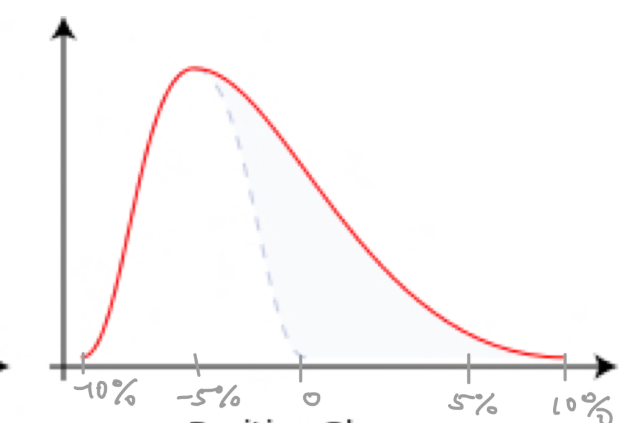
what skew is this + what happens to mean
positive, mean is higher bc highest data point drags everything to right

biomodal distribution
has TWO modes
why is range not rlly useful
doesn’t show what’s inside
outliers can affect it a lot
high/low standard dev. + how it looks on graph
high standard dev = more spread (more variability)
low standard dev = clustered
stats to remember w standard dev
68% fall within 1 standard dev from mean
95% fall within 2 standard dev from mean
99% fall within 3 standard dev from mean
p-value (probability value)
the LIKELIHOOD that the difference in the dependent variable for experimental + control groups is DUE TO CHANCE
effect size
how much of a difference we see between control and experimental groups
0.2 is small
0.5 is medium
0.8 is large
within vs between group variation
within: variations of weight loss in just keto diet
between: variations of weight loss between general keto diet and no keto diet
inferential statistics
can generalize if:
sample is representative
less variation in data the better
more examplesthe better
no cohort effects
statisically significant
meaning that scores were NOT likely due to chance