G&D 4
 Call Kai
 Learn
 Practice Test
 Spaced Repetition
 Match
 Flashcards
 Knowt Play
1/13

There's no tags or description
Looks like no tags are added yet.
14 Terms
CYTOKINESIS-
stimulate cell division
Cytokinins
Discovered* through efforts to find substances which stimulate cell division and promote buds/branching in callus culture
purine, adenine
isolated from degraded herring sperm DNA
Named – KINETIN (a by-product of degraded adenine)

naturally occurring cytokinin (1)
ZEATIN
Synthesized primarily in roots (especially in actively dividing cells i.e., in root apical meristem); but also in immature seeds and developing fruits
--Transported from roots to above ground parts primarily through xylem
Synthetic cytokinin (2)
Benzyladinine (BA)
Thidiazuron
Actions of Cytokinins:
Promote cell division-Cyto-kinesis
(Cytokinins affect/regulate activities of certain enzymes that catalyze various steps of the cell-cycle)

Growth and developmental effects of cytokinins in Horticulture
Promote lateral bud formation
Delay senescence
crown gall
Tumor/cancer (crown gall) caused by Agrobacterium tumefaciens
Transfers its T-DNA segment (and the genes*) into host plant’s DNA
*genes for cytokinin synthesis
genes for opine synthesis
Infected cells provide the tumor / gall for bacteria to thrive and enjoy good food

how do Scientists exploit crown gall
Bacteria trick the plant cells into playing a hospitable host: role of cytokinins
Scientists exploit this trick property of Agrobacterium by using it as a vehicle to transfer ‘genes of interest’- transgenic plants (GMOs) - 2013 World Food Prize
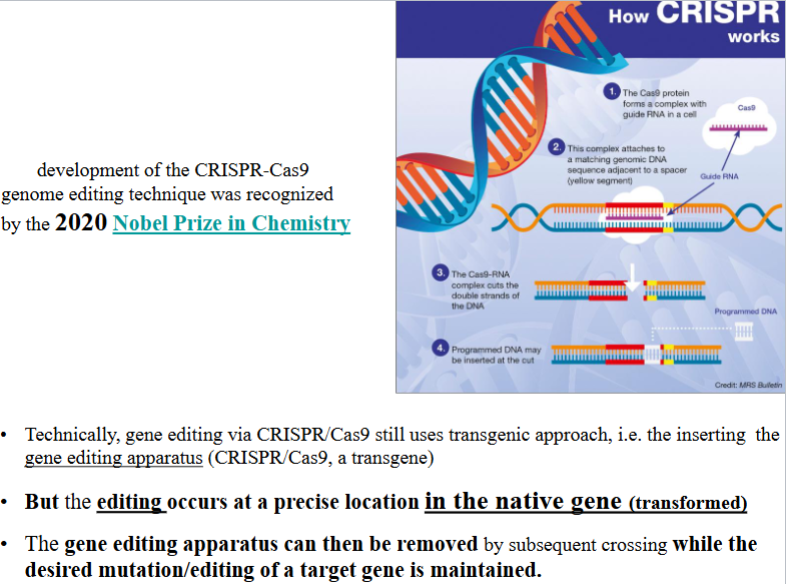
‘Gene editing’ - ‘CRISPR Cas9’
edits the sequence of a selected native gene (targeted deletion / insertion of DNA sequences / point mutation)
no transfer of a foreign gene(s) – less controversial

How CRISPR works
gene editing via CRISPR/Cas9 still uses transgenic approach, i.e. the inserting the gene editing apparatus
But the editing occurs at a precise location in the native gene (transformed)
The gene editing apparatus can then be removed by subsequent crossing while the desired mutation/editing of a target gene is maintained
Cytokinins Lateral bud formation and axillary branching
– Plant tissue culture
• Callus
• Individual shoots
•entire plant is produced
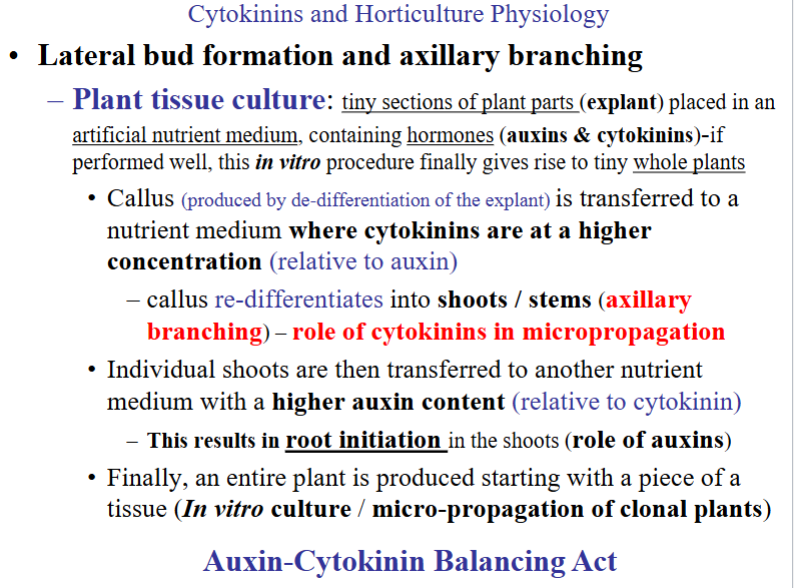
Auxin-Cytokinin Balancing Act ORGANOGENESIS
Multiple shoots produced when cytokinin is present
ORGANOGENESIS
Individual shoots transferred and grown on a medium with different hormonal composition (Auxins) to initiate ROOT FORMATION

Auxin-Cytokinin Balancing Act
Auxin-induced apical dominance can be overcome by cytokinin
think of witchs broom
• Extreme axillary branching
• Believed to stimulate overproduction of cytokinins which antagonizes auxins
• Apical dominance is not only countered but the lateral buds go crazy!

Delay senescence -cytokinins