Calc III (midterm)
 Call Kai
 Learn
 Practice Test
 Spaced Repetition
 Match
 Flashcards
 Knowt Play
1/101

Earn XP
Description and Tags
Up to midterm
Name | Mastery | Learn | Test | Matching | Spaced | Call with Kai | Chat |
|---|
No analytics yet
Send a link to your students to track their progress
102 Terms
domain of arcsin()?
[-1,1]
domain of arccos()?
[-1,1]
domain of arctan()
(-infinity, + infinity)
(asking “what is the domain of arctan?” is the same as asking “what is the range or tan?”
domain of cos()
(-infinity, +infinity)
domain of sin()
(-infinity, +infinity)
Equation of a plane?
z = ax + by + c / ax+by+cz=d
Equation of a paraboloid?
z = x² + y²
Equation of a hyperbolic paraboloid (saddle)
z = x² - y²
What does a hyperbolic paraboloid look like?
A saddle/ pringle
Equation of an ellipsoid?
x²/a² + y²/b² + z²/c² = 1
Equation of a sphere?
x² + y² + z² = r²
Equation of a cone?
z = sqrt(x² + y²)
The domain of arcsinx is the ________
range of sin(x)
Domain of ln(x)?
x > 0
sqrt(x²) =
abs (x)
Domain of sqrt(x)?
x >= 0
Derivative of arcsin(x)?

derivative of arccos(x)?

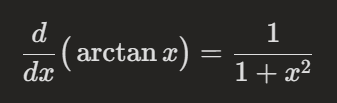
derivative of arctan(x)
What are the special triangles?

arcsin(1/2) = ___
pi/6
T/F f(x+y) = f(x) + f(y)
False! (in general)


T/F f(xy) = f(x)f(y) ?
False
T/F f(x/y) = f(x) / f(y) ?
False
How to find partial derivative of f(xy) wrt x?
Use chain rule to get:
y f’(xy)
What does Clairaut's Theorem state?
fxy = fyx
IF the second partial derivatives exist and are continuous.
What functions does Clairaut's Theorem (fxy = fyx) hold for?
When the second order partial derivates exist and are continuous.
What is Laplace's equation?
fxx + fyy = 0
What functions satisfy Laplace's equation? (fxx + fyy = 0)
Harmonic functions
What are the three log laws?

(cosh (x))’ = ____
sinh (x)

(sinh (x))’ = ____
cosh(x)

What is the equation for a hyperbola?
1 = (x²/a²) - (y²/b²)
Equation of a circle (not centered at zero)
r² = (x-h)² + (y-k)²
(h,k) is the origin of the circle!
How to find trace of function in the x-z plane?
Set y = 0 in the function
What three cases should you consider when finding the level curves for a functoin?
c = 0, c>0 , c<0
What are the ways of finding the limit of multivariable function?
Direct substitution.
Factoring numerator.
Squeeze thrm
How to prove that the limit of a multivariate function does not exist?
By approaching the limit from two different paths for ex) on the x-axis and on the y-axis and showing that limits don’t agree.
if lim abs(f) = 0 then ________
lim (f) = 0
When is a function of two variables continuous at a point (a,b)?
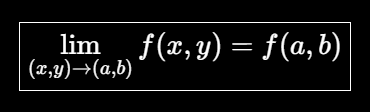
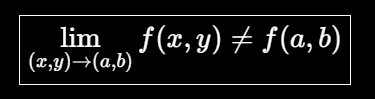
How to show a function of two variables is not continuous at (a,b)?
Show that:
When are rational functions continous?
When their denominator does not equal 0
Where are real value polynomials continuous?
Everywhere
Where are sqrt function continuous?
ex) sqrt(x)
When their argument is greater or equal to zero.
(x>=0)
what is the equation of an ellipese centred at zero?

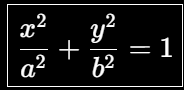
What are a and b in this equation?
This is the equation of an ellipse centered at zero.
A is the horizontal radius and B is the vertical radius.
What is the equation for an ellipse not centered at zero?


What are h and k in this equation?
This is the equation for an ellipse that is centered at (h,k).
14 − 4x − 5y = 0
Is the equation of a _________
Plane
(where z can be any value)
How to graph
f(x, y) = 11 − 4x − 5y
Find its intercepts and plot them.
It’s a plane to its easy to draw/identify
-1 = x² - y² vs 1 = x² - y²
They are both hyperbolas except:
1 = x² - y² has its intercepts on the x axis
-1 = x² - y² has it’s intercepts on the y-axis
How to find the level curves for a function?
Set the function equal to c
Identify if the function is a circle/hyperbola if not then try to solve for x or y whatever is easier.
Set c = 0 or 1/-1, 2/-2 etc.
And plug in y or x values in the domain (depending on what you arranged for) to get some points for that level curve
Once you have an idea of what the curve looks like sketch the curve by connecting the points.
Repeat for c=1, c=-1 etc..
x²+y²−z²=1
is the equation of a _______
Hyperboloid of one sheet
What does a hyperboloid of one sheet look like?
Like an hour glass
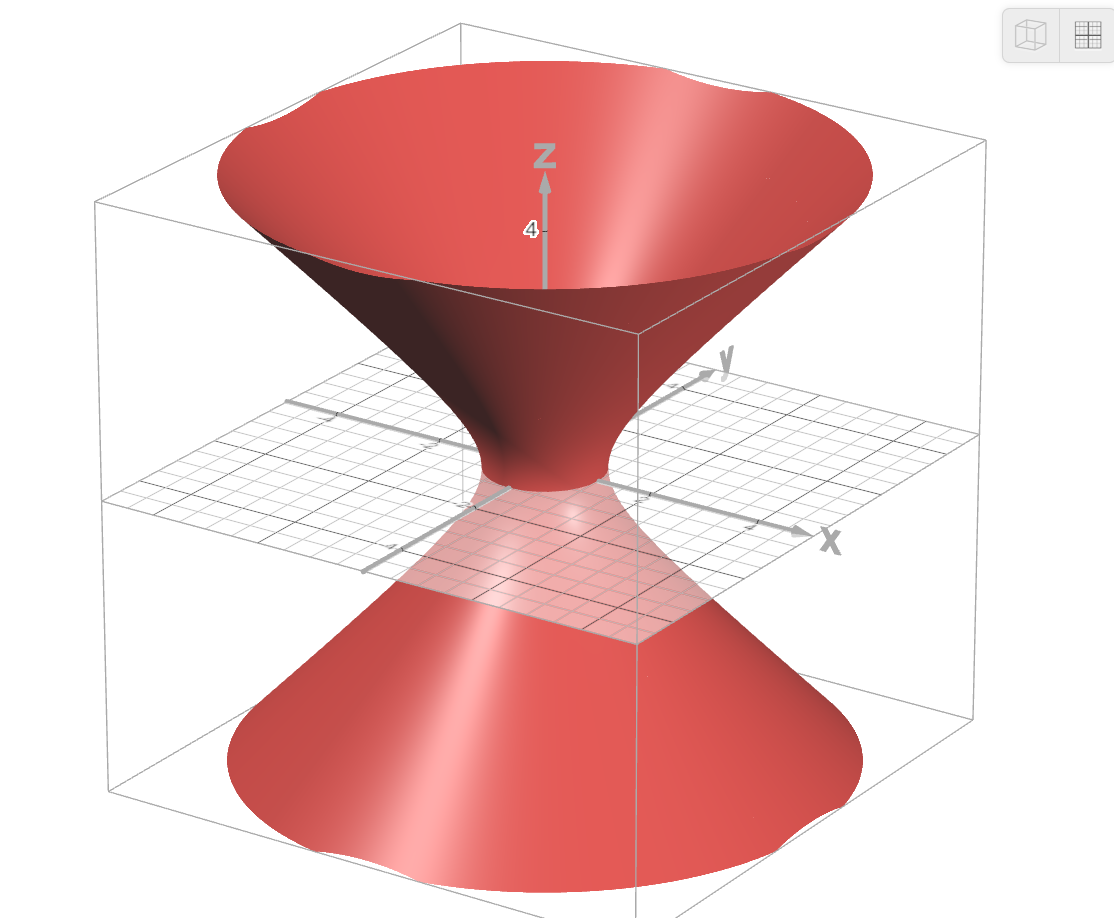
What does a hyperboloid of two sheets look like?

Equation for a hyperboloid of two sheets?
x² -y²- z² =1


If fx(a,b) and fy(a,b) exist is f(x,y) continuous at (a,b)?
No!
Counter example that shows even if fx(a,b) exits that f(a,b) may not be continous.


When differentiating does the order you take the partial derivatives in matter?
Yes. (unless Clairaut's thrm can be applied)


What order do you take the partials in?
innermost to outer most.
(x then y then z)

Graph of y = 1/x

Graph of y = -1/x

What is the gradient conceptually?
A vector that points in the direction with the largest IROC and it’s magnitude will give the largest IROC. The gradient lies in the domain of the function.
ex)
f(x,y) = x*y the gradient with be in R² ie (a,b) but the graph of the function will b in R³
What is the directional derivative conceptually? (DuF)
The directional derivative gives the IROC at a point x of the function along a unit vector.
What does intanenous mean?
At a point not over an interval.
What is the linear approximation conceptually?
The tangent plane to a point on the surface of f.
What is the gradient equation?

What is the linear approximation equation?
z = f(a,b) + f_X(a,b) (x-a) + f_y(a,b) (y-b)
Directional vector formula?

Limit definition of the partial derivative wrt y
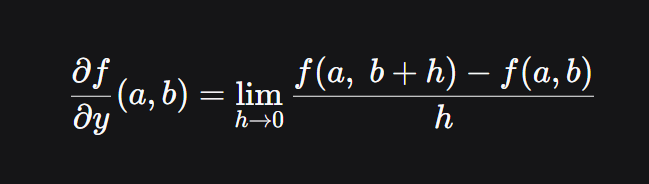
Limit definition of the partial derivative wrt x

T/F the existence of the partial derivatives Fx and Fy at a point (a,b) guarantee continuity at (a,b)?
FALSE!
T/F If f(x,y) is differentiable at (a,b) then it’s continuous at (a,b)
True!
Continuity at (a,b) is ________ but not ________ for differentiability at a that point (a,b).
necessary, sufficient
Physical interpretation of the partial derivative wrt x of f(x,y)
Gives the IROC of the function along the x-axis
Physical interpretation of the partial derivative wrt y of f(x,y)
Gives the IROC of the function along the y-axis
T/F Fx and Fy are directional deriatives?
True they give the IROC along a line so they are directional derivatives.
(However the directional derivative formula we use in the course is gradient of f dot unit vector which gives the IROC only along a unit vector not a whole line like the partial derivatives)
Chain rule for multivariable functions?

Definition of a differentiable multivariable function

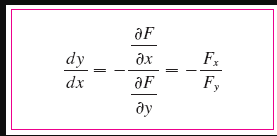
Formula for implicit differentiation
T/F the existence of the partial derivatives Fx and Fy at a point (a,b) guarantee differentiability at (a,b)?
False
T/F if f(x,y) is differentiable at a point (a,b) then its partial derivatives exist?
True
Steps to find crit points and local extrema for 2 var functions?
Find partial derivatives, set them to zero and solve for crit points.
Find 2nd order partial derivatives
Find the discriminant D. (det of hessian matrix)
Plug critical points into the discriminant to classify them.
2×2 hessian matrix formula

Critical point classification based on discrand Fxx?
D > 0 Fxx > 0 → local min
D > 0 Fxx > 0 → local max
D < 0 saddle point
D = 0 inconclusive
If the critical point is a saddle point what is the value of D?
D < 0
If D is positive at the critical point what are the two possible classifications for that point?
Minimum if Fxx > 0 (concave up along x-axis)
Maximum if Fxx < 0 (concave down along x-axis)
What does Fxx(a,b) > 0 mean graphically?
The function is concave up at along the x axis at that point.
Formula for relative error?
relative error = Error/Actual value
Steps for finding relative error using differentials?
Find the differential of the given equation.
Divide the differential by of equation to get an equation for the relative error.
Plug in the relative error for each variable (ie dx/x, dy/x) and solve.
What is the absolute error of a function f using differentials?
df
What is the percent error of a function f using differentials?
df/f x 100
What is the relative error of a function f using differentials?
df/f
If you have a function f(x,y) and you are given the relative error of x to be 0.2 units, how do you find the absoloute error?
given: dx/x = 0.2 thus the absolute error is equal to 0.2*x
(where x is whatever value of x is given in question)
z = f(x,y)
What is change in z? (delta z) from the point (a,b)
delta z = f(a + delta x, b + delta y) - f(a,b)
ie) new point - starting point = change from starting point to new point.
How to prove that z = f(x,y) is diff?
Show that delta z = fx(a,b) delta x + fy(a,b) delta y + eps 1 delta x + eps 2 delta y
(start with the equation for the change in f from point a, simplify until you get the definition)

The gradient at a pint (x,y) on a level curve is _________ to the tangent at (x,y)
Perpendicular