BIOL 1062: Test Two Outline (Nervous & Endocrine Systems)
 Call Kai
 Learn
Learn Practice Test
 Spaced Repetition
 Match
Match Flashcards
 Knowt Play
1/18

Earn XP
Description and Tags
Vocabulary flashcards covering test logistics, nervous system divisions and neuroanatomy, endocrine signaling, pituitary function, stress response, and hormonal homeostasis for BIOL 1062 Test Two.
Name | Mastery | Learn | Test | Matching | Spaced | Call with Kai | Chat |
|---|
No analytics yet
Send a link to your students to track their progress
19 Terms
What are the two anatomical divisions of the nervous system?
Central Nervous System (CNS)
Peripheral Nervous System (PNS)

Briefly describe the Central Nervous System (CNS)
What does it consist of?
What does it do?
Main framework of the body
Includes:
Brain
Spinal Cord
Processess, interprets and stores information
Issues orders to muscles, glands, organs

Briefly describe the Peripheral Nervous System (PNS)
What does it consist of?
What does it do?
Connection of nerves into/out of the CNS
Transmits information to/from the CNS

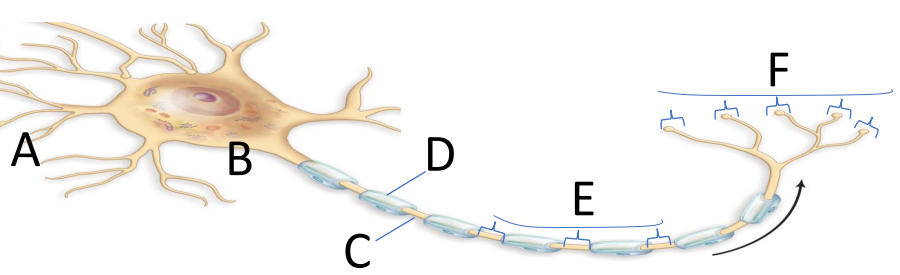
Label and describe each part of the neuron
A. Dendrites:
Extensions that pick up signals from surroundings and send the impulses to the Cell Body
B. Cell Body
Contains nucleus and other organelles
Processes incoming signals
C. Axon
Conducts nerve impulses away from the Cell Body
D. Myelin
Lipid-based covering around axon
E. Nodes of Ranvier
Only in myelinated neurons
Regions of the axon without myelin; gaps between myelin
F. Axon Terminal
Ends of the neuron
Used in communication with other neurons or effectors (muscles, glands)

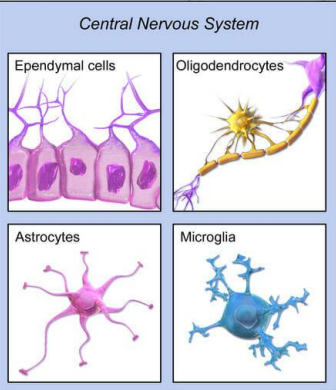
What is the role of Neuroglial Cells in the CNS?
Microglial
Immune cells in the brain
Respond to pathogens/bacteria/damage in the environment
Oligodendrocytes:
Produces/forms myelin sheaths for neurons in the CNS
Ependymal:
Secretes Cerebrospinal Fluid (CSF)
CSF homeostasis
Cleaning of waste in brain
Astrocytes:
Provide nutrients to neurons for growth and protection
Essential for formation/maintenance of the Blood Brain Barrier (BBB)
BBB filters incoming material
What is the role of Neuroglial Cells in the PNS?
Schwann Cells:
Wrap around an axon and form a myelin sheath
Satellite Cells:
Surround the cell body of some neurons in the PNS
Provides nutrient support and protection


What are the three classes of neurons and their function?
Sensory (Afferent) Neurons: “A” for approach/bring into system
Takes messages from the environment to the CNS
Myelinated
May have specialized endings/receptors that detect changes in the environment
Interneuron
Receives input from sensory neurons and other interneurons
Not myelinated
Summarizes messages and communicates with motor neurons
Motor (Efferent) Neurons: “E” for exit/taking out of system
Carries messages from the CNS to an effector (output; muscle/gland)

What kind of conduction occurs in Unmyelinated vs Myelinated Neurons?
Unmyelinated Neuron:
Continuous conduction:
Action potential moves slowly through the axon
Myelinated Neuron:
Saltatory Conduction:
Myelin sheath speeds up the movement of electrical impulses
Action potential jumps from one Node of Ranvier to another
Node of Ranvier: gap between myelinated segments

What is the Action Potential?
Series of quick changes in voltage across a cell membrane
Electrical signal quickly travels down a cell membrane, transmitting information
Electrochemical Synapse
A junction that facilitates signal transmission between pre-synaptic and post-synaptic neurons using synaptic vesicles.
Cerebrum
One of the four major parts of the brain, characterized by lobes and structures that connect and separate the left and right hemispheres.
Diencephalon
One of the four major divisions of the brain that encompasses specific subdivisions, including the hypothalamus.
Limbic System
A functional brain network that includes components such as the Amygdala and Hippocampus.
Somatic Reflex Arc
A neural circuit in which three distinct classes of neurons interact to generate a somatic reflex response.
Autonomic Nervous System
The nervous system division consisting of sympathetic and parasympathetic branches that exert opposing regulatory effects on target organs (e.g., increasing versus decreasing heart rate).
Tropic Hormone
A category of hormone distinguished from somatic hormones by the way it is directed toward and stimulates another endocrine target cell.
Posterior Pituitary
The pituitary lobe connected to the hypothalamus that stores and releases two hormones synthesized by hypothalamic cells via positive or negative feedback mechanisms.
Anterior Pituitary
The glandular lobe connected to the hypothalamus that secretes regulatory hormones such as Thyroid-Stimulating Hormone (TSH) and Adrenocorticotropic Hormone (ACTH) to maintain systemic homeostasis.
Antagonistic Hormones
Pairs of opposing hormones produced by endocrine glands that act in balance to regulate physiological homeostasis, such as the regulation of calcium and glucose levels.