DIGITAL CIRCUITS

0.0(0)
Studied by 0 people
call kaiCall Kai
learnLearn
examPractice Test
spaced repetitionSpaced Repetition
heart puzzleMatch
flashcardsFlashcards
GameKnowt Play
Card Sorting

1/136

encourage image

There's no tags or description

Looks like no tags are added yet.

137 Terms

1
New cards

AND Gate

Outputs 1 when both inputs are 1
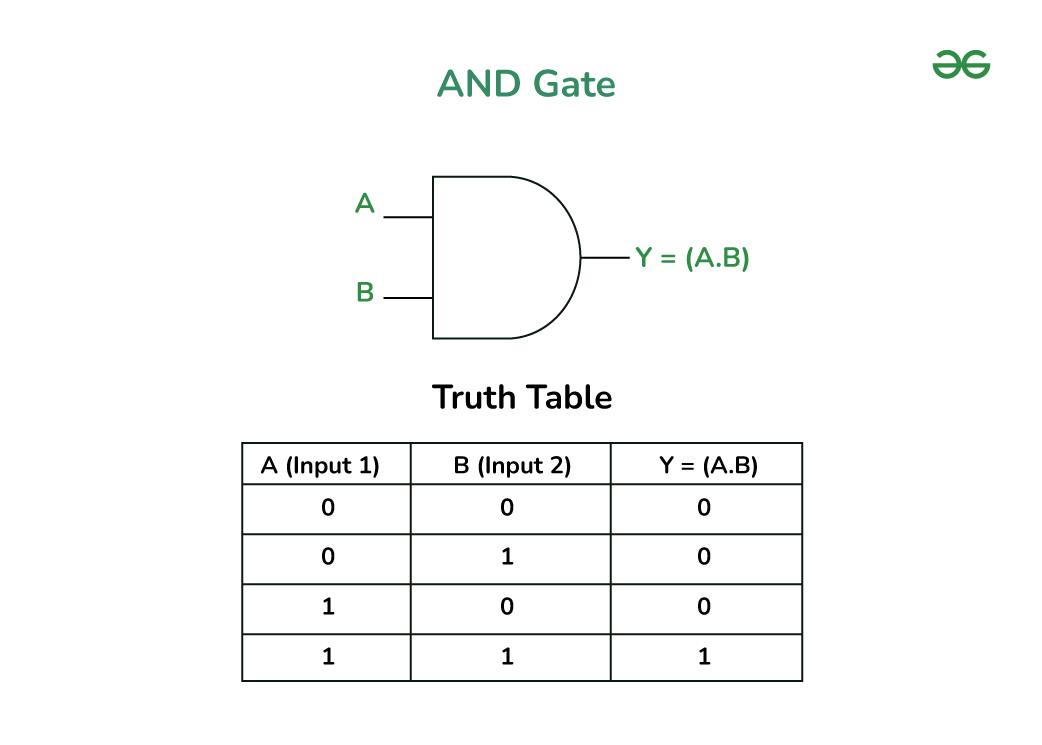
<p>Outputs 1 when both inputs are 1</p>
2
New cards

OR Gate

Outputs 1 when at least one input is 1.

<p>Outputs 1 when at least one input is 1.</p>
3
New cards

NOT Gate

Inverts the input. A 1 becomes 0 and a 0 becomes 1.

<p>Inverts the input. A 1 becomes 0 and a 0 becomes 1.</p>
4
New cards

NAND Gate

An AND gate followed by NOT. Outputs 0 only when all inputs are 1.

<p>An AND gate followed by NOT. Outputs 0 only when all inputs are 1.</p>
5
New cards

NOR Gate

An OR gate followed by NOT. Outputs 1 only when all inputs are 0.

<p>An OR gate followed by NOT. Outputs 1 only when all inputs are 0.</p>
6
New cards

XOR Gate

Outputs 1 when the inputs are different.

<p>Outputs 1 when the inputs are different.</p>
7
New cards

XNOR Gate

Outputs 1 when the inputs are the same.
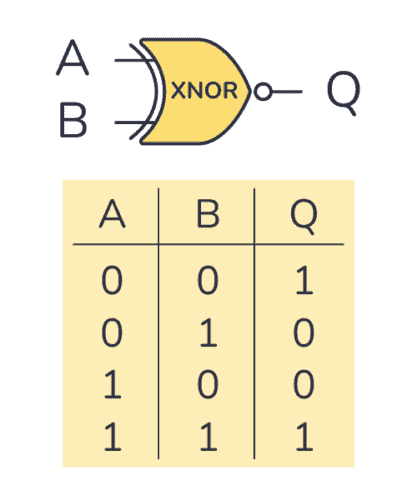
<p>Outputs 1 when the inputs are the same.</p>
8
New cards

Multiplexer (MUX)

Selects one of several inputs and connects the selected input to a single output.

<p>Selects one of several inputs and connects the selected input to a single output.</p>
9
New cards

Demultiplexer (DEMUX)

Takes one input and routes it to one of several outputs.

<p>Takes one input and routes it to one of several outputs.</p>
10
New cards

Encoder

Converts an active input into a binary code.

<p>Converts an active input into a binary code.</p>
11
New cards
Priority Encoder
An encoder that assigns priority when multiple inputs are active.
12
New cards
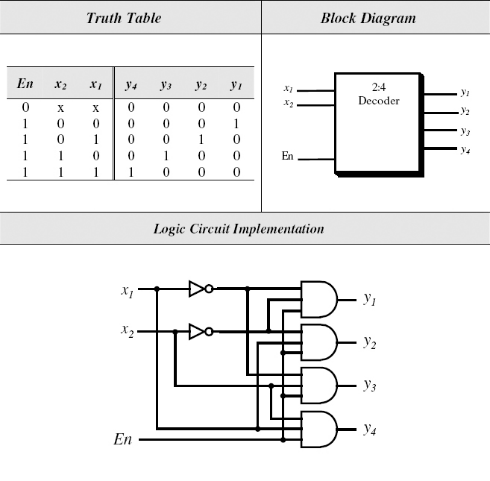
Decoder
Decoder
Converts a binary input code into one of several outputs.
13
New cards
Comparator
Compares two binary values and determines whether A>B, A=B, or A<B.
14
New cards
15
New cards

Half Adder

Adds two 1-bit binary numbers and produces a Sum and Carry output.
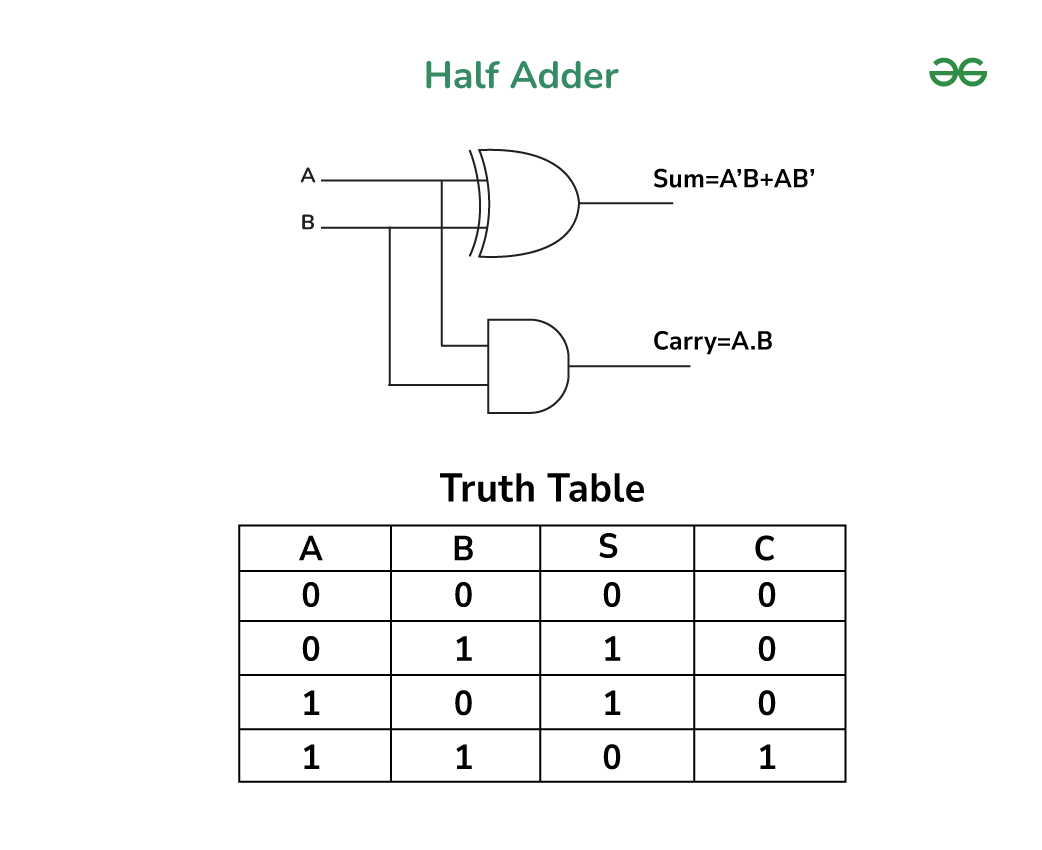
<p>Adds two 1-bit binary numbers and produces a Sum and Carry output.</p>
16
New cards
<p>Full Adder</p>

Full Adder

Adds two binary bits plus a carry-in and produces a Sum and Carry-out.

17
New cards
<p>Ripple-Carry Adder</p>

Ripple-Carry Adder

A multi-bit adder made by connecting full adders so each carry feeds the next stage.

18
New cards
Carry-Lookahead Adder
A faster adder that calculates carry signals without waiting for each previous stage.
19
New cards
Half Subtractor
Subtracts one binary bit from another and produces Difference and Borrow outputs.
20
New cards
Full Subtractor
Subtracts two bits while also including a borrow-in.
21
New cards
Barrel Shifter
A circuit that shifts a binary word by multiple positions in a single operation.
22
New cards
ALU (Arithmetic Logic Unit)
A circuit that performs arithmetic and logic operations such as addition, subtraction, AND, OR, and comparisons.
23
New cards
24
New cards
Combinational Logic
Logic whose output depends only on the current inputs.
25
New cards
Sequential Logic
Logic whose output depends on current inputs and previously stored state.
26
New cards
27
New cards
Latch
A level-sensitive circuit that stores one bit of information.
28
New cards
SR Latch
A basic memory circuit with Set and Reset inputs.
29
New cards
D Latch
A latch that stores the value of D when its enable signal is active.
30
New cards
Flip-Flop
An edge-triggered circuit that stores one bit.
31
New cards
D Flip-Flop (DFF)
Copies the D input to the Q output when the active clock edge occurs.
32
New cards
JK Flip-Flop
A flip-flop similar to an SR flip-flop that can also toggle its output.
33
New cards
T Flip-Flop
A flip-flop that toggles its output when T is active.
34
New cards
Register
A group of flip-flops used to store multiple bits.
35
New cards
Shift Register
A register that moves stored bits left or right on clock edges.
36
New cards
Counter
A sequential circuit that changes its binary value in response to clock pulses.
37
New cards
Up Counter
A counter that increases its value each clock cycle.
38
New cards
Down Counter
A counter that decreases its value each clock cycle.
39
New cards
Up/Down Counter
A counter capable of counting both upward and downward.
40
New cards
Ring Counter
A shift register where the output of the final stage feeds back into the first stage.
41
New cards
Johnson Counter
A ring counter where the inverted output of the final stage feeds back into the first stage.
42
New cards
43
New cards
Clock
A periodic digital signal used to synchronize sequential circuits.
44
New cards
Clock Period
The amount of time required for one complete clock cycle.
45
New cards
Clock Frequency
The number of clock cycles occurring per second, measured in hertz.
46
New cards
Rising Edge
The transition of a digital signal from 0 to 1.
47
New cards
Falling Edge
The transition of a digital signal from 1 to 0.
48
New cards
Duty Cycle
The percentage of one clock period that the clock signal remains high.
49
New cards
50
New cards
Setup Time
The minimum amount of time data must remain stable before a flip-flop's clock edge.
51
New cards
Hold Time
The minimum amount of time data must remain stable after a flip-flop's clock edge.
52
New cards
Clock-to-Q Delay
The delay between a clock edge and the corresponding change at a flip-flop's Q output.
53
New cards
Clock Skew
The difference in clock arrival time between different sequential elements.
54
New cards
Clock Jitter
Small variations in the timing of clock edges from their expected positions.
55
New cards
Metastability
A temporary unpredictable state that can occur when a flip-flop violates setup or hold time.
56
New cards
57
New cards
Propagation Delay
The amount of time required for a change at a circuit input to affect the output.
58
New cards
Critical Path
The longest-delay combinational path in a synchronous circuit and therefore a major factor limiting maximum clock frequency.
59
New cards
Timing Path
A path through the circuit whose delay is analyzed to determine whether timing requirements are satisfied.
60
New cards
61
New cards
Finite State Machine (FSM)
A sequential circuit whose behavior depends on its current state and inputs.
62
New cards
State
The stored condition of a finite state machine at a particular moment.
63
New cards
Next State
The state an FSM will enter after the next active clock edge.
64
New cards
State Transition
The movement of an FSM from one state to another.
65
New cards
State Register
A collection of flip-flops that stores the current state of an FSM.
66
New cards
Moore Machine
An FSM whose outputs depend only on the current state.
67
New cards
Mealy Machine
An FSM whose outputs depend on both the current state and current inputs.
68
New cards
State Encoding
The method used to assign binary values to FSM states.
69
New cards
70
New cards
Reset
A signal that forces a sequential circuit into a known starting state.
71
New cards
Synchronous Reset
A reset that only takes effect on the active clock edge.
72
New cards
Asynchronous Reset
A reset that takes effect immediately without waiting for the clock.
73
New cards
Active-High Reset
A reset signal that is asserted when its value is 1.
74
New cards
Active-Low Reset
A reset signal that is asserted when its value is 0.
75
New cards
Enable
A control signal that determines whether a circuit is allowed to perform an operation.
76
New cards
77
New cards
Bit
A single binary digit that can have a value of 0 or 1.
78
New cards
Bus
A group of digital signals used together to carry multiple bits.
79
New cards
Word
A group of bits treated as a single piece of data.
80
New cards
MSB (Most Significant Bit)
The bit with the highest place value in a binary number.
81
New cards
LSB (Least Significant Bit)
The bit with the lowest place value in a binary number.
82
New cards
83
New cards
Binary
A base-2 number system using only the digits 0 and 1.
84
New cards
Hexadecimal
A base-16 number system commonly used as a compact representation of binary values.
85
New cards
Unsigned Number
A binary number representation where all bits represent magnitude.
86
New cards
Signed Number
A binary number representation capable of representing positive and negative values.
87
New cards
Two's Complement
The most common method for representing signed binary integers.
88
New cards
Overflow
A condition where the result of an arithmetic operation cannot fit in the available number of bits.
89
New cards
Carry
A bit produced when binary addition exceeds the capacity of a digit position.
90
New cards
Borrow
A value taken from a higher bit position during binary subtraction.
91
New cards
Sign Extension
Extending a signed binary number by copying its sign bit into the new upper bits.
92
New cards
Zero Extension
Extending an unsigned binary number by adding zeros to the upper bits.
93
New cards
94
New cards
Boolean Algebra
A mathematical system used to analyze and simplify digital logic.
95
New cards
Truth Table
A table showing the output of a logic function for every possible input combination.
96
New cards
De Morgan's Laws
Boolean identities used to convert AND operations to OR operations and vice versa when complements are applied.
97
New cards
Minterm
A Boolean product term that corresponds to exactly one row of a truth table where the output is 1.
98
New cards
Maxterm
A Boolean sum term that corresponds to exactly one row of a truth table where the output is 0.
99
New cards
Sum of Products (SOP)
A Boolean expression consisting of ORed product terms.
100
New cards
Product of Sums (POS)
A Boolean expression consisting of ANDed sum terms.