MSK part 6: random
 Call Kai
 Learn
Learn Practice Test
 Spaced Repetition
 Match
Match Flashcards
 Knowt Play
1/20

There's no tags or description
Looks like no tags are added yet.
Name | Mastery | Learn | Test | Matching | Spaced | Call with Kai | Chat |
|---|
No analytics yet
Send a link to your students to track their progress
21 Terms
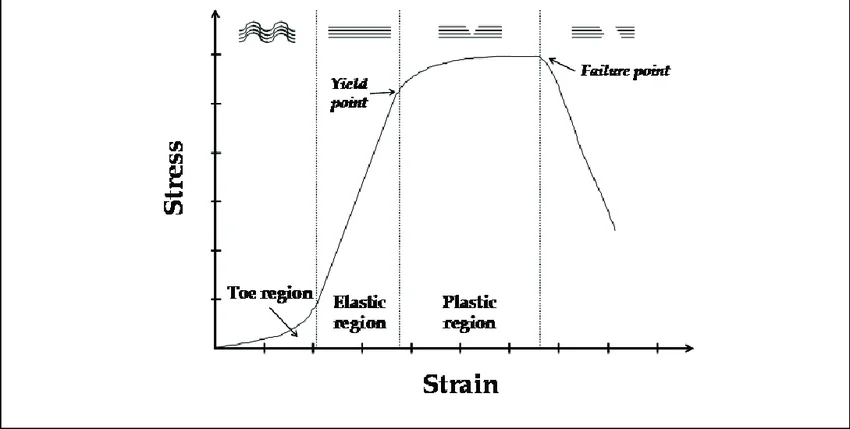
Stress-strain curve (regions)
elasticity
the ability of soft tissue to return to its previous length after the stretch is no longer applied
viscoelasticity
a time-dependent property of soft tissue that results in resistance to stretch when it is initially applied, but allows for tissue elongation as the strech is held for lonfer durations. As with elasticity, the tissue will resturn to its previous length after the strech is no longer applied
plasticity
a property of soft tissue that allows for tissues to elongate even after stretch is no longer applied
stress-strain curve
a graphic representation that depics the relationship between the amount of force (stress) applied to connective tissue and the amount of deformation (strain) it experiences
creep
due to viscoelastic properties, soft tissue that is stretched for a sustained duration will elongate and not return to its origional length after the load has been removed. The principle of creep is the basis for stretching
stress-relaxation
the longer a stretching force is maintained, the more the tension within the tissue decreased, therefore less force is required to maintain the same tissue length
toe region
initial stress that results in the wavy collage fibers becoming straight and aligning with one another
elastic regions
added stress to the tissue results in greater deformation, though the tissue return to its resting length if the stretch force is not maintained. Tissue with greater stiffness will have a deeper slope in this portion of the curve
plastic regions
the addition of more stress results in permenant deformation even after the stretch force is no longer applied due to the failure of bonds between the collagen fibers
PNF
Proprioceptive neuromuscular facilitation
PNF incorperates active muscle contractions into stretching techniques. Muscular contraction is thought to lead to muscular relazation through the principles of autogenic or reciprocal inhibition and results in greater gains in muscle flexibility. Because these techniques exert their effects on muscle fibers, they are more effective at treating range of motion limitations due to muscle spasm as opposed to connective tissue tightness.
NOT EFFECTIVE FOR SPACTICITY OR PARALYSIS (requires active contraction)
dynamic vs ballistic
dynamics: emphasizes movement based approach
ballistic: emphasizes bouncing movements
muscle fiber layers
endomysium (innermost - covers individual muscle fibers)
perimysium (groups bundles of muscle fibers (fasciculus) together)
Epimysium (surrounds the enire muscle)
they are all connective tissue
myofibrils - sarcomeres (these are both within the muscle fibers)
sarcomeres are composed of myofilaments actin and myosin
actin and myosin attach to one another and slide together and apart to allow for muscle contraction and relaxation

overload principle
in order for a muscle to adapt and become stronger, the load that is placed on it must be greater than what it is normally accustomed to
SAID principle
Specific Adaptation to Imposed Demands
states that the body will adapt according to the specific type of training that is utilized
training should mirror the goal
transfer of training principle
there can by carry over effect from one exercise task to another
reversibility principle
within 1-2 weeks your adaptations can reverse
force-velocity relationship
concentric: as speed increases, force decreases
eccentric: as speed increases, force increases
endurance, movement arm, muscle performance, power, strength, torque, work

Legg-Calve perthes Disease
ER, and abduction limited with trendelenburg sign, pain and antalgic gait
avascular necrosis
can treat
stages: Condensation, fragmentation, re-ossification, remodeling
osteogenesis imperfecta
is a connective tissue disorder that affects the formation of collage during bone development. there are 4 classifications of osteogenesis imperfecta that can vary the level of severity
etiology: genetic inheritance with types I and IV considered autosomal dominant traits and II and III and autosomal recessive traits
Signs and Symptoms: pathological fractures, osteoporosis, hypermobile joints, bowing of long bones, weakness, scoliosis, impaired respiratory function
treatment: AROM, symmetry, positioning, functional mobility