1.1.4 Production possibility frontiers
 Call Kai
 Learn
 Practice Test
 Spaced Repetition
 Match
 Flashcards
 Knowt Play
1/10

There's no tags or description
Looks like no tags are added yet.
11 Terms
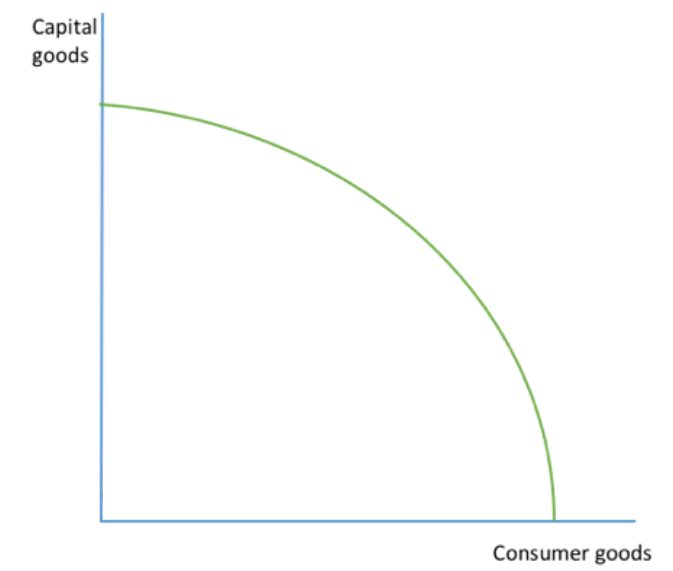
What does the PPF show?
maximum possible combinations of capital and consumer goods that the economy can produce with its current resources and technology.
The maximum potential potential of an economy:
Any point on the curve represents the maximum productive potential of the economy, the most that the country can produce

Opportunity cost in PPFs
Moving from A to B, the opportunity cost of producing an extra 15 consumer goods is 30 capital goods.
● The opportunity cost of producing 60 capital goods is 20 consumer goods. If they produced 0 capital goods, then 80 consumer goods could be produced. By producing 60 capital goods, they can only produce 60 consumer goods. Producing these 60 capital goods means they lose 20 consumer goods.
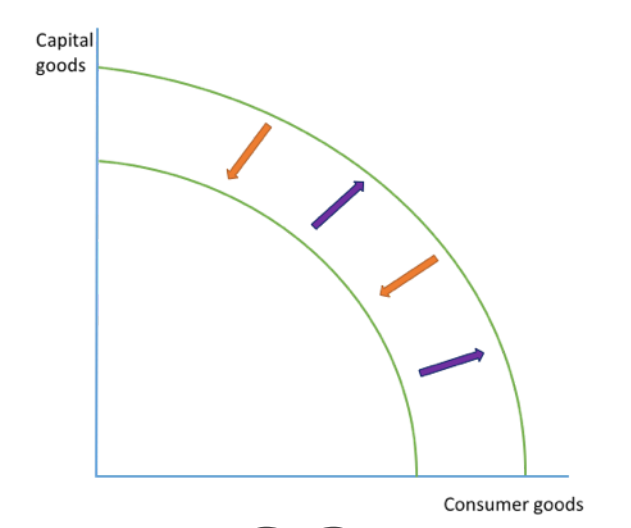
Economic growth or decline:
● The purple arrows show that the economy has grown because it can produce more of both goods. This growth may be achieved by increasing the quantity and/or quality of resources.
● The orange arrows show the economy is declining as it can produce less goods than previously. This could be caused by a number of factors such as: natural disasters; natural resources running out; or a decrease in the quantity/quality of labour, due to war, migration or a fall in spending on education.

Efficient or inefficient allocation of resources and possible or unobtainable production:
● Economic efficiency is achieved when resources are used for their best use. At all points on the PPF, resources are allocated efficiently.
● The economy will aim to produce at point A (or any other point on the curve), this is possible and efficient production. Point B is possible but inefficient, as they are producing within the curve so not maximising output. Point C is unobtainable production, because it is beyond the PPF so they don’t have enough resources/technology to produce there.
● If the economy decides to use all its resources to produce consumer goods, they can produce at D whilst if they decide to produce only capital goods, they can produce at E. Neither of these points are likely.

Change in production:
shows an increase in the ability to produce consumer goods but no change in capital goods which could be due to an improvement in technology that makes production of consumer goods more efficient.

More changes in production:
shows a fall in capital production but no change in consumer production. This shows a fall in efficiency or a change in resources that only affects capital good manufacture
What does a movement along the curve indicate?
change in the combination of goods produced: more capital goods are produced and less consumer goods are produced, or vice versa. The same amount of resources are allocated amongst the two goods differently.
What does a shift along the curve indicate?
change in the productive potential of the economy: more consumer and capital goods can be produced or less consumer and capital goods can be produced. There has been a change in the number of resources and/or the technology available to the country and so their potential output has changed.
Consumer goods
are goods that are demanded and bought by households and individuals.
Capital goods
are goods that are produced in order to aid the production of consumer goods in the future. Some goods can be both consumer and capital goods, for example computers.