Microbiology exam 4
 Call Kai
 Learn
 Practice Test
 Spaced Repetition
 Match
 Flashcards
 Knowt Play
1/43

There's no tags or description
Looks like no tags are added yet.
44 Terms
antimicrobial measures
Sterilization
Destruction of ALL living cells, spores, and/or viruses
Disinfection
Killing or removal of disease-producing organisms from inanimate surfaces
Does not necessarily result in sterilization
Antisepsis
Removal of disease-producing organisms from the surface of living tissues, such as the skin
Does not necessarily result in sterilization
Sanitization
Reducing microbial population to “safe” levels
Does not necessarily result in sterilization
Cidal agents
Kill microbes
Lethal effects
Bactericidal agents kill bacteria.
Fungicides, virucides, algicides, etc.
Static agents
Inhibit or control microbial growth
Slow or stop metabolism or reproduction, but are not necessarily lethal
Bacteriostatic agents inhibit bacterial growth.
Fungistatic, virustatic, algistatic, etc.
sterilizing and cidal agents kill exponentially
high temperature and pressure
pasteurization
cold
filtration
irradiation
chemical agents of disinfection
measuring the efficacy of disinfectants
commercial disinfectants
bacterial resistance to disinfectants
concepts of antimicrobial therapy (know table)
Antibiotics - chemical compounds synthesized or naturally occurring ones produced by one microbes to selectively kill other microbes
A generic term for natural and synthesized antibiotics is chemotherapeutic agents
Antibiotics target bacteria only
Selective toxicity: selectively kills or inhibits the pathogen, but not the host.
“Magic bullet” concept

Bactericidal versus Bacteriostatic antibiotics
In vitro tests for antibiotic effectiveness determine how little is needed to stop growth.
Minimal inhibitory concentration (MIC)
Lowest concentration of the drug that will prevent growth of an organism
Minimal bactericidal concentration (MBC)
Starts with MIC, requires plating of MIC “no growth” tubes to determine if any cells survived
what is the minimum concentration that will kill the bacteria i’m targeting
1.0 is the minimum MIC to treat this bacteria
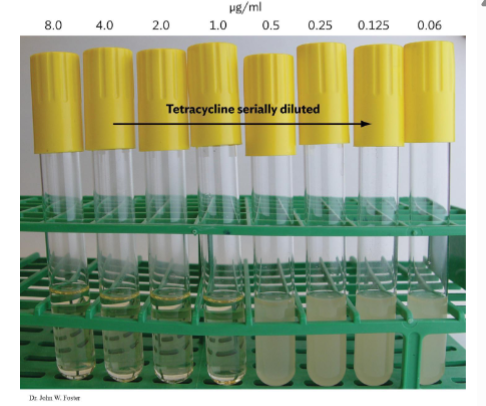
Kirby-Bauer assay
Uses round filter-paper disks impregnated with different antibiotics, placed on a specialized agar (Mueller-Hinton) inoculated with a standard inoculum concentration
Zone of inhibition is measured around to determine the susceptibility of the organism to the antibiotic
determining whether an antibiotic is clinically useful - clinical considerations
Clinical considerations
Drug concentration > MIC during treatment
Organ/ tissue interaction (Half life of drug over time, Toxicity, Allergic response)
The chemotherapeutic index
Therapeutic dose: Minimum dose per kilogram of body weight that stops
pathogen growth
Toxic dose: Maximum dose tolerated by the patient
Ratio of the toxic dose to the therapeutic dose is called chemotherapeutic index.
The higher the chemotherapeutic index, the safer the drug.
synergism and antagonism
Combinations of antibiotics either work together or against each other
Synergistic: Drugs have greater effectiveness when used together (combined effect is greater than additive effect).
▪ Example: aminoglycoside + vancomycin
Antagonistic: Drugs interfere with each other and decrease effectiveness.
▪ Example: penicillin + macrolides
targets of antimicrobial agents
know table

drugs that target the cell wall
▪ Beta-lactam antibiotics
Enzymes that attach the disaccharide units to preexisting peptidoglycan and produce the peptide cross-links are collectively called penicillin-binding proteins.
Penicillin and related antibiotics bind to them.
microbial resistance to protect cell wall
Bacteria may develop resistance by inheriting a gene encoding one of the beta-lactamase enzymes, which cleaves the beta-lactam ring structure of beta-lactam antibiotics.
Random mutation in a gene for a penicillin-binding protein, in the cell wall, prevents
penicillin from binding and halting peptidoglycan synthesis.
Bacteria have begun to develop extended-spectrum beta-lactamase (ESBL) enzymes,
which also confer resistance to beta-lactam antibiotics.
▪ Plasmid-borne; generally found in Enterobacteriaceae
A mutation in a key penicillin-binding protein may also confer resistance to beta-
lactams.
▪ Method used by methicillin-resistant Staphylococcus aureus (MRSA)
drugs that target the bacterial membrane
▪ Poking holes in the bacterial cytoplasmic membrane eventually kills bacteria (gramicidin)
▪ Prevention of membrane synthesis (platensimycin)
drugs that affect DNA replication and integrity
Selective toxicity for bacterial DNA
synthesis
Metronidazole (Flagyl) Prodrug that is harmless until activated, which occurs after metabolism by microbial protein cofactors found specifically in anaerobic and microaerophilic bacteria.
Quinolones
Inhibit DNA synthesis by blocking the action of DNA gyrase, preventing
the bacteria from regulating supercoiling
▪ Mammalian DNA gyrase is structurally distinct and thus not affected.
protein synthesis inhibitors

drugs that affect intermediary metabolism

challenges of antibiotic resistance
▪ The Centers for Disease Control and Prevention estimates that 35,000 people in the United States die every year from infections caused by antimicrobial-resistant (AMR) bacteria.
Mechanisms that prevent intracellular accumulation
Destroy the antibiotic before it enters the cell
Pump antibiotics out of the cell
Decrease membrane permeability
Mechanisms that prevent binding
Modify the target so that it no longer binds the antibiotic
Add modifying groups that inactivate the antibiotic
Mechanism that dislodges the antibiotic
Ribosome protection (or rescue)

how does drug resistance develop
Antibiotic treatment failure occurs when a patient treated with antibiotics appears to recover and the infection suddenly comes back.
Transiently silent acquired AMR
▪ A newly identified problem: poorly expressed AMR genes don’t provide clinically relevant resistance until reactivated, which is often triggered by treatment.
Persister cells
▪ Antibiotic-sensitive cells neither grow nor die in the presence of bactericidal antibiotics.
▪ Once antibiotics are discontinued, the cells regrow; they are dormant, not antibiotic-resistant.
antibiotic stewardship
a set of guidelines designed to slow the development of antibiotic-resistant microbes:
know when antibiotics should be administered
de-escalate antibiotic usage once the pathogen and subsequent resistance pattern is identified
fighting drug resistance
Fake target compounds are used to inactivate resistance enzymes
Clavulanic acid: may be added to beta-lactam antibiotics to tie up beta-lactamase enzymes; allows beta-lactam to avoid destruction and kill the bacteria
▪ Multiple antibiotics with different modes of action may be administered simultaneously to reduce the likelihood of developing resistance.
▪ Antivirulence drugs are being developed to interfere with a pathogen’s ability to induce virulence factors, which makes it difficult to cause disease in the host.
Antibiotic stewardship
A set of guidelines designed to slow the development of antibiotic-resistant
microbes:
Know when antibiotics should be administered
De-escalate antibiotic usage once pathogen and subsequent resistance
pattern is identified
virulence factors
Virulence factors
• help establish a pathogen in the host
• disturb host functions
• enable transmission to new hosts
• Pathogenicity island: a genomic island that contains virulence factors,
generally identified
Examples of virulence factors:
– Pili
– Enzymes that harm the host or prevent detection
– Proteins that disrupt normal cellular function
– Capsule: completely cover and protect
– Enzymes that inactivate antibiotics
pathogenesis
the process by which a pathogen causes disease
Steps:
Entry into the host
Attachment and colonization of tissue(s)
Avoidance of host immunity
Host damage
Exit from host
Repeat
pathogen attachment
The human body has many ways to exclude pathogens. Pathogens must evade these mechanisms.
Pathogen attachment
Adhesin: any microbial factor that promotes attachment
Types of adhesins
Pili: hairlike appendages
Fimbriae: short, bristle-like structures
Nonpilus adhesins
colonization and biofilm development
▪ Pathogens need nutrients for growth
▪ Biofilms = living cells + debris + dead cells + extracellular matrix
▪ Benefits:
Adhesion
Protection
Prevents desiccation.
extracellular pathogens, immune avoidance
Capsules
Opsonizing antibodies can bind to the capsule.
Protein A can sequester antibodies by binding to Fc region of Ab -> prevent opsonization
Changing of surface antigens (antigen shift)
Quorum sensing can also help pathogens evade the immune system
intracellular pathogens
Facultative intracellular pathogens vs. Obligate intracellular pathogens
Live inside host cell (ex. viruses)
Benefits to pathogen:
Avoid innate and humoral immune response
Phagosome
Thriving under stress
Inhibiting phagosome-lysosome fusion
Escaping from the phagosome
exotoxin modes of action
Two-subunit AB toxins
A subunit = toxin (causes the damage)
B subunit = binding (to host cell receptors)
endotoxin
only gram negative bacteria make endotoxin (LPS) - lipid A
part of the outer membrane (LPS)
Leads to a cytokine storm
Fever
Activation of clotting factors -> intravascular coagulation
Activation of the alternative complement pathway
Vasodilation, leading to hypotension
Shock due to hypotension
Death (severe)
protozoan pathogenesis
Four major groups of protozoa, including the more commonly known pathogenic genera from each group:
Amebas: Entamoeba (GI tract, amebic dysentery)
Flagellates: Trypanosoma (blood infection, sleeping sickness), Leishmania (cutaneous or visceral leishmaniasis), Trichomonas (urogenital track; trichomoniasis), and Giardia (GI tract; giardiasis)
Ciliates: Balantidium (GI tract, balantidiasis)
Apicomplexans: Plasmodium (blood infection, malaria) and Toxoplasma (tissue cysts, toxoplasmosis)
immunosuppression via cytokine expression
antigenic shift (VSG in Trypanosomes)
fungal pathogenesis
Medically important fungi
May produce
Superficial mycoses of skin or hair
Systemic infections (target entire organism)
Two broad types of fungi
Molds that grow as long multicellular filaments, called hyphae or mycelia
Single-celled yeasts, which bud to replicate
May produce sexually or asexually
▪ Innate immune clearance
Pathogens – avoid clearance
Potential methods:
-Hide cell wall elements during the transition from mold to yeast forms
-Preventing acidification and lysosomal fusion
- Neutralizing reactive oxygen and nitrogen
- Metabolism - making own nutrients