E&E 151 S Introductory Geology: Chapter 2 (Atoms, Elements, and Minerals) Visualization Study
 Call Kai
 Learn
Learn Practice Test
 Spaced Repetition
 Match
Match Flashcards
 Knowt Play
1/22

There's no tags or description
Looks like no tags are added yet.
Name | Mastery | Learn | Test | Matching | Spaced | Call with Kai | Chat |
|---|
No analytics yet
Send a link to your students to track their progress
23 Terms
Silica Tetrahedron (SiO₄⁴⁻)
What is the term/concept being visualized in this image?
Definition: The fundamental building block of all silicate minerals. Visually represented as a 4-sided pyramid with a small central silicon atom (Si⁴⁺) surrounded by four larger oxygen atoms (O²⁻) at the corners.

Isolated Silicate Structure
What is the term/concept being visualized in this image?
Definition: Individual silica tetrahedra are bonded to positively charged metal ions without sharing any oxygen atoms between tetrahedra (e.g., Olivine).

Single-Chain Silicate Structure
What is the term/concept being visualized in this image?
Definition: Tetrahedra share two oxygen atoms to form single, continuous parallel chains (e.g., Pyroxene group / Augite).

Double-Chain Silicate Structure
What is the term/concept being visualized in this image?
Definition: Two adjacent single chains share oxygen atoms, creating double-chain structures with characteristic cleavage angles near 60° and 120° (e.g., Amphibole group / Hornblende).
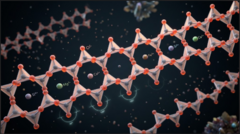
Sheet Silicate Structure
What is the term/concept being visualized in this image?
Definition: Tetrahedra share three oxygen atoms to form continuous 2D sheets, yielding one direction of perfect basal cleavage (e.g., Mica group such as Biotite and Muscovite, as well as Clay minerals).

Framework Silicate Structure
What is the term/concept being visualized in this image?
Definition: All four oxygen atoms in every tetrahedron are shared in a continuous 3D network (e.g., Quartz and Feldspar group minerals like Plagioclase and Potassium Feldspar).

Crystal Form
What is the term/concept being visualized in this image?
Definition: The geometric shape bounded by flat, smooth planar surfaces (crystal faces) that develop when a mineral grows without spatial restriction (e.g., cubic crystals in pyrite, six-sided hexagonal prisms in quartz).

Cleavage Directions & Intersecting Angles
What is the term/concept being visualized in this image?
Definition: The tendency of a mineral to break along flat, parallel planes of atomic weakness.

1 direction (basal cleavage)
What is the term/concept being visualized in this image?
Definition: Splits into thin sheets (Micas: biotite, muscovite).

2 Directions at 90°
What is the term/concept being visualized in this image?
Definition: Breaks into rectangular blocks (Feldspars).

2 Directions not at 90°
What is the term/concept being visualized in this image?
Definition: Cleaves into diamond-shaped cross-sections (Amphiboles/Hornblende) versus Pyroxenes which cleave at ~90°.

3 directions at 90° (cubic cleavage)
What is the term/concept being visualized in this image?
Definition: Breaks into cubes (Halite, Galena).

3 directions not at 90° (rhombohedral cleavage)
What is the term/concept being visualized in this image?
Definition: Breaks into slanted rhombohedrons (Calcite).

4 directions (octahedral cleavage)
What is the term/concept being visualized in this image?
Definition: Breaks into 8-sided forms (Fluorite).

Fracture
What is the term/concept being visualized in this image?
Definition: Breaking along irregular, rough, or curved surfaces when atomic bond strength is equal in all directions. A key visual example is conchoidal fracture, which produces smooth, curved, shell-like fracture surfaces (characteristic of quartz and obsidian glass).

Luster
What is the term/concept being visualized in this image?
Definition: The quality and intensity of light reflected from a mineral's surface.

Non-metallic
What is the term/concept being visualized in this image?
Definition: Subdivided into vitreous/glassy (quartz, feldspar), adamantine (brilliant diamond spark), resinous, silky, pearly, or earthy/dull (kaolinite clay).
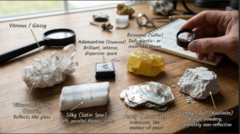
Metallic
What is the term/concept being visualized in this image?
Definition: Opaque and highly reflective like polished metal (e.g., galena, pyrite, hematite).

Streak
What is the term/concept being visualized in this image?
Definition: The color of a mineral in powdered form, observed by scraping the mineral across an unglazed porcelain streak plate. It is more reliable for identification than surface color (e.g., metallic hematite may look dark grey or silvery, but always leaves a diagnostic red-brown streak).

Double Refraction
What is the term/concept being visualized in this image?
Definition: Transparent calcite crystals split light rays passing through them, creating a distinct double image of text underneath.

Effervescence (Acid Test)
What is the term/concept being visualized in this image?
Definition: Dropping dilute hydrochloric acid (HCl) onto calcite or limestone causes immediate fizzing as carbon dioxide (CO₂) gas bubbles escape.

Magnetism
What is the term/concept being visualized in this image?
Definition: A mineral's physical response to a magnetic field, observed by bringing a standard hand magnet close to the specimen. It is a highly diagnostic property for identifying specific iron-bearing minerals (e.g., magnetite is strongly attracted to a magnet and can sometimes act as a natural magnet itself, instantly distinguishing it from visually similar dark, metallic minerals like ilmenite or chromite).

Compositional Zoning
What is the term/concept being visualized in this image?
Definition: Concentric structural or color bands visible under a polarizing microscope caused by chemical changes during crystal growth (e.g., zoned plagioclase feldspar).
