Unit 3 AP Macro (Everything)
 Call Kai
 Learn
 Practice Test
 Spaced Repetition
 Match
 Flashcards
 Knowt Play
1/155

There's no tags or description
Looks like no tags are added yet.
156 Terms
what happens to unemployment if the underemployment, discouraged, and marginally attached workers are included
The measured rate of labor underutilization increases substantially, reaching a significantly higher percentage than the official unemployment rate.
how does the unemployment rate vary for age groups? use an example
The unemployment rate is generally much higher for younger workers and lower for prime-age, more experienced workers, as seen in December 2013 when the overall national rate was 6.7% but reached 18.0% for White teenagers and 35.5% for African-American teenagers.
what happens to unemployment rate during recession
The unemployment rate always rises during a recession because falling real GDP causes companies to lay off workers and reduce hiring.
what happens to the unemployment rate during economic expansion
During an economic expansion, the unemployment rate usually falls because growing production leads businesses to hire more workers, though it may occasionally continue to rise briefly if the economy is not growing fast enough.
which types of unemployment make up the natural rate of unemployment
Frictional unemployment and structural unemployment make up the natural rate of unemployment.
how does cyclical unemployment relate to the natural rate of unemployment
Cyclical unemployment is the deviation of the actual unemployment rate from the natural rate of unemployment, meaning that actual unemployment equals natural unemployment plus cyclical unemployment.
list 3 factors that can lead to a change in the natural unemployment rate
Changes in labor force characteristics: Shifts in the experience level of the workforce, such as an increase or decrease in the proportion of young or inexperienced workers, alter the natural rate because experienced workers have lower frictional unemployment and tend to stay in jobs longer.Changes in labor market institutions: Institutional factors, such as the prevalence of labor unions, the growth of temporary employment agencies, or online job search websites (like monster.com), can increase or decrease structural and frictional unemployment.Changes in government policies: Public policies can directly impact the rate
what would happen to the natural unemployment rate if the US suddenly increased unemployment benifits
If the U.S. suddenly increased unemployment benefits, the natural rate of unemployment would rise because more generous and longer-lasting benefits reduce the financial incentive for unemployed workers to quickly accept new positions, thereby increasing frictional unemployment.

why dpoes frictional unemployment account for a larger share of total unemployment when unemployment rate is low
When the total unemployment rate is low, job openings are plentiful and most unemployed workers find new employment quickly, meaning long-term structural and cyclical joblessness drop significantly while short-term job search naturally continues.
what are three factors that leads to structural unemployment
Minimum Wages: When governments set a binding minimum wage above the market equilibrium rate, the quantity of labor supplied exceeds the quantity demanded, creating a persistent surplus of job seekers.Labor Unions: Collective bargaining by unions can push wages and benefits above the market equilibrium rate, resulting in more people wanting jobs at those higher wages than employers are willing to hire.Efficiency Wages: Employers may voluntarily set wages above the equilibrium rate as an incentive for workers to deliver better performance and stay with the company, which leaves a pool of workers who want those high-paying jobs but cannot find them.
How is Real GDP calculated?
Real GDP is calculated by taking current-year production quantities and multiplying them by constant prices from a chosen base year to remove the distortion of inflation.
What is nominal GDP?
Nominal GDP is the total market value of all final goods and services produced in an economy during a given year, calculated using that same year's current prices.
Explain the relationship between chain linking and real GDP.
Chain-linking calculates Real GDP growth by taking the average of the growth rates computed using an early base year's prices and a late base year's prices.
How is GDP per capita different?
Real GDP per capita differs from standard Real GDP in two key ways: it divides total output by the population size to enable fair comparisons between countries, and it measures average economic capacity rather than overall human welfare or living standards.
What are the limitations of real GDP per capita?
While Real GDP per capita measures an economy's total output per person, it fails as a direct metric of human welfare because it excludes non-market benefits like leisure time and housework, increases from harmful expenditures like crime and disease, and ignores how income is distributed across the population.
Indicate the effect on real GDP: Chevrolet increases its production of truck.
An increase in Chevrolet's truck production increases real GDP because it represents a greater physical output of domestically produced final goods.
Indicate the effect on real GDP: Consumer expenditures increase because of inflation.
The distortion in expenditures caused by price changes is removed by real GDP using constant base-year prices, leaving real GDP completely unaffected by inflation.
Indicate the effect on real GDP: You spend 10,000 hours volunteering.
Volunteering 10,000 hours creates substantial non-market value, but because no market transaction or financial payment takes place, it has zero effect on Real GDP.
The unit-of-account role of money
refers to its function as a standardized measure and common baseline for pricing goods, stating contracts, and making economic calculations across an economy.
why does the rate of price change matter, and how is it calculated in terms of the inflation rate
The rate of price change matters because rapid inflation imposes real economic costs—such as shoe-leather costs from avoiding cash, menu costs from constantly updating prices, unit-of-account costs that distort economic decisions and taxes, and unexpected redistribution between borrowers and lenders.InflationRate=PriceLevelinYear2PriceLevelinYear1/PriceLevelinYearx100
explain the difference between shoe leather cost and menu cost
Shoe-leather costs are the time and effort people waste trying to avoid holding cash during high inflation (such as making frequent trips to the bank). Menu costs are the real resources businesses spend directly to update and reprint listed prices (such as updating price tags, changing supermarket computer codes, or reprinting menus).
what are some cost examples that are subjest to price chnages
Retail & Grocery Prices: Individual item price tags on supermarket shelves, clothing store stickers, and online storefront listings.Dining Costs: Printed restaurant menus, daily food special boards, and takeout flyers.Service & Contract Rates: Published catalog rates, printed price quotes, monthly subscription fees, and taxi or rideshare fare tables.
How is the dollar affectcted by inlfation? provide an example.
inflation reduces the purchasing power of the dollar, meaning each dollar buys fewer goods and services over time. For example, if a gallon of milk costs $4.00 and the annual inflation rate is 5%, that same gallon of milk will cost $4.20 next year. Your dollar hasn't physically changed, but its real value has decreased because it buys 5% less than it used to.
Who are the winners during a higher-than-expected inflation period, borrowers or lenders? Why?
Borrowers are the winners. When inflation is higher than expected, borrowers repay their loans with dollars that have lower purchasing power than anticipated, reducing the real value of their debt. Lenders lose because the money they receive back buys fewer goods and services than they originally projected.
Who is the loser during a lower-than-expected inflation period, borrowers or lenders? Why?
Borrowers are the losers. When inflation is lower than expected, the dollars borrowers pay back have a higher real purchasing power than originally anticipated, making the debt effectively more expensive. Lenders win because the money they receive back buys more goods and services than projected.
you borrow $1000 for one year at 5% interest to buy a couch. Although you did not anticipate any inflation, there is an unexpected inflation of 5% over the life of your loan. What is the real interest rate on your loan?
The real interest rate on your loan is 0%.It is calculated by subtracting the actual inflation rate (5%) from the nominal interest rate (5% - 5% = 0%), meaning the real purchasing power of the money repaid equals the amount originally borrowed.
Why do some economists believe the CPI overstates the inflation rate? write down all 3 reasons
Substitution Bias: The fixed CPI market basket does not capture how consumers switch away from goods that become relatively more expensive toward cheaper substitutes. Product Improvements: Price increases often come with quality upgrades ("new and improved" versions), meaning consumers are paying more for a better product rather than simply facing higher costs for the same item. Innovation: New products and technology enter the market and expand consumer choice, making a given amount of money worth more in ways that a fixed market basket fails to measure.
Why does the SRPC slope downward?
The Short-Run Phillips Curve slopes downward because higher aggregate demand forces firms to hire more workers—reducing unemployment—while simultaneously driving up wages and production costs, which pushes inflation higher.
explain why a decrease In AD caused a movement along the short-run Philips curve?
A decrease in aggregate demand lowers output and price pressures, which causes a movement down and to the right along the fixed Short-Run Phillips Curve as lower inflation is traded for higher unemployment.
why is there no long-run trade-off between unemployment and inflation
There is no long-run trade-off between unemployment and inflation because people and businesses fully adjust their expectations of inflation over time, returning unemployment to its natural rate (NAIRU) at whatever inflation rate policy dictates.
why is disinflation so costly for a country? are there ways to reduce these cost?
Disinflation is costly because contractionary policies raise unemployment above its natural rate, sacrificing real GDP and aggregate output
why wouldn't anyone lend money at a negative nominal rate of interest? how can this pose problems for monetary policy?
Nobody lends at negative rates because holding physical cash yields a 0% return, which beats paying someone to hold money.This creates a liquidity trap at the zero bound, preventing central banks from cutting interest rates further to stimulate the economy
Labor force participation rate
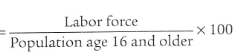
Unemployment rate

Discouraged workers
are nonworking people who are capable of working but have given up looking for a job due to the state of the job market.
Marginally attached workers
would like to be employed and have looked for a job in the recent past but are not currently looking for work.
underemployed
workers who would like to work more hours or who are overqualified for their jobs
CIRCULAR FLOW MODEL (MATRIX) SHOWS:
THE CIRCULAR FLOW OF EXPENDITURES
AND INCOMES
• THE WAY CHOICES INTERACT IN MARKETS
DETERMINES WHAT, HOW, AND FOR WHOM
GOODS AND SERVICES ARE PRODUCED
HOUSEHOLDS
a person or group of people who share income
FIRMS (BUSINESSES
ORGANIZE PRODUCTION OF GOODS AND SERVICES.
MARKETS
A MARKET IS ANY ARRANGEMENT THAT BRINGS BUYERS AND SELLERS TOGETHER AND ENABLES THEM TO DO BUSINESS
PRODUCT (GOODS) MARKETS:
where GOODS AND SERVICES ARE BOUGHT AND SOLD
RESOURCE (FACTOR) MARKETS:
where resources, especially capital and labor, are bought and sold.
IN FACTOR MARKETS households supply…
factors of production & labor, and firms hire the labor

In Goods markets firms supply…
goods households buy the goods
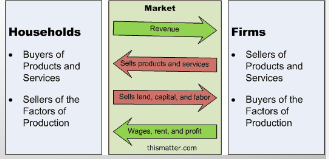
MONEY FLOWS
FIRMS PAY FOR THE FACTORS OF PRODUCTION AND HOUSEHOLDS’ INCOMES FOR THE SERVICES OF FACTORS OF PRODUCTION.
Households pay firms for the goods and services they buy, which generates revenue for the businesses
GOVERNMENTS IN THE CIRCULAR
FLOW
● Households & firms pay taxes and receive transfer payments.
●Governments both provide services and sell goods (Bonds)

HOUSEHOLDS AND FIRMS IN THE US AND THE WORLD INTERACT BY…
INTERNATIONAL TRADE (BUYING AND SELLING GOODS AND
SERVICES) and INTERNATIONAL FINANCE (BORROWING AND LENDING)

What do the arrows show
THE RED FLOW SHOWS THE
EXPENDITURE BY AMERICANS
ON IMPORTS OF GOODS AND
SERVICES
• THE BLUE FLOW SHOWS THE
EXPENDITURE BY THE REST
OF THE WORLD ON U.S.
EXPORTS (OTHER
COUNTRIES’ IMPORTS
• THE GREEN FLOW SHOWS
U.S. LENDING TO THE REST
OF THE WORLD.
• THE ORANGE FLOW
SHOWS U.S. BORROWING
FROM THE REST OF THE WORLD
THE BUSINESS CYCLE
THE UNITED STATES’ GDP IS NOT
CONSTANT FROM YEAR TO YEAR.
• INSTEAD, THE GDP GROWS AND
THEN SHRINKS IN MOST YEARS
• THE UPS AND DOWNS IN GDP
OVER TIME ARE CALLED THE
BUSINESS CYCLE
THE BUSINESS CYCLE
CONSISTS OF 4 PHASES:
1. RECOVERY (OR
EXPANSION)
2. PEAK
3. RECESSION
4. TROUGH.

RECOVERY PHASE
GDP IS INCREASING.
• TO PRODUCE MORE GOODS AND SERVICES, DO BUSINESSES NEED TO HIRE
MORE WORKERS
• UNEMPLOYMENT DECREASING
• PRICES INCREASING
• INFLATION INCREASING
PEAK PHASE
GDP HAS TEMPORARILY MAXED OUT.
• UNEMPLOYMENT IS DECREASING AND LOW
• PRICES HIGH
• INFLATION HIGH
RECESSION PHASE
GDP IS DECREASING
• UNEMPLOYMENT RATE IS INCREASING
• PRICES ARE DECREASING
• INFLATION IS DECREASING
TROUGH PHASE
GDP IS LOW.
• UNEMPLOYMENT RATE IS HIGH
• INFLATION IS LOW
National income and product accounts (aka national accounts)
keep track of the flows of money among different sectors of the economy
The Circular-Flow Diagram

Consumer spending
household spending on goods and services
An Expanded Circular-Flow Diagram: How Money Flows Through the Economy

stock
A stock is a share in the ownership of a company held by a shareholder.
bond
A bond is a loan in the form of an IOU that pays interest.
Government transfers
are payments that the government makes to individuals without expecting a good or service in return
Disposable income
equal to income plus government transfers minus taxes, is the total amount of household income available to spend on consumption and to save
Private savings
equal to disposable income minus consumer spending, is disposable income that is not spent on consumption
financial markets
The banking, stock, and bond markets, which channel private savings and foreign lending into investment spending, government borrowing, and foreign borrowing, are known as the financial markets
Government borrowing
he amount of funds borrowed by the government in the financial markets
Government purchases of goods and services
are total expenditures on goods and services by federal, state, and local governments
exports
Goods and services sold to other countries
imports
Goods and services purchased from other countries
Inventories
are stocks of goods and raw materials held to facilitate business operations
Investment spending
is spending on new productive physical capital, such as machinery and structures, and on changes in inventories
Final goods and services
are goods and services sold to the final, or end, user.
Intermediate goods and services
goods and services bought from one firm by another firm to be used as inputs into the production of final goods and services
Gross domestic product
is the total value of all final goods and services produced in the economy during a given year
value-added approach
to calculating GDP is to survey firms and add up their contributions to the value of final goods and services
expenditure approach
calculating GDP is to add up aggregate spending on domestically produced final goods and services in the economy—the sum of consumer spending, investment spending, government purchases of goods and services, and exports minus imports.
Aggregate spending
the total spending on domestically produced final goods and services in the economy—is the sum of consumer spending, investment spending, government purchases of goods and services, and exports minus imports.
income approach
to calculating GDP is to add up the total factor income earned by households from firms in the economy
National income = rent + wages + interest + profit.
value added approach
The value added of a producer is the value of its sales minus the value of its purchases of inputs or adding us the value at each stage of the production process
Net exports
the difference between the value of exports and the value of imports (X- IM)
whats included in GDP
• Domestically produced final goods and services, including capital goods, new con-struction of structures, and changes to inventories
Not Included in GDP
• Intermediate goods and services
Inputs
Used goods
Financial assets such as stocks and bonds
Foreign-produced goods and services
Aggregate output
the total quantity of final goods and services produced within an economy
Real GDP
the total value of all final goods and services produced in the economy during a given year, calculated using the prices of a selected base year in order to remove the effects of price changes
IT IS FOUND BY MULTIPLYING THE OUTPUT BOUGHT AT A CONSTANT PRICE LEVEL
IF REAL GDP HAS INCREASED, THEN OUTPUT HAS INCREASED,
Nominal GDP
the total value of all final goods and services produced in the economy during a given year, calculated with the prices current in the year in which the output is produced
also known as current-dollar GDP. The nominal
gross domestic product for the fourth quarter of 2012 was $15.864 trillion.
IT IS FOUND BY MULTIPLYING THE OUTPUT BOUGHT AT
THE CURRENT PRICE LEVEL.
IF THERE IS INFLATION, NOMINAL GDP INCREASES,
Chain-linking
is the method of calculating changes in real GDP using the average between the growth rate calculated using an early base year and the growth rate calculated using a late base year
GDP per capita
GDP divided by the size of the population; it is equivalent to the average GDP per person
Employed
people are currently holding a job in the economy, either full time or part time
Real gross domestic product (GDP)
the total market value of all final goods and services produced in an economy in a given year, calculated by using a base year’s price for goods and services; nominal GDP adjusted for inflation. Also known as constant-dollar GDP. The real gross domestic product for the fourth quarter of 2012 was $13.665 trillion (2005 dollars).
Why does our government constantly measure the economy
To ENSURE THAT OUR ECONOMIC GOALS
OF FULL EMPLOYMENT, STABLE PRICES, AND
ECONOMIC GROWTH ARE MET
THREE IMPORTANT MEASURES of economy
GROSS DOMESTIC PRODUCT (GDP)
UNEMPLOYMENT RATE
INFLATION RATE
GDP IS A MEASURE OF AN ECONOMY'S ______ AND ______,
income and expenditures
GDP includs goods and services CURRENTLY PRODUCED, not…
transactions involving goods produced in the past (example: second hand sales) or intermediate goods: components of the final good. (example: ford buy tires for its car)
Purely Financial Transactions
stocks, bonds, CDs (not counted in GDP because no new good or service was created—you are simply exchanging money for a claim on future income or financial assets.)
UNREPORTED LEGAL business activity
Unreported "legal" business activity does not count. This is two-thirds of the uunt]eryrounc] economy (example: And what if the dentist doesn't report $400 for teeth whitening)