Learning & Motiv Weeks 8-10
 Call Kai
 Learn
 Practice Test
 Spaced Repetition
 Match
 Flashcards
 Knowt Play
1/35

There's no tags or description
Looks like no tags are added yet.
36 Terms
Do rats prefer water that precedes audiovisual stimulus or water that precedes sickness
water that precedes audiovisual stimulus
Do rats prefer water that precedes shock or water that precedes sickness
water that precedes illness
Rats VS Quails: salty water consumption (salty water → sickness, reg water does not)
Quails drink the same amount pre and post test because of their lack of chemoreception(compared to rats), quails cannot detect salt in water
Rats VS Quails: colored water consumption (salty blue water → sickness, reg water does not)
rats will drink less of the salty water post test and quails will drink less of the blue water post test
What does CS belongingness depend on
species of the organism
Hihger-order conditioning (learning without a US)
second-order conditioning, sensory preconditioning
Second-order conditioning
a CS is paired with a US and then a new CS is paired with the original CS. The new CS should cause responding
If tone → food doesn’t cause any particular response in pigeons, are they learning about this association? How do we know?
yes, the pigeons are learning about the tone they just can’t show it. They show this in second order conditioning to light when tone is the original stimulus
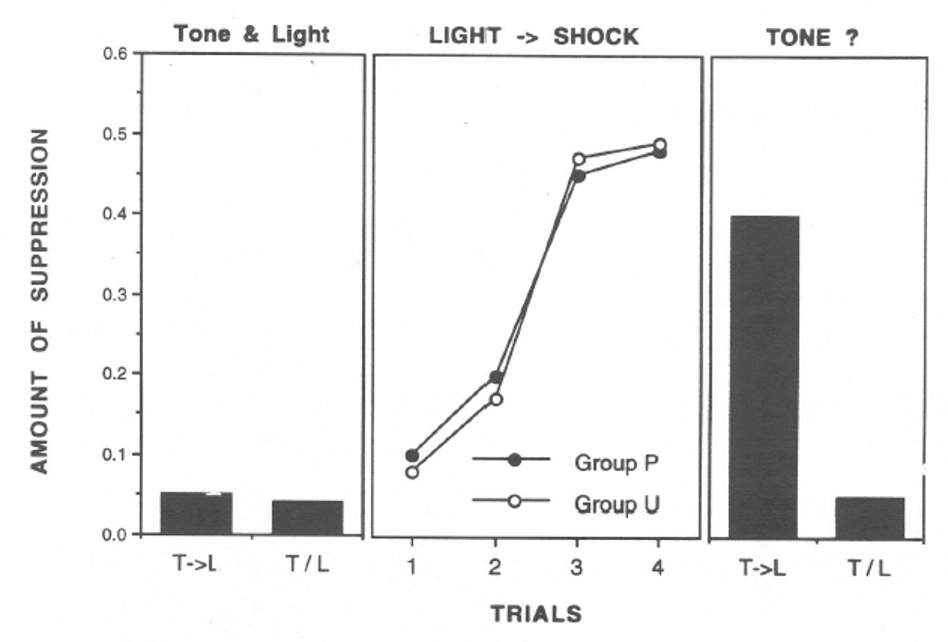
Sensory preconditioning
first it is established that a CS precedes another CS, then the second CS becomes scary, therefore the first CS is also scary
Procedures for conditioned inhibition
Pavlov’s procedure (standard procedure), negative CS-US contingency
Standard procedure
the excitatory CS predicts the US except when the inhibitor is present (ex: A → US but AX does not)
Negative CS-US contingency
set up like an unpaired control condition, there is a large amount of time between the CS and US, leading the organism to learn that the CS indicates a period of time when the US will not happen
Tests for Conditioned Inhibition
summation test, retardation of acquisition test
Summation test
pairing an excitatory stimulus with an inhibitory stimulus to test whether the inhibitory stimulus causes inhibition to any excitatory stimulus
Retardation test
testing whether learning of a stimulus as excitatory will be more difficult for organisms that have already learned the stimulus as an inhibitor
Why does an event have to pass both summation and retardation tests to be regarded as a conditiond inhibitor?
if it passes the summation test but fails a retardation test this may be due to a generalization decrement
if it passes the retardation test but fails the summation test this may be due to a lack of attention or processing of the CS or CS preexposure
Generalization decrement
novel circumstances can cause an inability to perform (ex: rats don’t learn learn light and tone as a conditioned inhibition because light and tone together is so novel so they learn it as a new thing entirely)
Two aspects of the stimulus substitution model
conditioned response is dependent on connections btwn the CS and US not the CS and UR
CR must be equivalent to UR
Which aspect of the stimulus substitution model was debunked?
that CR must be equivalent to UR, it is often not (especially in aversive conditioning)
How do we test whether S - S matters more than S - R
devaluation and mediated conditioning
How do we test whether S - S matters more than S - R using devaluation
After CS is devalued, animal is less likely to approach food magazine. If it was S-R, animal would continue to approach after DEV. This supports CS-US learning
How do we test whether S - S matters more than S - R using mediated conditioning (think peppermint water!!)
testing whether a stimulus(eg tone) that was paired with a certain flavor water and then after paired with illness will still be drank by the rats (it is not)
What is the exception to the rule that conditioned response is dependent on connections between the CS and US not the CS and UR
second-order conditioning
Contiguity vs contingency
number and degree of conjunction of stimulus pairings vs the likelihood of a US given a CS
Likelihood (or probability) of a US when there is a CS Formula
P(US|CS) = number of US’s during the CS/number of CS
Likelihood (or probability) of a US when there is no CS
P(US|no CS) = number of US’s in the absence of CS/number of no CS’s
If P(US|CS) is closer to 1, the conditioning is…
excitatory
If P(US|no CS) is closer to 1, the conditioning is…
inhibitory
Contingency scores from no learning to most amount of learning
0, 0.2, 0.3, 0.4
As contingency increases, suppression
increases (ratio declines)
When an animal has an expectancy that matches the outcome, will suppression increase or decrease?
Decrease
Precocious vs altritical
born equipped for environment vs born premature and must learn to adapt
Procedural difference between Pavlovian and operant conditioning
pavlovian: occurrence of events is under the control of the experimenter
operant: occurrence of events is under the control of the subject
If tone is paired with food except if rats approach the food source during the tone, how will rats behave? Why?
rats will continue to approach the food source because of Pavlovian conditioning of the relationship tone → food
Operant VS Pavlovian-actions
controlled/deliberated actions vs automatic/reflexive responses
How to calculate a suppression ratio
suppression ratio = responding during CS/responding before CS + responding during CS