Kinetic Particle Theory
 Call Kai
 Learn
Learn Practice Test
 Spaced Repetition
 Match
Match Flashcards
 Knowt Play
1/46

There's no tags or description
Looks like no tags are added yet.
Name | Mastery | Learn | Test | Matching | Spaced | Call with Kai | Chat |
|---|
No analytics yet
Send a link to your students to track their progress
47 Terms
Describe the change in arrangement and movement of particles in dry ice as it sublimes. (Particles ________ from being ______ _________ in _______ arrangement to very ___ ______ in ____________ arrangement. Particles _________ from_________ _________ _______ ______ to _________ ________ at ______ _______.)
Particles change from being closely packed in orderly arrangement to very far apart in disorderly arrangement. Particles change from vibrating about fixed positions to moving randomly at high speeds.
Sublimation (is a _ by which a _ _ _ into a _ _ _ _ the _ state and occurs when _ at the _ of the _ have _ _ to _ _ from the _ and _ as a _)
is a process by which a solid changes directly into a gas without passing through the liquid state and occurs when particles at the surface of the solid have enough energy to break away from the solid and escape as a gas
Examples of substances that sublime
iodine ammonium chloride dry ice
Explain how a cold surface can cause iodine vapour to change back into a solid. (Iodine vapour _ _ into a _ by the _ of _. The _ _ _ _ _ from the iodine vapour, causing them to _ _ _ and _ _ _. _ _ _ _ particles _ and particles are _ _ into _ _ to form a _.)
Iodine vapour changes back into a solid by the process of deposition. The cold surface absorbs thermal energy from the iodine vapour, causing them to lose kinetic energy and move more slowly. Forces of attraction between particles increase and particles are pulled together into fixed positions to form a solid.
At what temp does boiling occur at?
fixed temp
At what temp does evaporation occur at?
any temp
how fast is the process of boiling?
fast process
how fast is the process of evaporation?
slow process
what supplies boiling with heat?
external energy source
what supplies evaporation with heat?
no external source
which part of the liquid does boiling take place at?
throughout
which part of the liquid does evaporation take place at?
only at the surface
is bubbling observed during boiling?
yes
is bubbling observed during evaporation?
no
Diffusion (is the _ _ of _ from a _ of _ _ to a _ of _ _)
is the net movement of particles from a region of higher concentration to a region of lower concentration
Two factors that affect the rate of diffusion
temperature relative mass
How does temp affect rate of diffusion: (as temperature increases, the _ have _ _ _ and _ _. Hence the rate of diffusion _)
as temperature increases, the particles have more kinetic energy and move faster. Hence the rate of diffusion increases
How does relative mass affect rate of diffusion? As relative mass increases, rate of diffusion _
decreases
Why does a solid have a fixed shape and a fixed volume? (_ of a _ are _ _ by _ _ _ of _ and have _ _ _ _. _ only _ about their _ _ and hence, _ have _ _ . _ are _ _ in an _ _ and hence, _ cannot be _ and have _ _.)
Particles of a solid are held together by very strong forces of attraction and have very low kinetic energy. Particles only vibrate about their fixed positions and hence, solids have fixed shape. Particles are closely packed in an orderly arrangement and hence, solids cannot be compressed and have fixed volumes.

Why does temp increases from A-B, C-D, and E-F? (As _ are _, _ _ _ _ which is _ to _ _. Since _ _ _ _, temperature _.)
As substances are heated, particles gain thermal energy which is converted to kinetic energy. Since average kinetic energy increases, temperature increases.

Why does temp decrease from A-B, C-D, and E-F? (As _ are _, _ _ _ _ in the _ of _ _. Since _ _ _ _, temperature _.)
As substances are cooled, particles lose kinetic energy in the form of thermal energy. Since average kinetic energy decreases, temperature decreases
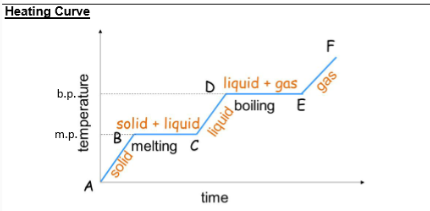
Why does temp remain unchanged from B-C and D-E? (_ _ is _ by _, which is _ to _ the _ of _ _ _. Since _ _ in _ _ _, temperature remains _.)
Thermal energy is absorbed by particles, which is used to overcome the forces of attraction between particles. Since no change in average kinetic energy, temperature remains constant.

Why does temp remain unchanged from B-C and D-E? (_ are _ _ to _ the _ _ _ _, _ _ _ to the _. Since _ _ in _ _, temperature remains _.)
Particles are close enough to strengthen the attractive forces between them, releasing thermal energy to the surroundings. Since no change in kinetic energy temperature remains constant.
Thermal energy absorbed from solid to gas
sublimation
Thermal energy absorbed from solid to liquid
melting
Thermal energy absorbed from liquid to gas
boiling
Thermal energy released from liquid to solid
freezing
Thermal energy released from gas to liquid
condensation
Thermal energy released from gas to solid
deposition

Diffusion in gases: (A gas jar is filled with reddish-brown bromine gas at the bottom and with air at the top separated by a glass plate. After removing the glass-plate for some time, the reddish-brown bromine gas _ _ _ the gas jar to form a _ _ of bromine and air. The _ _ _ _ _ via the _ of _ to _ _ the gas jar.)
A gas jar is filled with reddish-brown bromine gas at the bottom and with air at the top separated by a glass plate. After removing the glass-plate for some time, the reddish-brown bromine gas spread uniformly throughout the gas jar to form a homogenous mixture of bromine and air. The bromine gas molecules move randomly via the process of diffusion to spread throughout the gas jar.
atom is (s_ p_ of an e_that has the c_ p_ of that e_)
smallest particle of an element that has the chemical properties of that element)
molecule (_ or more _ c_ b_ t_)
two or more atoms covalently bonded together
element (_ s_ that cannot be _ into _ or more _ s_ by p_ or c_ processes)
pure substances that cannot be split into two or more simpler substances by physical or chemical processes
compound (s_ which contains _ or more _ c_ c_ in a f_ c_)
substance which contains two or more elements chemically combined in a fixed composition
mixture (_ or more s_ _ _ in any p_)
two or more substances physically mixed in any proportion
two or more elements chemically combined in a fixed composition
compounds
can only be broken down into its elements or into simpler compounds by chemical processes
compounds
physical and chemical properties of a compound are different from its constituent elements
compounds
two or more substances physically mixed together in any proportion
mixtures
components of a mixture can be separated by physical means
mixtures
the chemical properties of a mixture are the same as those of its components
mixtures

True or false: in the experiment above, only the bromine gas molecules undergo diffusion. (_, _ p_ that are _ in the gas jars, including the _ particles present in the top gas jar, _ _ from a region of _ _ to a region of _ _)
False, all particles that are present in the gas jars, including the air particles present in the top gas jar, undergo diffusion from a region of higher concentration to a region of lower concentration

Effect of relative mass on rate of diffusion: Make a comparison between the Mr. State the effect on rate of diffusion. (_ of HCl gases and NH3 gas _ into the tube and react to _ white solid _. The gases do not meet in the _ because _ molecules which has a _ Mr of 17 as compared to _ molecules which has a _ Mr of 36.5 diffuse _ resulting in the _ of the white solid _ to the _ end of the glass tube.)
Molecules of HCl gases and NH3 gas diffuse into the tube and react to produce white solid NH3Cl. The gases do not meet in the middle because NH3 molecules which has a lower Mr of 17 as compared to HCl molecules which has a higher Mr of 36.5 diffuse faster resulting in the formation of the white solid closer to the HCl end of the glass tube.

A porous pot experiment is set up as shown below. Carbon monoxide (CO) can diffuse out through the porous pot, and gas P can diffuse in through the porous pot. If gas P is hydrogen (H2), what will happen to the water level at X? (Mr of _ < Mr of _, _ will diffuse _ the pot _ than _ diffuses _. _ inside pot _. Water level at X goes _.)
Mr of H2 < Mr of CO, H2 will diffuse into the pot faster than CO diffuses out. Pressure inside pot increases. Water level at X goes downwards.

A porous pot experiment is set up as shown below. Carbon monoxide (CO) can diffuse out through the porous pot, and gas P can diffuse in through the porous pot. What happens to the water level if the experiment is carried out over a long time? (Gases _ _ the porous pot until _ of gases is the _ on _ sides. The levels eventually become the _ again on _ sides.)
Gases diffuse across the porous pot until concentration of gases is the same on both sides. The levels eventually become the same again on both sides.

A porous pot experiment is set up as shown below. Carbon monoxide (CO) can diffuse out through the porous pot, and gas P can diffuse in through the porous pot. What happens if gas P is carbon dioxide (CO2)? (Mr of _ > Mr of _. CO will diffuse _ of the pot _ than CO2 diffuses _. Water level at X goes _.)
Mr of CO2 > Mr of CO. CO will diffuse out of the pot faster than CO2 diffuses in. Water level at X goes upwards.

A porous pot experiment is set up as shown below. Carbon monoxide (CO) can diffuse out through the porous pot, and gas P can diffuse in through the porous pot. What happens if gas P is nitrogen gas (N2)? (Mr of _ = Mr of _. _ _ in rate of diffusion of _ gases. Pressure inside pot _ the _. Water level at X _.)
Mr of N2 = Mr of CO. No difference in rate of diffusion of both gases. Pressure inside pot remains the same. Water level at X remains.