Met Instrumentation Exam 2
 Call Kai
 Learn
 Practice Test
 Spaced Repetition
 Match
 Flashcards
 Knowt Play
1/137

There's no tags or description
Looks like no tags are added yet.
138 Terms
What are three types of anemometers?
Cup,Vane, Ultrasonic
What common challenges impact wind measurements?
Physical obstructions, elevation, extreme weather events (ice), high relative humidity, pressure changes
What standards should be followed when installing wind sensors?
Height requirements, following meteorological / WMO guidelines, technical and electrical standards, true calibration (WIND VANES MUST BE ALIGNED TRUE NORTH)
History of Wind Measuring Instruments
1450 - Leon Battista Alberta
1483- Da Vinci
1846 - J.T Romney Robinson
1892 - W. H Dines
1965- P. Minnick
1970 - A.Pfitsch
KNOT
-reference to velocity while the distance is using nautical miles
was a standard unit of measurement in 1600s using a common log device
speed of ship was the number of knots counted
1knot- 1.15mph-0.514ms^-1
What are typical wind speeds near the surface?
slight breeze, gusts, sustained winds
0-130 its (0-67 ms^-1)
What are typical wind speeds in the mid-troposphere, near the jet stream?
200+ its (103 ms^-1)
wind is a highly non-linear phenomenon

Measuring Wind: Drag Force
a force acting opposite to the relative motion of any object moving with respect to a surrounding fluid
can also be described as resistance
Measuring wind: Mechanical Sensors
ex - cup or propeller anemometer, wind vane
uses: measurement at weather station (official and home)
Measuring wind: In-situ electronic sensors
ex- hot-wire anemometer
fast response measurements; turbulence characterization
Measuring wind: Drifting-position sensors
ex- radiosonde, driftsonde, pibal
uses: atmospheric sounding
Measuring wind: sensors based on impact pressure
ex: pitot tube
use: measuring airspeed of moving vehicles including aircraft
Measuring wind: sensors that use measurements of a time shift
ex: ultrasonic anemometer → Passive
Use: modern official weather stations; research that investigates turbulence or fluxes
Measuring wind: sensors that use measurements of a Doppler shift
ex: doppler radar and lidar; wind profiler
Use: Remote measurement of wind at a range of positions from the sensor

Does a cup anemometer spin in a different direction based on wind direction?
No, a cup anemometer always spins in the same direction no matter which way the wind is blowing!
Does not measure direction
Which shape has the larges drag?
open shapes have larger drag force

Cup Anemometers
mechanical rotation of the cups and the internal supporting shaft
rotation of the shaft can be manually determined or determined using an electrical sensors
Shaft rotation is equal to revolutions per minute (frequency) and is proportional to wind speed

Cup Anemometer - Optical shutter arrangement
as the shaft rotates, a light beam between the source and electronic detector is interrupted
Generates a series of digital pulses at a rate which is proportional to the rotation speed
Cup Anemometer - Reed Switch
as the shaft rotates an internal magnet spins closing and opening the reed switch
- a brief electrical current is created and measured
Cup Anemometers: Advantages
simple and robust construction
Simplicity of speed calculation
Low maintenance requirements
Can capture a large measurement range
Cup Anemometers: Disadvantages
Overspending: records average wind speeds that are too high in gusty winds
- - When the wind speed increases, the cups spin faster, but a decrease in wind of the same magnitude does not cause the cups to slow down as quickly
reduce the distance between the cups and the rotational axis
Thresholding: wind speeds greater than 1 ms^-1 are necessary to cause the cup anemometer to turn

Propellar Anemometer
measures the 3 components of wind (u,v, and w)
the rotation speed of the propellers is proportional to the wind speed (component) perpendicular to the propeller plane
often used on buoys and for turbulence studies
Carbon fiber vs. Polystyrene: lighter material breaks faster
Propeller Anemometer: Advantages
lightweight material have fast time responses
overestimation of the mean wind speed is less than cup anemometers
Propeller Anemometer:
V-error: Azimuthal variations in the wind meaning the propeller is not perpendicular (or parallel) to the wind direction - underestimation to the wind speed
Lightweight propellors can break in high winds
overspeeding error

Impeller Anemometer
Wind rotates the impeller, the magnet, and the shaft inducing a current through a coil
-axis of rotation parallel to the direction of the wind
-a magnet located in the impeller along with an inductor
- the rotation of impeller produces an electrical signal proportional to the wind speed
-instrument range: 0.4-35ms^-1
QUICK TIME RESPONSE

Pressure Plate Anemometers
deflection of a vertically hanging plate that is oriented into the mean wind direction common in 1600s
The deflection is proportional to the strength of the wind
non-linear response
A deflection of a small weight is called a telltale

Pressure Tube Anemometers
measures the pressure differences of static and moving (dynamic) flow
has directional sensitivity
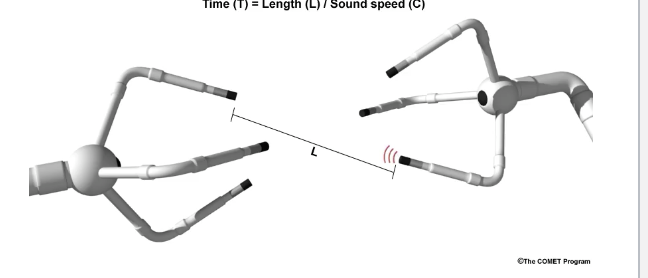
Ultrasonic Anemometer
time it takes for ultrasound pulses to travel forward and backwards from fixed transducers
-separation of transducers are usually 10-20 cm
-soundwaves are sent at 40-100 kHz frequency
Dependent on temperature and humidity
Ultrasonic Anemometer - Advantages
it is absolute measurement not needing calibration (except to check that the instrument parameters are specified correctly)
measurements do not exhibit a time lag and can be repeated frequently to resolve high-frequency to resolve high-frequency fluctuations in the wind
measures all three components of the wind vector and are therefore beneficial for studying turbulent mass fluxes
the instrument has no moving parts that require maintenance
Ultrasonic Anemometer - Disadvantages
fairly expensive
requires more power
signal loss in heavy rain or wet snow
Wind Profilers
similar to weather radar, but operates on a wavelength of 0.33m or 0.6m as a vertical doppler radar
-sensitive to the backscattering of turbulent structures in the water-vapor field
-measures the Doppler shift at multiple angles

Wind Vanes
flat vertical plate attached to a horizontal arm that rotates on a vertical shaft
- the direction of the arm becomes aligned with the wind direction due to drag force and lift force
-reduction of the drag force
-static error: misalignment of vane
Besides visually determining the direction of the vane what methods are there?
mechanical switch with multiple contacts distributed around the shaft
optical encoders giving a digital representation of measure angles
a precision potentiometer
ASOS Wind Measurements
Prior to 2007: rotating cup anemometers and a wind vane 10 meters in height
Now: Sonic anemometer
From Satellite
monitor cloud movements
How is the wind speed/direction at various heights determined?
using a mix of physical instruments, remote sensing technology, and mathematics modeling
Calibration
wind sensors are place in a wind tunnel with a pitot tube as the reference instrument
the wind tunnel must be large enough to fit the sensors and provide a uniform wind flow across the tunnel
Exposure - Is the height of wind sensors standardized?
yes, by the world meteorological organization
10 m in height
good exposure in all directions with 3km
obstructions should be at least 20 times the height of the obstruction from the sensor
show accumulation, icing, extreme temperature, high wind gust, lightning induced surges
What are three measurement principles that are utilized for radiometric measurements?
Attenuation (thickness, absorbs, scatters, etc), Resolution, Response Time
What are two of the basic radiation laws?
Stefan-Boltzmann Law & Wien’s Law
What are measured errors that impact radiation sensors?
Exposure, drift, systemic errors, calibration errors

Radiation
pulses of electromagnetic energy traveling as waves and generated as electrons oscillate

Shortwave (SW)
solar radiation
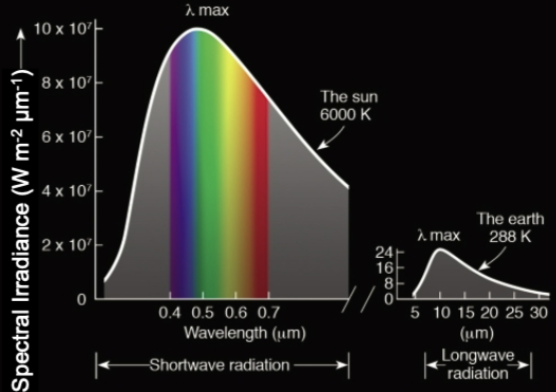
Longwave (LW)
terrestrial

Azimuth
the angle between North, measured clockwise around the observer’s horizon, and a celestial body
Kirchoff’s Law
good absorbers are good emitters and vice versa at peculiar wavelengths
Stefan-Boltzmann Law
the amount of energy emitted by a body is directly proportional to the fourth power of its absolute temperature
sigmaT^4 = emissivity
Units: Wm^-2
(assuming perfect black body)
Wien’s Law
hotter temperatures, shorter wavelengths
Lamdam = 2898/T. Units [(must)(m)]
Planck’s Law
describes the spectral density of radiation emitted by a black body at each wavelength at a given temperature (blackbody curves)

Intensity Law
the amount of radiant power flux is inversely proportional to distance squared
Solar constant = 1379 Wm^-2
E=P/4pid². Units [ Wm^-2)
Sine/Cosine Law
radiant energy striking a surface at an acute angle becomes less concentrated than direct (perpendicular) radiation
Radiant Flux
the amount of radiation coming from a source per unit time (W)
sun’s radiant flux is 3.9×10^(26) W
Radiance
radiant flux emitted by a unit area of a source or scattered by a unit area of a surface within a given solid angle (wm^-2sr^-1)
Sun’s radiance is 1×10^7 Wm^-2sr^-1
Watt
Js^-1 (kgm²s^-3) - Power
Radiant Intensity
the radiant flux leaving a point on the source, per unit solid angle of space surrounding the point in W sr^-1
Radiant Flux Density
radiative flux per unit area W m^-2
flux can be negative or positive

Irradiance
radiant flux incident on a receiving surface from all directions per unit of area surface in W m^-2
ALWAYS POSITIVE
all angles combined
Direct Solar Radiation
radiation emitted from the solid angles of the sun, received on a surface perpendicular to the axis of the cone
comprised of mainly unscattered and unreflected solar radiation in Wm^-2 (1367 Wm^-2)
MEASURED BY A PYRHELIOMETER
Diffuse Solar Radiation
downward scattered and reflected radiation coming from the whole hemisphere with the exception of the solid angle subtended by the sun’s disc in W m^-2
measured by a pyranometer in a shadow band
Global solar radiation
solar irradiance received on a horizontal surface in W m ^-2
measured by a pyrometer
What is the difference between transmitted and emitted?
Transmitted: to pass or send existing energy, light or signal THROUGH a medium
Emitted: to create and give off energy light, heat, etc NOT THROUGH a medium
Reflection
fraction of the incident flux that is reflected by a medium
Absorption
fraction of the incident flux that is absorbed by a medium

Transmission
fraction of the incident flux that is transmitted (passed through) by a medium
Net Radiation (R)
R= SWD-SWU+LWD-LWU [Wm^-2]
^^^ Shortwave down, shortwave up, long wave down, long wave up
Why might the history of radiometer be relatively new?
depending you are referring to radiometer as medical device corporation (founded in 1935) or the radiometer as a scientific instrument
History of the Radiometer
1853- Campbell-Stokes reordered invented
1873- Crookes radiometer
1885 - Jordan Sunshine recorders invented
1893 - pyranometer and pyrheliometer is invented by Angstrom (Knutsson) and anderson
1905 - Angstrom invents the pyrgeometer
Angstrom - a constant and law of absorption (a)
Instruments - Purpose
Pyrheliometer - direct solar radiation
Pyranometer - global solar radiation
Photometer - light in the visible part of the spectrum
Albedometer - shortwave radiation received by and reflected from a surface
Pyrradiometer - net radiative flux of shortwave
Pyrometer - terrestrial radiation
Pyrometer - longwave radiation emitted from a surface
Spectro-radioometer - specific wavelength
What does “pyro” and “ano” and “helio” in Greek mean?
Pyro - fire
Ano - above
Helio - sun
Ways radiant energy is detected
measure the rise of temperature of a small detecting surface
measure the response of a photoelectric cell
measure response of photochemical solution
MET USES FIRST TWO

Photodiode
LED photodiode in circuit board (I soldered)
1) Light (photons) generate electrons are attracted to the K region
2) holes are attracted to the A region
Campbell - Stokes Sunshine Recorder
glass sphere filled with water that focuses the sun’s rays and burns the material behind it
sphere was altered to be solid glass
Length of the scorch mark indicates daily sunlight duration
no scorch mark indicates clouds
continual scorch marks on same material makes measuring daily insolation difficult
What does a pyranometer measure? Also, why are black and white surfaces used?
measures shortwave radiation (irradiance) (global solar radiation over a hemispheric field of view)
great reflector and absorbers (large for each)
Pyranometer Theory
black surface with a thermopile sensor surrounded by a white plate
the glass bulb shields the body of the instrument from the sunshine.
||» helps isolate the measurement from external thermal interferences and weather - only reacts with pure solar radiation - glass allows solar radiation but doesn’t change anything
good balance arguments between the black surface and white surface
Pyranometer Theory - Thermopile
converts thermal energy energy into electrical energy
composed of thermocouples (usually in series)
output voltage proportional to a local temperature difference
range of tens or hundreds of millivolts
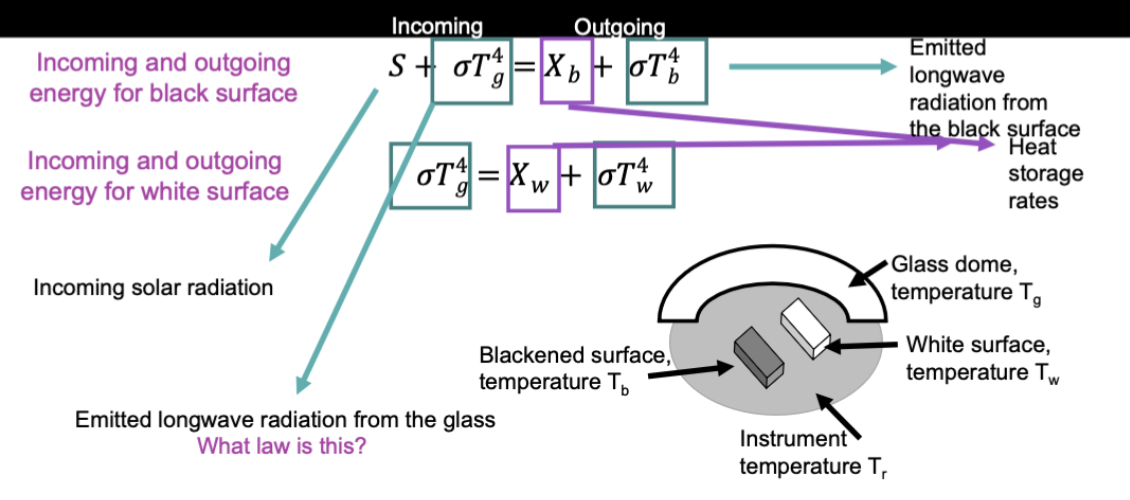
Pyranometer Theory
Look at the parts

Pyranometer Theory - S equation
Look at the equation
Eppley Black and White Pyranometer
measures global solar radiation
reference instrument in calibration procedures of pyranometers
the detectors consists of three white and three black wedges representing the cold (white) and hot junctions (black) of an electroplated copper-constantan thermopile
can be inverted to measure albedo
(double domes are used to protect the instrument from the weather and a second to isolate the receiving surface from local heating)
Why is albedo important?
Tells us urban heat island, tells us about energy balance
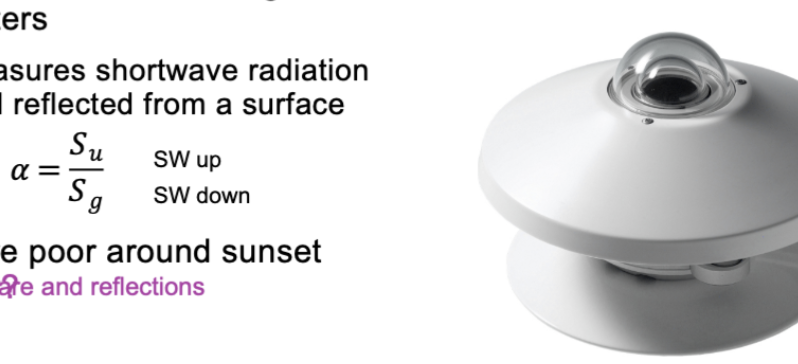
Albedometer
measures shortwave radiation using a pair of pyrometers
specifically measures shortwave radiation received by and reflected from a surface
measurements are poor around sunset and sunrise - sun is at lower angle
Large change in albedo?
snow, cloud coverage, knocked down forest into parking lot

Which line is which?
Bottom - Su (shortwave up)
Top - Sg (shortwave down)

Pyrheliometer
measures direct shortwave radiation
specially, the measurement of direct solar radiation, normal to the solar beam
has a thermocouple sensor
a solar tracking instrument is needed- follows the sun in elevation and azimuth
Photometer
measures shortwave radiation
specially measures light in the visible part of the spectrum only as energy
convert light into electricity using a photoresistor, photodiode (resistance down, intensity up), photomultiplier (amplifies the light, very sensitive)
light might be passed through a filter to measure at a defined wavelength
Diffuse Solar Radiation Measurement
the pyranometer sensors is shaded from the direct solar beam
the shade ring must be regularly adjusted
some of the diffuse radiation is lost by the obstruction of the ring itself
depends on latitude and time of year
can be corrected by multiplying the measure value by the k factor
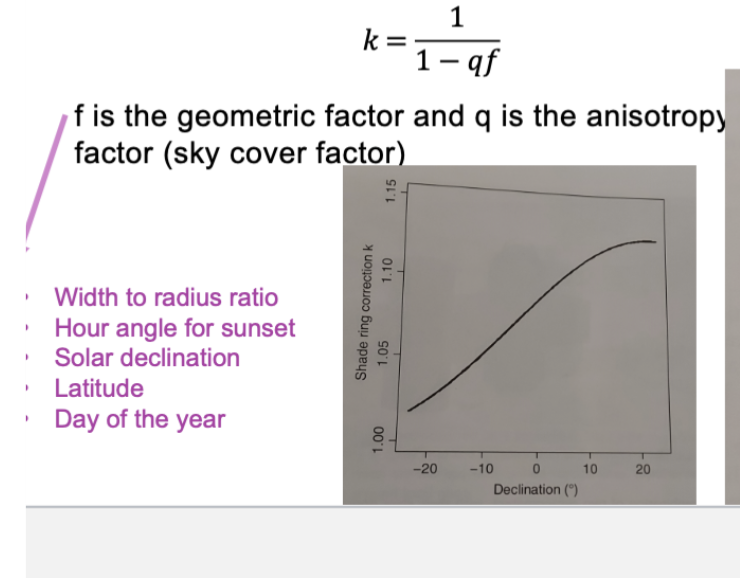
Look at this
“f” is the geometric factor and q is the anisotropy factor (sky cover factor)
width to radius ration
hour angle for sunset
solar declination

SW+LW - Pyrrandiometer Theory

Pyrradiometer
measures total global radiation (shortwave and long wave)
glass domes are not used for pyrradiometers
polytene or sillicon domes are transparent to a large range of wavelengths
sillicon degrades in sunlight becoming brittle, and needs to be replaced monthly
Pyrradiometer vs. pyrometer
pyrometer doesn’t care about shortwave radiation
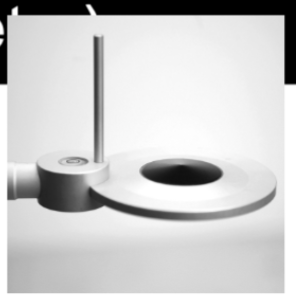
Net Pyrradiometer (radiometer)
measures shortwave and long wave radiation
specifically measures the net radiative flux of shortwave and long wave radiation
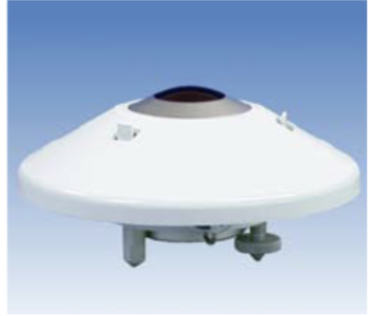
Pyrgeometer
measures long wave only
specially, measure the terrestrial radiation usually over a hemisphere, either upward or downward
measurements are made at night or during the day if the shortwave amount is independently measured and subtracted
Pyrometer - Infrared Thermometer
measures the long wave radiation emitted in the 7.5-13.5 (mu m)
radiation received is related to the temperature of the surface
Emmistitivty = sigmat^4
a thermopile sensing element, composed of small thermocouples on a sillicon chip, absorb the energy and produce an output signal
ASOS Radiometer
no radiometers at the ASOS stations
NYS Mesonet: Li-Cor Pyranometer:
weather resistant and durable in long-term outdoor deployments
measures global solar radiation under unobstructed natural daylight conditions
uniform sensitivity u to 82 degrees incident angle
detachable sensor simplifies installation and removal, making it ideal for platforms with complex cabling
Radiometers and Satellites
radiometers flown on satellites are NOT cameras
moving mirror make the radiometer view different regions of the earth
radiometer scans a scene line-by-line
data is recorded in a two-dimensional format (line and element) which, when displayed on a computer monitor or television screen, makes up an image
Radiometers on a satellite is a…
Passive sensors
Radiometric resoultion
the number of bits representing the recorded energy
8-bit: 256 values (2^8)
4-bit: 16 values (2^4)
1-bit: 1 value (0 or 1)
Spectral Resoultion
the greater the number of bands, the greater the spectral resolution
Spatial Resolution
the size of a pixel that is recorded in a raster image, typically pixels may correspond to square areas ranging in side length from 1 to 1000m
very expensive
Temporal Resolution
geostationary orbit
near polar-orbit
sun-synchronous orbit
Measurement Error: Azimuth Error
change in the sensors output as the sensor is rotated about the normal axis at a particular angle of incident radiation
Measurement Error: Linearity Error
the sensor output is not linearly proportional to the input