PSY389 LECTURE 1: Historical Context and Theories of AOD Use
 Call Kai
 Learn
 Practice Test
 Spaced Repetition
 Match
 Flashcards
 Knowt Play
1/24

There's no tags or description
Looks like no tags are added yet.
25 Terms
Why is understanding historical views on substance use important?
Attitudes/perceptions/views change with time
Attitudes to drugs and alcohol are different in different places/countries
Beliefs may influence behaviours of drug users
Beliefs influence drug policies
Beliefs influence treatments of substance abuse/dependence
History of alcohol beliefs
Part of European culture
Beer was a food source
Drunkenness was a sin
Compassion to drunkenness was shown but punishment also
Punishments were consistent with the normal processes of social pressure, control & restraint on alcohol use of that time (from religious beliefs)
Therefore, peoples attitudes towards alcohol use was considered moral
The moral model
Problem lies in the moral weakness of the person (lack of will power to restrain from substance use and for moderation or abstinence))
The moral model interventions
Strengthen people’s will power by encouragement, teaching, exhortation, punishment, social pressure.
Post moral model
Advanced method of distilling wine into stronger drinks (e.g., vodka, brandy , whiskey)
Problems became worse during industrial revolution with economic & social changes where people could afford to drink.
Drinking increased and so did social issues
Accidents occurred due to drinking while operating machinery
Government subsidised farmers for growing grains (surplus of grains was turned into gin).
Problems escalated → a change in people attitude
In 1826 a treaty for alcohol called “Six Sermons on Intemperance” & formation of “American Temperance Society” in the US & UK.
Temperance Society: drink in moderation or not at all
Early pharmacological model
Problem lies in the substance itself i.e. its pharmacology, not the person
Alcohol was known as the ‘demon’ drink
Early pharmacological model Interventions
Temperance, Teetotal, prohibition, abstinence from the harmful pharmacological effects of alcohol.
Temperance movement flourished in America & spread to Britain
Temperance movement
Split occurred between those who believe in moderation (Temperance) and those in total abstinence ('Teetotaller“)
Triggered debates: moral persuasion and legal coercion
Debates ended with introduction of Prohibition (banning of alcohol sales) in US after the First World War
Prohibition
Did not reduce alcohol related problems as:
1. Drinking continued illegally
2. Created crime and corruption associated with underground manufacture and sale of alcohol
3. Public lost respect for law
Public opinion swung against in 1930s, which was repealed in 1933
Alcoholic Anonymous
helping people to become abstinent
AA grew rapidly as many saw AA as hopeful
Narcotics Anonymous (NA) and Cocaine Anonymous (CA) developed
AA claimed success: 1.50% people achieved sobriety - 2. 25% achieve sobriety, after several relapses - 3. 25% showed improvements
Difficult to determine efficacy of AA treatment due to its anonymity
Abstinence rates of 25-50% (similar to hospital treatment programs)
Early disease model
Problem lies in the user, who is somehow infected by the agent (alcohol) and cannot resist it, leading to a disease of the will
Disease of mind led to disorder functions of health
Leading to semi-scientific intervention treatment (development of treatment facilities)
Main goal of treatment involved total abstinence from all forms of liquor.
This model generated hall marks for modern view of 'alcoholism‘, including:
1. compulsive loss of control over drinking
2. it is a disease
3. abstinence was the only cure
Late disease model
Jellinek (1937) proposed disease model involving loss of control over drinking
Problem lies in a few users who are susceptible to the harmful substance
Majority drink without harmful consequences but only a few will become infected and require treatment
Calling for non-judgmental response and compassion treatment
Organisations were formed: Yale Center for Alcohol Studies (1937), National Council on Alcoholism (1962), and N.I.A.A.A (1970).
Gained support of American Medical Association and World Health Organisation (WHO)
Main challenge to Jellinek’s Disease model
‘Loss of Control’:
1. Once drinking starts, one cannot stop
2. The problem becomes worse and worse
3. One loses complete control over one’s drinking
But ‘loss of control’ is not as hopeless as it is thought!
Natural recovery of Vietnam veterans from heroin addiction when retuning to the US (Tutorial 1 reading Robins (1993)
Reflection on historical models
All are true in part but each represents only part of the whole picture of dependency
Moral – individual’s ‘lack of will’ which can be changed with rewards to ‘try harder’
Pharmacological – drugs certainly provide reward for repeating behavior
Disease – dependence can be “caught” by modeling on other people (environmental factors)
Weil(1973) – one theory of why people take drugs
The desire to alter consciousness is innate, normal drive such as hunger or sex desire
This theory proposed that:
Innocent children experienced ‘altered consciousness’ through whirling, choking each other, sniffing cleaning fluids or gasoline;
When they become older they ‘experiment’ drinking alcohol or smoking tobacco for the first time,
In adulthood, their drug use/abuse becomes fullblown.
Theories of alcohol and Other Drug Use:
Psychologically based theories (Intrapersonal, Personality/Temperament)
Biologically based theories (Biologically based Personality)
Socially based theories (Social Learning and Social Influences, Expectancies)
Intrapersonal theories
Tension reduction theory:
drug use reduces tension and helps relaxation
The stress response dampening theory: physiological responses to drug use reduce stress (applies to individuals who are more likely to drink to cope when under stress).
Personality/temperament theory
unconscious motives for alcohol and drugs
may reflect the influence of intensely emotional experience during infancy/early childhood
use drug to achieve immediate oral gratification and pleasure may stem from arrested development or fixation at the oral stage of development
however no evidence to support alcoholic personality
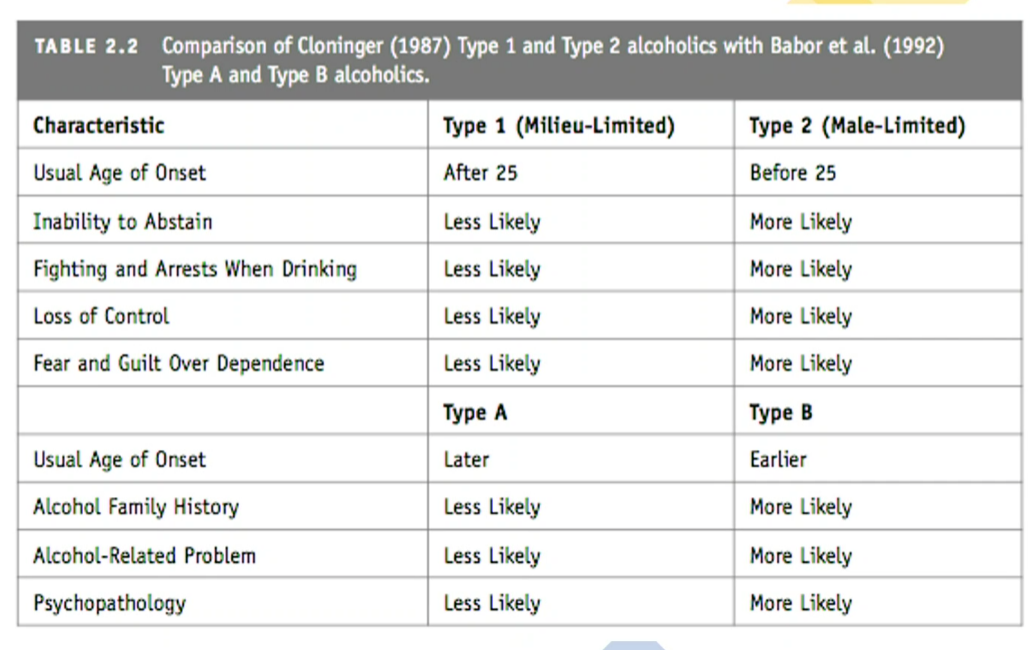
evidence proposed classifications of alcoholism including
1. Introversion–extraversion
2. milieu-limited alcoholism (Type 1) vs Male-limited alcoholism (Type 2)
3. Type A and Type B alcoholism
Extraversion & alcohol
higher associated with increased alcohol use dye to greater social engagement, reward sensitivity, and sensation-seeking
Introversion & alcohol
not a strong risk factor for alcoholism
some may develop problematic drinking when it is used to cope
Types of alcoholism
The enhanced reinforcement model
Having a greater predisposition to sensitivity to AOD
AOD functions as reinforcers in reducing stress (for individuals without good psychological coping skills)
The negative affect model
using AOD as a form of self medication
suffering from depression or anxiety, combined with stressful life events and having poor coping skills
Zinburg’s DIE model of drug experience (Zinburg, 1984)
aka Drug, Set and Setting Model
To understand behaviours of drug users we must look into factors relating to not only the Drug itself but also the Individual and Environmental/social factors

Zinberg’s theory and harm minimization
Offers one of the most useful and practical means to reduce the negative consequences of substance use, especially in harm minimization approaches with substance users.
E.g. someone may reduce harm by making sure they eat before drinking (Individual) or only drink in the company of others (Environment).
Or someone may share that they used less drugs when employed, reflecting that:
They may feel better about themselves (Individual) when they are spending more productive time at work (Environment).
They may also make new and nonsubstance abusing friends at work (Environment).