Heart Sound/Auscultations
 Call Kai
 Learn
 Practice Test
 Spaced Repetition
 Match
 Flashcards
 Knowt Play
1/41

There's no tags or description
Looks like no tags are added yet.
42 Terms
What is the normal HR range for adults
60-100 bpm
What is the typical HR range for aerobically trained inviduals
40-60 bpm
What is the HR range for newborns
80-180 bpm
What are causes of compensatory tachycardia
Volume loss after surgery or due to dehydration
What is postural tachycardia syndrome
Sustained HR increase of >30 bpm within 10 minutes of standing
Define irregular pulse
Variations in force or frequency; due to arrhythmias, myocarditis
What are causes of weak or thready pulse
Low SV, cardiogenic shock, increased peripheral resistance, severe CHF
What are causes of bounding, full pulse
Increased SV, shortened ventricular systole, decreased peripheral pressure, aortic insufficiency, anxiety, fever, HTN, exercise
Where is the best site for ausucultation of S3
Mitral valve
Where/When is splitting of S2 heard
During inspiration at pulmonary site
Where would you hear the aortic valve during heart auscultations
2nd intercostal space, right sternal border
Where would you hear the pulmonic valve during heart auscultations
2nd intercostal space, left sternal border
Where would you hear the tricuspid valve during heart auscultations
4th intercostal space, left sternal border
Where would you hear the mitral valve during heart auscultations
5th intercostal space, left midclavicular line
What do you hear at Erb point and where is it located
Auscultation location for heart sounds and heart murmurs located at the 3rd left intercostal space
What are heart sounds associated with
Valves closing
S1 heart sound
Mitral and tricuspid valves (AV) closing → onset of systole
When is the S1 (lub) sound decreased
With a 1st degree heart block
S2 heart sound
Aortic and pulmonic valves (semilunar) closing → onset of diastole
When is the S2 (dub) sound decreased
Aortic stenosis
When does systole occur between
S1 and S2
When does diastole occur between
S2 and S1
S3 heart sound
kenTUCKy (S1-S2-S3)
Ventricular gallop
May be normal in children and young athletes
What are S3 heart sounds associated with
Ventricular filling after mitral and tricuspid valves open; low frequency turbulence; heart during early diastole
What is the hallmark sing of a S3 heart sound
CHF
S4 heart sound
TENNessee (S4-S1-S2)
Atrial gallop
What is a S4 heart sound associated with
Abnormal ventricular filling and atrial contraction; low frequency turbulence; heart during late diastole, associated with MI, HTN, and LV hypertrophy
What is a heart murmur
Abnormal heart sounds due to valvular disorders resulting from changes in the blood flow through the altered valve
What is a systolic murmur
Turbulence between S1 and S2; valvular disease, aortic stenosis, or may be normal
What is a diastolic murmur
Turbulence between S2 and S1; aortic and pulmonary regurgitation or mitral stenosis
Grades of murmurs
Grade 1 (softest) and Grade 6 (audible with stethoscope lifted off chest)
What is a thrill murmur
Abnormal tremor with vascular or cardiac murmur; felt with palpation
What is a stenotic valve with a murmur
Impaired opening
What is a regurgitant valve with a murmur
Impaired closing
What is a bruit heart sound
Adventitious sound or murmur of arterial or venous origin; turbulent blood flow; common in carotid or femoral arteries
What does a bruit heart sound indicate
Atherosclerosis or partially blocked artery
What is a pericardial friction rub
Abnormal sound associated with each heart beat; high pitched, leathery, scratchy quality
What can cause pericardial friction rub
Inflammation of the pericardial sac (with or without excessive fluid)
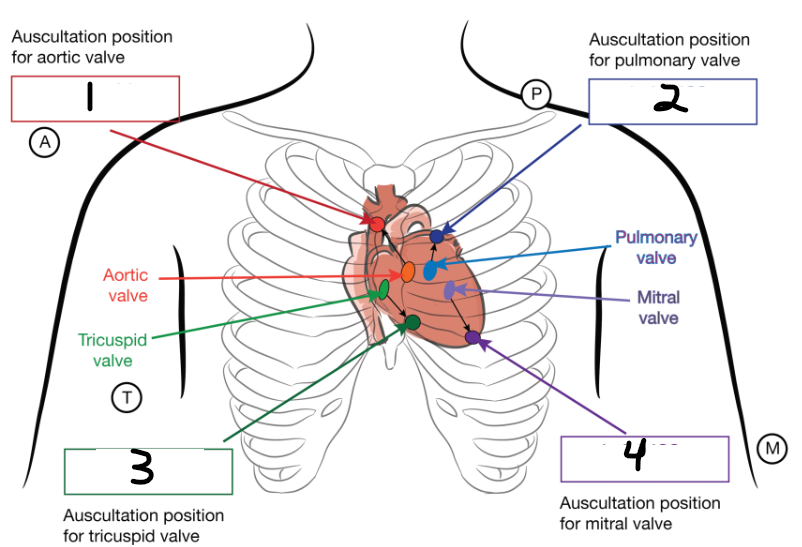
1
Right 2nd ICS PSL

2
Left 2nd ICS PSL

3
Left 4th ICS PSL

4
Left 5th ICS MCL