NEUR200: EXAM 3 STUDY GUIDE
 Call Kai
 Learn
 Practice Test
 Spaced Repetition
 Match
 Flashcards
 Knowt Play
1/87

There's no tags or description
Looks like no tags are added yet.
88 Terms
cochlea
-*TRANSDUCTION*
-contains *auditory receptors=hair cells* that move with vibrations of sound→opens potassium channels
-K+ ions flow into cell, creates electrical signal that results in *release of neurotransmitters*

auditory pathways
1. axons leave the cochlea (auditory nerve) to the *medulla*→on top of spinal chord
2. next synapse is in *inferior colliculus (midbrain)*
3. next synapse is in *medial geniculate nucleus of thalamus* (RELAY STATION FOR SENSORY INFO)
4. last stop is in *auditory cortex* (A1)→superior area of temporal lobe

Primary auditory area
tonotopic map
representation in the auditory cortex of different sound frequencies→*L*ower tones heard to the *LEFT*, higher tones heard to the *RIGHT*

organization of the cortex...
is NOT innate→comes with experience after birth
where do both the where and what pathway begin?
PRIMARY AUDITORY CORTEX (*A1*→superior temporal cortex)
-auditory imagery as well
what pathway (auditory)
-starts in A1
-ends in *superior temporal sulcus*
-*OBJECT RECOGNITION*→think MEMORY, meaning of words, music
where pathway (auditory)
-starts in A1
-ends in *posterior temporal cortex and parietal cortex*
object localization
directing movements with respect to auditory information
when you hear superior temporal sulcus, you should think...
body movement, body language, body intentions
connection of STG and ITG to Superior temporal sulcus?
underlies stimulus categorization→*INTEGRATES VISUAL AND AUDITORY INFO*
3 gyrus of temporal lobe
1. superior temporal gyrus
2. middle temporal gyrus
3. inferior temporal gyrus
superior temporal gyrus
*auditory* ventral stream
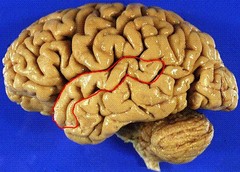
middle temporal gyrus
auditory and visual processes (more visual than auditory)
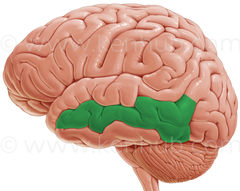
inferior temporal gyrus
visual ventral stream (together with fusiform gyrus)

insula
role with addiction, large internal area

medial temporal region
-*amygdala*: memory, fear conditioning
-*hippocampus*: memory, spatial information
what's the common denominator between the insula and medial temporal region?
the past, memory→*RECOGNITION*
*ventral pathway* in temporal lobe deals with...
*object recognition* and developing object categories
cross-modal matching (auditory and visual info) deals with...
SUPERIOR TEMPORAL SULCUS
biological motion perception and social cognition deals with...
SUPERIOR TEMPORAL SULCUS (think autism and dysfunction)
*affective responses* to sensory input deals with...
AMYGDALA
*spatial navigation* deals with...
HIPPOCAMPUS (spatial memory)
ex. taxi drivers have more grey matter in hippocampus

amusia (Heschl's gyrus)
impairment to make pitch discriminations
-much larger Heschl's gyrus in musicians
auditory hallucination
spontaneous activity in auditory regions
Wernicke's aphasia
disturbed word recognition, extreme form being "word deafness", an inability to recognize words despite hearing of pure tones (*lose meaning of words*)
fluent aphasia
can speak, but words have no meaning
anterograde amnesia
bilateral removal of the medial temporal lobes→*can't make new memories*
problems of conscious recall of information
inferotemporal cortex (left: verbal/ right: visual)
temporal-lobe personality (Geschwind syndrome)
pedantic speech, egocentricity, perseveration in discussions of personal problems, paranoia, proneness to aggressive outbursts→*epilepsy or damage of temporal lobe (limbic system)*
-being overly religious, philosophical
Kluver-Bucy syndrome
changes in medial temporal lobe, hyper-sexualized, tendency to put objects in their mouth

stimulation of _____ elicits movements (Penfield's experiments)
Primary Motor Cortex (M1)
M1 and somatosensory cortex...
match up nicely
role of cortex?
-*important for complex actions*
-less important for *involuntary actions* (ex. sneezing, laughing, crying)

what brain areas play a role in motor planning?
posterior parietal cortex, prefrontal cortex, supplementary motor area (SMA)
prefrontal cortex
movement organization (sequences), motor inhibition, observation of other people's actions→takes in goals, where/what pathways, past memories

mirror neurons
-active when we observe someone doing something and when we do that same thing
-*automatic imitation*: imitation reflex in newborns and yawning
-*understanding intentions + autism*: empathy, imitation is beneficial for some people with autism in learning language
organization of frontal lobe?
1. prefrontal cortex (makes decision based on decision from senses)
2. premotor cortex (makes plan)
3. motor cortex (executes plan)
the basal ganglia is a key area for...
-learning new habits, automatic responses
-important for *spontaneous, self-initiated behaviors*

3 key areas of basal ganglia
1. striatum (ex. caudate nucleus, putamen)
2. substantia nigra (*dopaminergic pathway*)
3. globus pallidus
disorders of basal ganglia
-dyskinesia
-Parkinson's
-Huntington's
-Tourette's
dyskinesia
unwanted movement (think Parkinson's)
Huntington's disease
caudate and putamen cells are destroyed
Tourette's syndrome
caudate and putamen damage→*involuntary movements*
Parkinson's disease
loss of dopamine cells in *substantia nigra*
Cerebellum
Balance and *coordination*→*rapid movements that require aim, timing, and alterations of movements* (ex. tapping a rhythm, seeing which visual stimulus moved faster)

damage to cerebellum?
symptoms resemble *alcohol intoxication* (poor movement coordination, ataxia)
Weirnecke-Korsakoff syndrome
lack of *vitamin B1* as a result of alcoholism→manifests in motor issues, amnesia, *ATAXIA* of cerebellum, lack of coordination of movement or speech
what are the two functional zones of the parietal lobe?
-anterior zone: *somatosensory cortex*
-posterior zone: *posterior parietal cortex (PE, PF, and PG)*
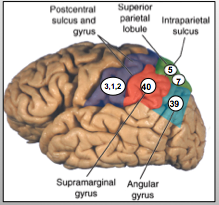
somatosensory cortex
organized into maps (*BODY MAP*)→homunculus

explain the idea of a body map
-adjacent areas of the skin project to adjacent areas in the brain
-some ares on the skin are represented by *disproportionately large area of the brain*→often frequently used areas where there are A LOT of receptors
The representation of a specific area of the body can...
become LARGER with experience→violin players have greater cortical representation for fingers of their left hand
disorders of parietal lobe
-anosognosia
-Balint's syndrome
-(spatial) neglect syndrome
-Gertsmann syndrome
-apraxia
Anosognosia
denial of illness
Balint's syndrome
simultagnosia and optic ataxia
(spatial) neglect syndrome
-affects one hemisphere of the brain
-ignore one side of space (ex. objects, sounds, people)
The Gerstmann syndrome
dysgraphia, dyscalculia, problems with right-left discrimination
apraxia
loss of a skill movement not caused by weakness
problems with sensoriomotor transformation (posterior parietal region)
when we move toward objects, we integrate movements of various body parts with sensory feedback of what movements aer actually being made (*COROLLARY DISCHARGE*) and the plans to make the movements
corollary discharge
efference copy of an action command that inhibits sensory responses so that those don't interfere with the execution of the motor task
why don't we feel anything when we tickle ourselves?
COROLLARY DISCHARGE→*frontal lobe* sends command, also sends a command to the *somatosensory cortex*→INHIBITS INFO PRODUCED BY SELF
somatic nervous system
system through which the brain *controls movement* and *receives sensory information* from the *BODY (spinal nerves)* and *head and neck (cranial nerves)*
do cranial nerves go through the spinal cord?
NO→go through small openings in the skull
Vagus (X) nerve
*motor* function: heart, lungs, bronchi, GI tract
movement depends on...
muscle contractions
neuromuscular junction
*synapse* between a motor neuron axon and muscle fiber
what neurotransmitter is released in skeletal muscles at the neuromuscular junction?
acetylcholine→excites the muscle to contract=MOVEMENT
two divisions of autonomic nervous system?
sympathetic and parasympathetic
sympathetic nervous system
-*VIGOROUS ACTIVITY*
-*increases* breathing and heart rate
-*decreases* digestive activity→nonessential when trying to run away from something
-most sympathetic axons release *norepinephrine*→ADRENAL GLAND (located at the top of the kidney)
parasympathetic nervous system
-*vegetative, nonemergency responses*
-*decreases* heart rate, breathing
-*increases* digestive activity→CONSERVES ENERGY
-releases *acetylcholine* onto organs (movement of digestive organs) and *serotonin* (important in digestion)
functions of hypothalamus
-hormones, sleep/wake cycles, sexual behaviors, eating behaviors/disorders
-*HOMEOSTASIS AND ALLOSTASIS*
homeostasis
-think *HYPOTHALAMUS*
-refers to *temperature regulation* and other biological processes that *keep body variables within a fixed range*
-changes that occur once you stray away from baseline amount of care
allostasis
adaptive way in which body anticipates needs depending on the situation, *avoiding errors rather than just correcting them*
-much of this control depends on the *hypothalamus*
allostasis and heroin?
brain anticipates use, body does opposite effect to compensate for changes induced by drug use
what other signals stimulate arcuate nucleus?
insulin and leptin→modulate ARC and other parts of hypothalamus
The ARC sends signals to the ________ of the hypothalamus that inhibit the __________
paraventricular nucleus, lateral hypothalamus
male and female mammals start with...
the same anatomy during an *early prenatal stage*
what gene on what sex causes the development of specific gonads?
*SRY gene* on *males* causes primitive gonads to develop into testes that produce *androgens (testosterone)*
organizing effects
-PERMANENT
-during the first trimester of pregnancy, sex hormones (mainly testosterone) determine whether the *body develops female or male genitals*
-testosterone plays an important role for the development of *external genitals*
-sex hormones produce additional organizing effects at *puberty* (breast, hair, changes in voice) and anatomical changes in some parts of the hypothalamus
activating effects
-TEMPORARY
-happen while hormone is present or shortly beyond (ex. if pregnant with boy, abundance of testosterone may lead to temporary hair growth or drop in voice)
organizing effects of sex hormones
-add early testosterone, individual becomes *male*→without testosterone, develops as *female*
-ex. in vitro female rat is injected with testosterone during critical prenatal period (i.e. first trimester in humans)= will be *partly masculinized*→clitoris grows larger than normal, behavior is masculinized (rat will approach sexually receptive females)
-if male rate lacks androgens during critical periods, they will develop *female anatomy and behavior*
-*causes*: genetic deficiency of androgen receptors, prenatal exposure to drugs that interfere with androgens (alcohol, marijuana, haloperidol, phathalates, cocaine)
organizing effects occur when?
prenatal and puberty ONLY
organizing effects: childhood behavior
prenatal hormones (especially *testosterone*) alter the brain in ways that influence differences between boys and girls in their *activities and interests*
influence of prenatal injections of testosterone on female monkey fetuses?
increases masculine-type play after they were born
phathalate levels and pregnant women?
phathalate levels *inhibit* testosterone production→sons of these women show *less interest in "typical boys' toys"*
genetic and prenatal influences on sexual orientation?
sexual orientation may depend on *testosterone levels during a sensitive period of brain* development
prevalence of homosexuality and older brothers?
slightly higher among men who have *older brothers*→mother's immune system may react against a protein in a son and then attacks subsequent sons enough to alter their development
stress during pregnancy
-stress releases *endorphins* which antagonize the effects of testosterone on the hypothalamus
-stress also elevates of *cortisol* that *decrease testosterone release*
-gene on X chromosome received from mother could be linked to sexual orientation