Orgo 2 Chapter 15 Open ended
 Call Kai
 Learn
 Practice Test
 Spaced Repetition
 Match
 Flashcards
 Knowt Play
1/59

There's no tags or description
Looks like no tags are added yet.
60 Terms
Rank the following dienes in order of increasing stability: trans-1,3-pentadiene, cis-1,3-pentadiene, 1,4-pentadiene, and 1,2-pentadiene
1,2-pentadiene < 1,4-pentadiene < cis-1,3-pentadiene < trans-1,3-pentadiene
Among a series of isomeric trienes, the more negative the ΔH° of the hydrogenation reaction of a given triene, the ________ stable it is relative to the others in the isomeric series.
less
Consider the hydrogenation of each compound listed and rank the compounds in order of increasing ΔH°. The most negative ΔH° should be listed first cis-pent-2-ene, 2,3-pentadiene, and trans-1,3-pentadiene
,3-pentadiene < trans-1,3-pentadiene < cis-pent-2-ene
Consider the hydrogenation reaction of each compound listed and rank the compounds in
order of increasing ΔH° of this reaction. The most negative ΔH° should be listed first.
2,5-dimethyl-1,3-cycloheptadiene,
1,4-dimethyl-1,3-cycloheptadiene, and
3,6-dimethyl-1,4-cycloheptadiene
3,6-dimethyl-1,4-cycloheptadiene
< 2,5-dimethyl-1,3-cycloheptadiene
< 1,4-dimethyl-1,3-cycloheptadiene
What is the resonance energy of a system?
he extra stability which arises when conjugation is present in a molecule.
In the addition of HBr to conjugated dienes, is the product which results from 1,2-addition or that which results from 1,4-addition typically the product of kinetic control?
The product of kinetic control typically results from 1,2-addition.
What name is given to the type of "control" which arises in a reaction which does not achieve equilibrium and in which the product distribution is determined by the relative activation energies of the pathways which produced them?
Kinetic Control
Provide the necessary synthetic sequence for preparing 1,3-cyclopentadiene from
cyclopentane.
1) Br2, hν
2) KOH
3) NBS, hν
4) KOH
Explain why SN2 reactions on allyl bromide proceed faster than corresponding reactions on ethyl bromide
When the substrate is allylic, resonance stabilization through conjugation with the adjacent π bond occurs in the transition state. This delocalization lowers the energy of the transition state and results in an enhanced rate.
For what does the acronym HOMO stand?
Highest Occupied molecular orbital

3-methoxy-1-methylcyclohexene and 3-methoxy-3-methylcyclohexene
In the addition of HBr to conjugated dienes, is the product which results from 1,2-addition or that which results from 1,4-addition typically the product of kinetic control?
he product of kinetic control typically results from 1,2-addition
What name is given to the type of "control" which arises in a reaction which does not achieve equilibrium and in which the product distribution is determined by the relative activation energies of the pathways which produced them?
kinetic control
In the diene shown below, there are two possible double bonds that could react when 1 eq. of
HBr is added. However, the double bond labeled "A" reacts preferentially to give the major
product. Using resonance structures, justify this observation

In a Diels-Alder reaction, what is the endo rule?
When the dienophile has a pi bond in its electron-withdrawing group (as in a carbonyl
group or a cyano group), the p orbitals in that electron-withdrawing group approach one of the
central carbon atoms (C2 or C3) of the diene. This proximity results in secondary overlap: an
overlap of the p orbitals of the electron-withdrawing group with the p orbitals of C2 and C3 of
the diene. Secondary overlap helps to stabilize the transition state. The unsaturated substituent on
the dienophile generally prefers the endo position in the transition state, giving rise to the endo
product in bicyclic systems.

Provide the structure of the major organic product in the following reaction.


What diene and dienophile would react to give the product below?


What diene and dienophile would react to give the product below?

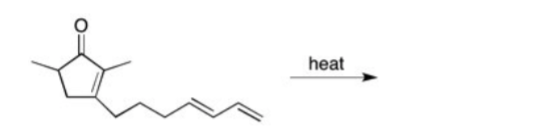
Draw the major organic product that results from the intramolecular Diels-Alder reaction.


Draw mechanism for the following reaction:


Using resonance structures, explain the regiochemistry observed in this reaction:


Provide the major organic product of the following reaction.


Provide the major organic product of the following reaction.


What diene and dienophile are used in the Diels-Alder route to the compound shown?


What diene and dienophile are used in the Diels-Alder route to the compound shown?
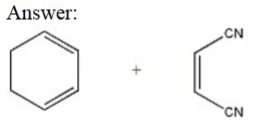

Provide the structure of the major organic product in the following reaction.


Provide the structure of the major organic product in the following reaction.


What diene and dienophile would react to give the product below?
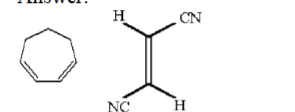

What diene and dienophile would react to give the product below?

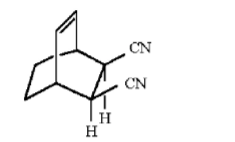
What diene and dienophile would react to give the product below?

Which diene reacts more rapidly in Diels-Alder reactions, cyclopentadiene or 1,3-butadiene?
Briefly explain your choice.
Cyclopentadiene reacts more rapidly since its π-system is fixed in the s-cis
conformation.

Provide the structure of the major organic product in the following reaction.

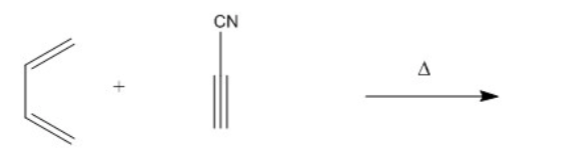
Provide the structure of the major organic product in the following reaction.


Provide the structure of the major organic product in the following reaction


Provide the structure of the major organic product in the following reaction.


Would you expect the following compound to absorb visible light? Why or why not?
yes, you would expect this compound to absorb visible light. It has an extended
conjugated system.

Provide the major organic product of the following reaction.


Provide the major organic product of the following reaction.
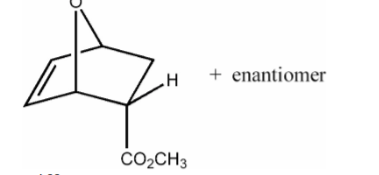

Provide the major organic product of the following reaction.
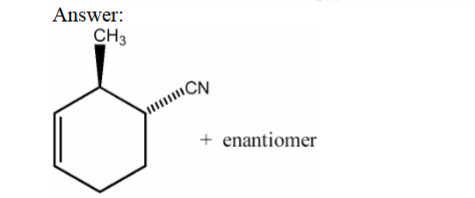

Anthocyanidins are the organic compounds largely responsible for the color of wine and grape juice. They can also be used as indicators in pH titrations. Given the reaction below, which form of the compound is colored and which is colorless.
the carbinal pseudobase form of the anthocyanidin is most likely the colorless form.
The extended conjugated network has been disrupted by the bonding of the OH.

Provide the major organic product of the following reaction?
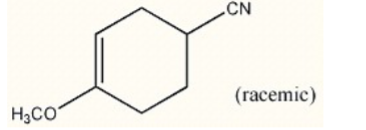

Provide the major organic product of the following reaction.


Provide the major organic product of the following reaction.
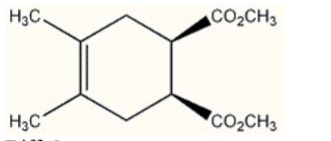

Assuming kinetic conditions, provide the correct stereochemistry and regiochemistry of the major product of the following reaction.


Provide the structure of the major organic product in the following reaction

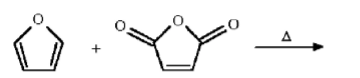
Provide the structure of the major organic product in the following reaction.

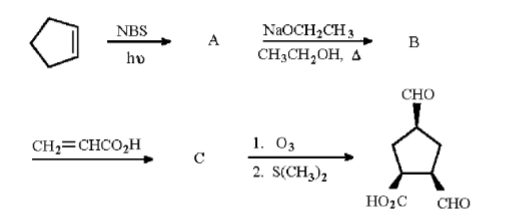
What are the structures of A, B, and C?

Why does the (E,E)-isomer of 2,4-hexadiene react much more rapidly with dienophiles than does the (Z,Z)-isomer?
The s-cis conformation, which is required for participation in a Diels-Alder reaction, is
hindered by a severe CH3/CH3 steric interaction in the (Z,Z)-isomer
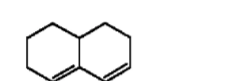
Why does the diene shown below fail to undergo a Diels-Alder reaction with even the most reactive dienophiles?
The diene cannot achieve the necessary s-cis conformation.
Dicylopentadiene results when cyclopentadiene reacts with itself in a Diels-Alder reaction. Provide the structure of dicyclopentadiene. Pay particular attention to stereochemical detail.


The following Diels-Alder reaction was featured in Tet. Lett. 2011, 960. Predict the
structure of the starting materials.

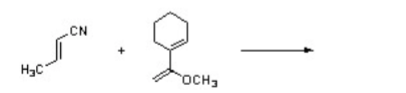
Assuming kinetic conditions, draw the major product of the reaction below. Include correct stereochemistry.


Predict the major product of the following reaction:

What characterizes a pericyclic reaction?
Pericyclic reactions involve concerted breaking and formation of bonds within a closed ring of interacting orbitals.
Provide a picture of the HOMO of 1,3,5-hexatriene.


Predict the outcome of the reaction shown below

Consider the possible thermal [4+4] cycloaddition of two molecules of 1,3-butadiene to generate cycloocta-1,5-diene. Show the HOMO/LUMO interaction which would result, and use this interaction to predict whether the proposed cycloaddition could occur.
The cycloaddition is thermally forbidden

Is the thermal [4+2] cycloaddition between allyl anion and ethylene an allowed one? To answer, draw the HOMO of allyl anion and the LUMO of ethylene, and comment on the symmetry match of the two.

Which compound requires a higher energy photon to cause a π to π* (HOMO/LUMO)
transition, 1,3-butadiene or 1,3,5-hexatriene?
1,3-butadiene
Which has a λmax in its UV spectrum at a longer wavelength, 2,4-hexadiene, 1,4-
hexadiene, or 1,5-hexadiene?
2,4-hexadiene