Clinical Examination
 Call Kai
 Learn
 Practice Test
 Spaced Repetition
 Match
 Flashcards
 Knowt Play
1/49

Earn XP
Description and Tags
week 5: UQ assessment
Name | Mastery | Learn | Test | Matching | Spaced | Call with Kai | Chat |
|---|
No analytics yet
Send a link to your students to track their progress
50 Terms
Observation
skin changes, atrophy, posture
skin changes
Redness, swelling, surgical scars, cysts, masses
signs of atrophy
Nerve palsies, muscle lesions, more serious pathologies, SCM, Trapezius, Deltoid, Supraspinatus. Infraspinatus
posture in all planes
Excessive kyphosis, rounded shoulders, forward head posture, Scoliosis, shoulder elevation/depression
gross AROM movement Screen
assess combined functional movements, look for symmetry, look for limitation in movement/pain reproduction
functional shoulder AROM (Ext/IR)

functional shoulder AROM (ABD/ER)

UE bony palpation
spine, inferior angle, vertebral border, supraspinous & infraspinous fossa, acromion & coracoid process
Humeral palpation sites
lateral epicondyle
medial epicondlye
elbow palpation sites
olecranon process, radial head
Shoulder AROM Assessment
perform standing or sitting
look for patients willingness, pain, limitation in AROM
compare bilaterally
look for compensatory behavior
Shoulder AROM: flexion
patient/therapist: standing position
check goniometer position
compensation: shoulder hiking, momentum use, trunk extenion, ipsilateral cervical SB
Shoulder AROM: flexion values
0-180 degrees.
Shoulder AROM: Extension
patient/therapist: standing position
check goniometer position
compensation: momentum use, trunk extension
Shoulder AROM: extension values
0-60 degrees
Shoulder AROM: abduction
patient/therapist: standing position
check goniometer position
compensation: shoulder hiking, momentum, trunk side bending, ipsilateral cervical SB
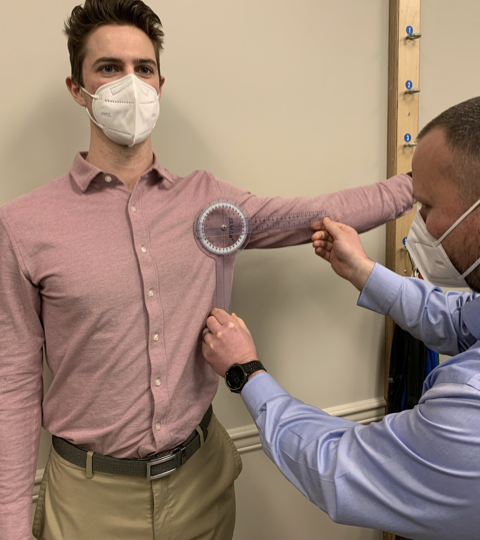
Shoulder AROM: Abduction values
normal values: 0-180 degrees
internal rotation behind back
record spinous process level that teh patient can reach
internal rotation example
R shoulder IRBB: T7 SP
compensation for internal rotation
using momentum, forward trunk lean
external rotation
while keeping the elbow against teh body, externally rotate the shoulder
external rotation
lifting arm away from body, rotating body to the same side, extending the elbow
PROM assessment
supine/prone
therapist performs 100% of the movement, patient is relaxed
assess end-feel
assess integrity, compare bilaterally
PROM: Flexion value
normal ROM: 0-180
PROM: shoulder extension value
normal ROM: 0-60
PROM: shoulder abduction
normal: 0-180 degrees
PROM: Internal rotation values
0-70 degrees
internal rotation compensation
anterior migration of scapula when IR is maxed out
PROM: external rotation values
normal ROM 0-90 degrees
PROM external rotation compensation
anterior migration of humeral head when ER is maxed out
manual muscle testing
grading scale utilized to objectify strength
consistent instruction to patient
“hold this position. Don’t let me move you.”
Assess the uninvolved side first
lets you know the. patient’s “normal'“ ability to generate force
Patient postitioning
helps isolate the targeted muscles & helps to minimize compensatory movement
assess muscle in _____ position
midrange
stabilization
one hand stabilizes the patient while the other hand is sued to provide resistive force to the muscle
direction of force
force is applied in the opposite direction of the lie of pul of the muscle.
speed of force production
therapist resistive force should ramp up over the course of 1-2 seconds, be held 3-4 seconds, and ramp down 1-2 seconds
the MMT grading scale is scaled 0-5 and is
This method of assessing strength is still used widely across settings and is recognized by insurance companies as a way to document improvements in strength.
MMT grading scale: 0/5 - 2+/5
gravity minimized positions
MMT grading scale: 2+/5 - 5/5
against gravity positions
only objective strength grade is ____ because no external force is applied.
3/5
0/5
no palpable or observable muscle contraction
1/5 (trace)
no visible movement, palpable or observable tendon contraction
2/5 (poor)
able to move through full ROM gravity eliminated.
3/5 (fair)
hold test position against gravity
3+/5 (fair+)
hold test position against slight resistance
4-/5 (good-)
hold test position against slight to moderate pressure
4/5 (good)
hold test position against moderate resistance
5/5 (normal)
hold test position against maximal resistance