C16 - Kinetics II
 Call Kai
 Learn
 Practice Test
 Spaced Repetition
 Match
 Flashcards
 Knowt Play
1/31

There's no tags or description
Looks like no tags are added yet.
32 Terms
Reaction rate
Measures the speed of a chemical change
How quickly reactants are used up or products are formed
Is defined as the change in amount of reactants or products per unit time
Mol dm-3 s-1
Measuring gas volume
If gas is produced, it can be collected in a gas syringe
Record the volume of gas at regular intervals
Convert gas volume to moles using ideal gas equation
Determine reactant concentration using stoichiometry
Measuring mass change
If gas is released, reaction system will lose mass
Measure the mass at regular intervals using a balance
Calculate moles of gas lost and remaining reactant concentration using mole calculations
Tracking colour change
Colorimeter measures the absorbance of solution
More concentrated coloured solution have higher absorbance
Create a calibration curve by plotting conc against absorbance
During reaction, measure absorbance of samples at regular intervals
Use calibration curve
Monitoring pH changes
If H+ ions are produced or consumed, the pH of the solution will change
Measure pH at regular intervals and calculate [H+]
pH = -log[H+]
Performing titrations
Take small samples of the reaction mixture at regular intervals
Titrate each sample with a standard solution
Calculate reactant or product concentration from titration data
Measuring electrical conductivity
Changes in the number of ions in solution affect electrical conductivity
Measure conductivity at regular intervals
Rate equations
Relate reaction rate to reactant concentration
For general reaction A + B ---> C + D
Rate reaction is k[A]m[B]n
Rate is in Mol dm-3 s-1
K is rate constant
[A] and [B] are concentrations of reactants A and B (Mol dm-3)
M and n are the orders of reaction with respect to A and B
Reaction orders
Values of m and n are reaction orders with respect to each reactant
Zero, first and second order
Zero order
M or n = 0
Rate is independent of the reactant concentration
Doubling or tripling the concentration has no effect on the rate
First order
M or n = 1
Rate is directly proportional to the reactant concentration
Second order
M or n = 2
Rate is proportional to the square of reactant concentration
Doubling the conc. Quadruples the rate
Overall order of reaction is the sum of m and n
Do NOT come from balanced chemical equations
Rate constant
Relates rate of reaction to concentration at specific temperature
Larger value of k
Faster rate of reaction
Constant value of k
Fixed temperature
Increasing temperature exponentially
Increases the value of k
Collisions between reactant molecules are more frequent and more energetic
Units
Depend on the overall order of the reaction
Rate-conc graphs
Can reveal the reaction order with respect to a particular reactants
Graph
Begin with a concentration-time graph for the reactant of interest
Calculate the rate (gradient) at various points along curve
Plot the rate y-axis against concentration
Fit a smooth curve or line through data points

Rate-conc graphs - orders
Zero order
Rate = k
Horizontal line shows rate is independent of reactant concentration
First order
Rate = k[X]
Straight line passes through origin signifies that the reaction rate is directly proportional to the reactant concentration
Second order
Rate = k[X]2
Curved plot indicates that it is proportional to the square
Half-life in first order reaction
Half life is time taken for concentration of a reactant to decrease to half of its initial value
First order reactions
Half-life independent of the initial concentration
Each successive half-life is the same duration
Half-life can be read directly from concentration time graph
Rate constant
K = ln(2) / half-life
Graph for half-life
Determine half-life
So half life is 100s
Use equation and substitution

Performing rate experiments to determine reaction orders
To determine rate
Initial rates method
Involves measuring how the initial rate changes when you alter the initial concentration of the reactant in the question
Continuous
Tracking the change in concentration of the reactant over time
Plot a rate-concentration graph
Initial rates method
Initial rate of a reaction refers to rate at the beginning
Can be calculates by the gradient of the tangent to concentration-time graph at t=0
Steps
Perform the reaction several times
Change the initial concentration of one reactant while keeping the others the same
Calculate the initial rate from the c-t data for each experiment
Analyse how the initial rates change with varying initial conc
Deduce the order of reaction with respect to each reactant
Simplifying initial rate experiment with clock reactions
Clock reactions
Time taken to produce a fixed amount of product
Measured as initial concentrations of reactants are variable
Clear observable change
Faster the clock reaction finishes, higher the initial rate
Assumes
Reaction concentrations do not change over the timescale
Temperature remains constant
Initial rate is inversely proportional to time taken for colour change
Iodine clock reaction
H2O2(aq) + 2I-(aq) + 2H+(aq) ➔ 2H2O(l) + I2(aq)
Small quantity of sodium thiosulfate and starch indicator is added to excess hydrogen peroxide and acidified iodide
Sodium thiosulfate
Rapidly consumes any iodine produced
2S2O32-(aq) + I2(aq) ➔ S4O62-(aq) + 2I-(aq)
Initially
All iodine generated in the first reaction is immediately consumed by the second
Once all the thiosulfate is exhausted, iodine accumulates
Triggers a sudden blue-black colour change
Varying concentration
Done with iodide and hydrogen peroxide
Change endpoint time and therefore reflect the reaction rate
Continuous monitoring methods
Measuring volume of gas evolved
Measuring the mass loss as a gas escapes
Measuring pH changes
Using colorimetry to quantify colour changes
Rate determining step
Slowest step in a multi-step reaction mechanism
Rate equation and RDS
Helps to identify which reactants are involved in the rate-determining step
Key points
If a reactant appears in the rate equation, it must be involved in the RDS
Conversely, if reactant is absent from rate equation, it does not participate in the RDS
RDS is not always the first step in the mechanism
Reaction mechanism usually cannot be deduced solely from the balanced equation
Predicting rate equation from mechanism
Order of reaction with respect to a particular reactant shows how many moles of that reactant are involved
If a reaction is second-order with respect to X, then two moles of X present in RDS
Using rate equation to deduce mechanism
Knowledge of which reactants feature in RDS can help deduce the mechanism
Substitution of Cl in chloromethane by the OH- nucleophile
Two mechanisms:
1 step
2 step
C-Cl bond breaks, forming carbocation intermediate (slow)
Positively charged carbocation rapidly reacts with the negatively charged OH- nucleophile to form final product (fast)
Rate is k[CH3Cl] which shows that it must be the 2 step reaction
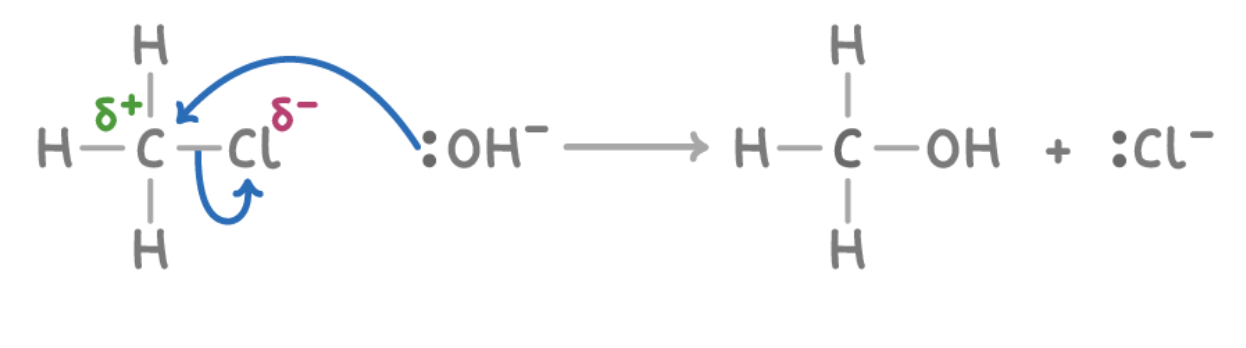
Intermediate in RDS
In some cases the RDS may involve an intermediate that is formed and consumed
Proceeds via a two-step mechanism
Step 1: 2NO ➔ N2O2
Step 2: N2O2 + O2 ➔ 2NO2
Rate = k[NO]2[O2]
RDS must involve 2 NO and 1 O2
1 cannot be RDS as no O2
While 2 doesn’t have NO it has N2O2 which is derived from NO
Step 2 is the RDS
SN1 and SN2
Nucleophilic substitution reactions of halogenoalkanes can proceed via two mechanisms
SN1
Two molecules are involved in RDS
Only secondary and tertiary haloalkanes
SN2
One molecule involved in RDS
Only primary and secondary haloalkanes
SN2
Primary haloalkanes
Consider reaction of iodoethane with hydroxide ions
CH3CH2I + OH- ---> CH3CH2OH + I-
Reaction occurs in single step
Rate equation therefore is k[CH3CH2I][OH-]
Shows that the reaction rate depends on the concentration of both reactants
Indicates that one molecule of each reactant is involved in the RDS
Primary halogenoalkanes favour this mechanism because there is enough space around the carbon atom for nucleophile to approach

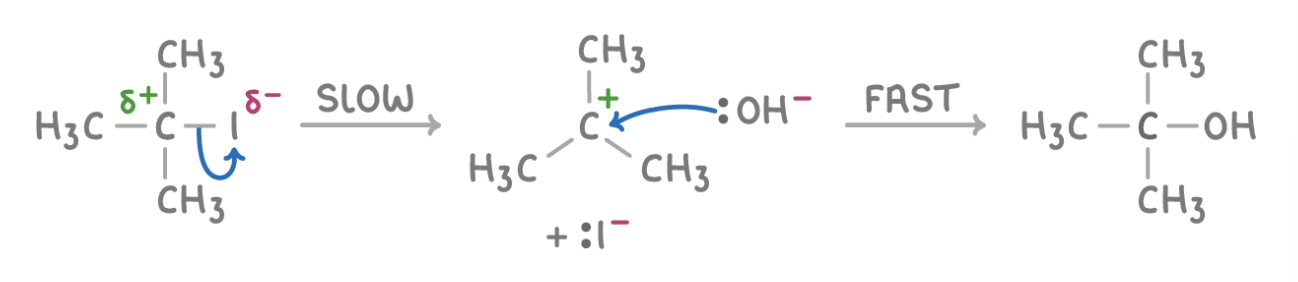
SN1
Tertiary haloalkanes
Favour this mechanism because carbon atom is surrounded by alkyl groups
Make it harder for direct nucleophilic attack
Carbocation intermediate is also stabilised by the surrounding alkyl groups
k[(CH3)3Cl]
Arrhenius equation
Ae (-Ea / RT ) = k
K = rate constant
A = Arrhenius constant
Ea = activation energy (J mol-1)
E = natural logarithm base
R = gas constant (8.31)
T = temperature (K)
Influence of activation energy on reaction rate
Activation energy
Higher Ea, lower rate constant becomes
A high activation energy means fewer reactant molecules have enough KE to react successfully
Therefore higher Ea means slower rate
Influence of temperature on reaction rate
Increase in temperature leads to an exponential increase in rate constant (k)
At higher temperatures, reactant molecules move faster
Results in more frequent collisions
Higher temp provides greater KE for reactant molecules
Higher proportion to exceed activation energy barrier
Both contribute to increased reaction rate when temperature increases
Calculating rate constant using a graph
Ln(k) = -Ea / RT + ln(A)
Y = ln(k)
X = 1/T
Gradient = -Ea / R
Y - intercept = ln(A)