Evolution and Development (Evo-Devo) Practice Problems
 Call Kai
 Learn
 Practice Test
 Spaced Repetition
 Match
 Flashcards
 Knowt Play
1/15

There's no tags or description
Looks like no tags are added yet.
16 Terms
Which of the following is not a feature common to most animals:
A. Development into a fixed body plan
B. Asexual reproduction
C. Specialized tissues
D. Heterotrophic nutrient sourcing
B. Asexual reproduction
During embryonic development, unique cell layers develop into specific groups of tissues or organs during a stage called ________
The organogenesis stage
Which of the following phenotypes would most likely be the result of a Hox gene mutation:
A. Abnormal body length or height
B. Two different eye colors
C. The contraction of a genetic illness
D. Two fewer appendages than normal
D. Two fewer appendages than normal
Which of the following questions could be answered using evo-devo:
a. Did modern human behavior develop in the Homo erectus lineage?
b. Are centipede segments derived from repeats of the same cell line?
c. Is cholera more prevalent in warm climates or cool climates?
d. Does hybridization increase environmental hypoxia tolerance in copepods
b. Are centipede segments derived from repeats of the same cell line?
Prolactin is the hormone responsible for milk secretion in mammals. This hormone, however, is also found in fish (for osmoregulation), reptiles (for molting), and birds (for parental care). Assuming that the ancestors of all these groups likely originally used prolactin for osmoregulation, this represents an example of ________
Exaptation
Which of the following demonstrates allometric growth:
a. Female Strepsitera wasps do not grow wings; instead, their adult form strongly resembles their larval form.
b. Bird feathers are created from the same protein family as reptile scales (keratin) but with different ratios of individual polypeptides (increased ratio of beta-keratin to alpha-keratin).
c. A giraffe’s neck vertebrae grow faster than the rest of their bodies, resulting in extended length.
d. In orchids, the labellum is a specialized flower petal modified to attract pollinators.
c. A giraffe’s neck vertebrae grow faster than the rest of their bodies, resulting in extended length.
Humans are the only mammal that drinks milk as adults. Normally, the lactase gene (which allows for the digestion of lactose, or milk sugar) switches off in adulthood. However, in some human populations, the gene is kept on well into adulthood. What is this an example of?
Heterochromy
T/F: Early developmental stages are more constrained than later developmental stages.
True
Which of the following correctly organizes the ontogeny of embryos:
A. zygote > cleavage > gastrula > blastula
B. zygote > blastula > cleavage > gastrula
C. zygote > blastula > gastrula > cleavage
D. zygote > cleavage > blastula > gastrula
D. zygote > cleavage > blastula > gastrula
Which of the following genes was critical in the development of complex animal body plans:
A. ATP Synthase
B. Sodium-Potassium antitransporter (Na-K Pump)
C. Homebox (Hox)
D. Alcohol dehydrogenase (ADH)
C. Homebox (Hox)
Which of the following questions could be answered using evo-devo:
A. Is cholera more prevalent in warm climates or cool climates?
B. Did modern human behavior develop in the Homo erectus lineage?
C. Are centipede segments derived from repeats of the same cell line?
D. Does hybridization increase environmental hypoxia tolerance in copepods?
C. Are centipede segments derived from repeats of the same cell line?
Which of the following is an example of a developmental constraint? Select ALL that apply.
A. Horse embryos grow through a five-digit stage before reducing down to one functional digit in their juvenile and adult stages.
B. Cells that have not specialized into a final function can divide, but cells that have differentiated into their final function cannot.
C. Human embryos possess gill slits in the neck that develop into the bones and muscles of the head and neck before birth.
D. Cave fishes that are eyeless as adults often have eyes as embryos that get broken down during metamorphosis.
A common feature of animal development is the formation of a gut through gastrulation. Three major groups of animals can be classified by gut development: basal animals (lack a complete digestive tract), protostomes (form the mouth pore first), and deuterostomes (form the mouth pore second). Which would best explain why the earliest divergences in animal groups coincides with the earliest stages of embryology:
A. Early life is more sensitive to disruption than later stages; selection constrains early development more than later development.
B. All life needs to grow through similar life stages to progress; more sophisticated body plans simply continue metamorphosing beyond initial life stages.
A. Early life is more sensitive to disruption than later stages; selection constrains early development more than later development.
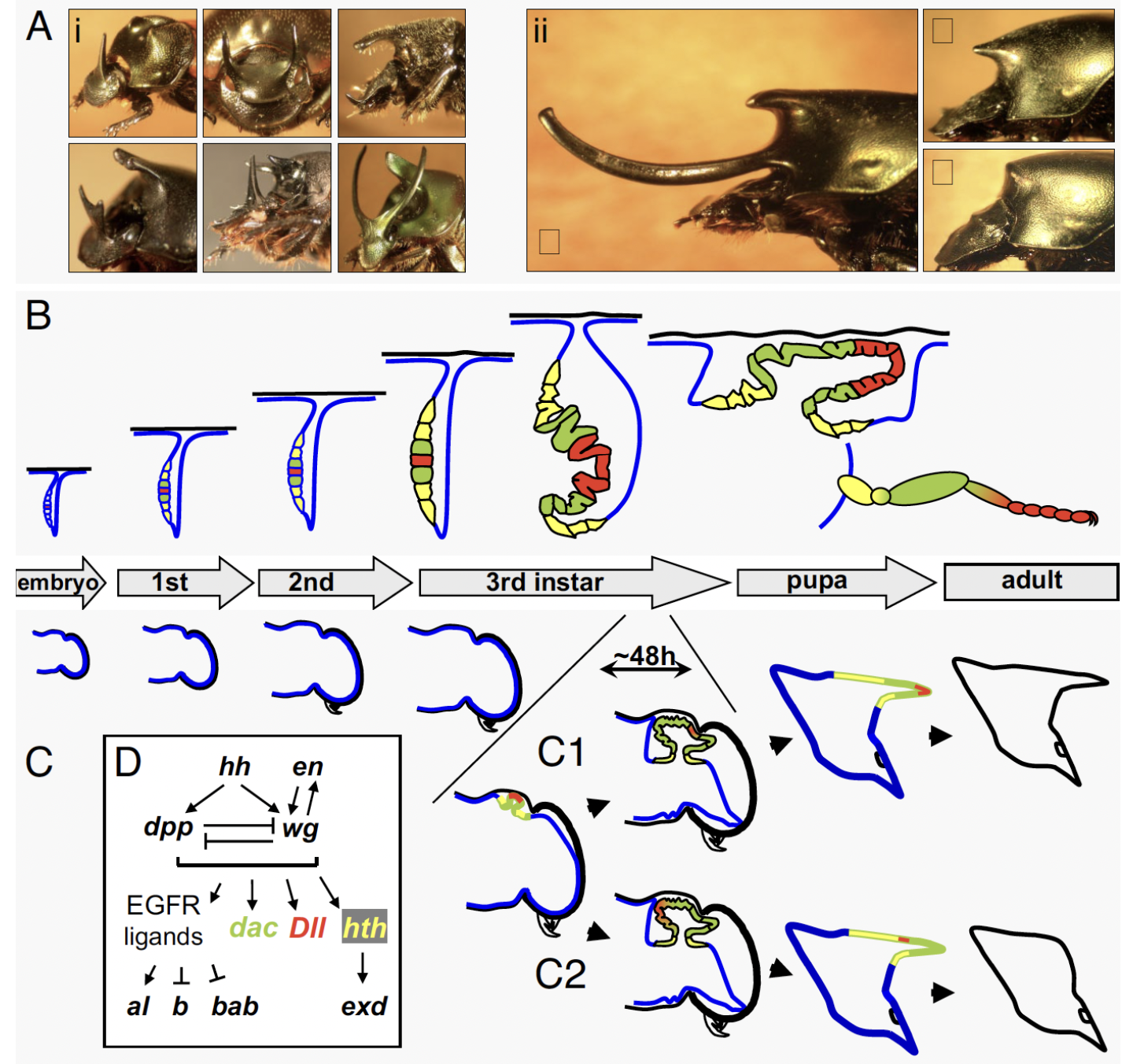
Panel A of the figure above shows a variety of horn phenotypes amongst several species of beetles. Panel B shows the ontogeny of legs in fruit flies, and Panel C shows the ontogeny of the horns. Panel D shows the gene network necessary for horn and limb expression. Three genes were the focus of this study (dac for dachshund, Dll for Distal-less and hth for homothorax). The colors of these three genes in Panel D correspond with their cellular expression in Panels B and C.
1. From the figure above, the three genes of interest (dac, Dll, and hth) control expression rates or protein structure to produce horn phenotypes? How were you able to come to this conclusion?
2. Unlike fruit flies, the horns of beetles only develop in some males (not in females and not in most males). Does this change or reinforce your answer for Q1?
3. What type of diversification mechanism appears to be operating on beetle horns?

4. The morphological results of using RNAi in larvae of male beetles are shown in Panels A, B, D, E, G and H. Do Dll, hth, and dac control thoracic horn development? Explain.
5. Do Dll, hth, and dac control the development of other features? Explain.
6. What do your answers to Q4 and Q5 suggest about the evolutionary history about the Dll, hth, and dac genes? In other words, was horn development their original function? Hypothesize what the original function of these genes were.
7. Looking at the morphological differences between the control and treatment groups, hypothesize whether there would be any fitness consequences for the RNAi treatment.
hth and Dll appear to control thoracic horn development because in the last pair of images in each panel, the comparison of the thoracic horn in the control and RNAi treated organisms is observably different. However, in the dac panel, the thoracic horn appears unchanged in both the control and treatment groups. This suggests that dac may not be an important gene regulator in horn development.
Yes, all three genes have pleiotropic effects. All three of them have visible effects on the antennae, and each gene also has visible effects on at least two other morphological traits (e.g. larval and adult legs for Dll).
No, it does not appear that horn development was their original function, especially since the dac gene doesn’t appear to affect horn development. All three genes are involved with antennae development, and all three genes ensure the proper length and development of other anatomical features. It seems likely, therefore, that the original function either related to antennae specifically or to anatomical growth rate in general.
There are likely to be fitness consequences for the RNAi treatment. On the one hand, the pleiotropic effects of the manipulated genes will likely result in decreased fitness of the adult beetles because other features for survival, such as antennae and legs, also exhibited stunted growth. In other words, the knockout of the three genes will likely decrease the survival, and ultimately the fitness, of beetles with these conditions. On the other hand, it is possible that not developing the features from the knockout will free resources for other features. As this study did not report on other features, however, we can’t really speculate about what might have been. Based solely on the data presented, the most likely scenario is that all of the beetles in the treatments will have decreased fitness.
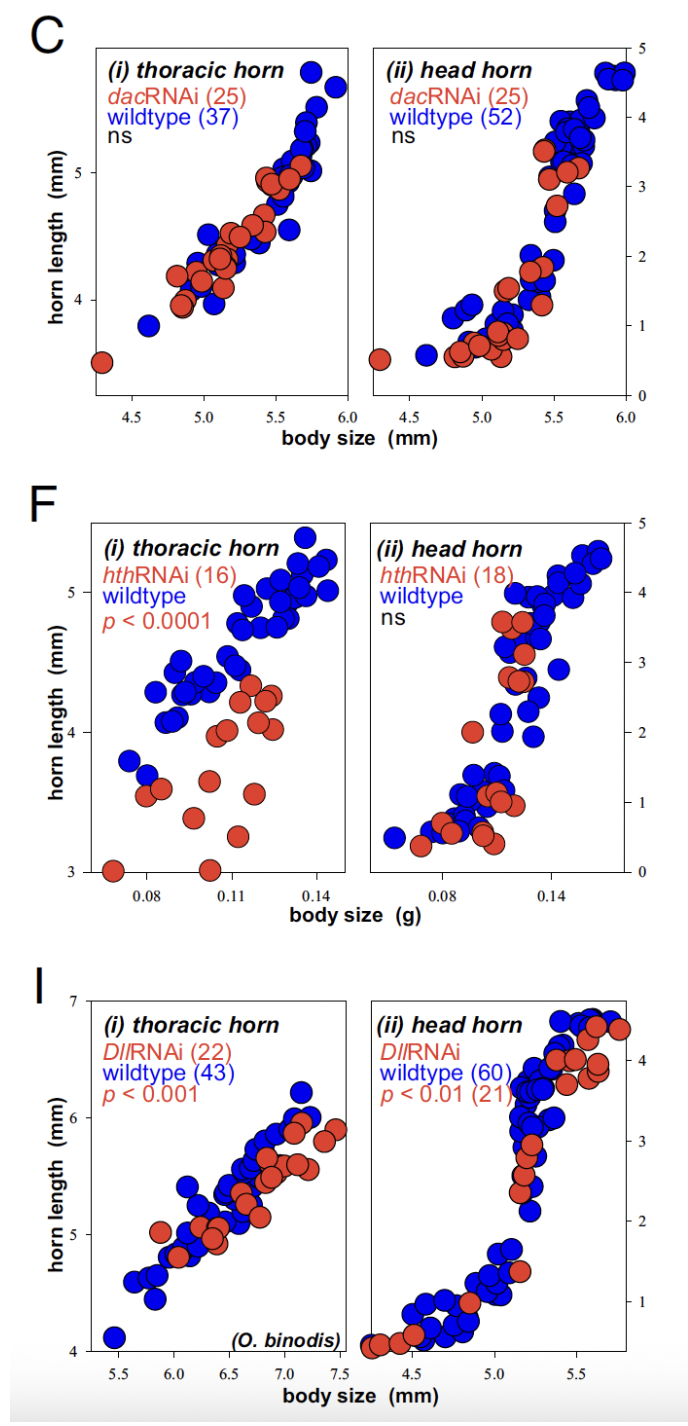
8. To the left are graphs of body size relative to horn length for Dll (Panel I), hth (Panel F), and dac (Panel C) genes. Of these genes, which appears to have had the greatest impact on thoracic horn length? How did you determine your answer?
9. Do the head horns appear to be controlled by these genes? Explain.
10. Notice the sample size differences between the wildtype (in blue) and the RNAi treated (in red) which are written in parentheses in each panel. Did the RNAi treatment have fitness consequences for larvae in the treatment group? Explain.
hth seems to have had the greatest effect on horn length. First, the thoracic horn length between treated and untreated groups was statistically significant, whereas dac was not. Additionally, the red dots (RNAi treated) have very little overlap with the blue dots (control), reinforcing that the gene produced substantial differences in phenotype.
The Dll gene may influence the head horn development because it is the only gene of the three shown that had a significant result.
Yes, it appears that the RNAi treatment did decrease survival. In every treatment, the sample size of the control is greater than the sample size of the RNAi treated. Assuming the researchers started with equal sample sizes before applying the treatment, it means that the RNAi treated beetles were much less likely to survive (so lower fitness), than beetles from the control group.