Ch 7 The Nervous System
 Call Kai
 Learn
Learn Practice Test
 Spaced Repetition
 Match
Match Flashcards
 Knowt Play
1/103

There's no tags or description
Looks like no tags are added yet.
Name | Mastery | Learn | Test | Matching | Spaced | Call with Kai | Chat |
|---|
No analytics yet
Send a link to your students to track their progress
104 Terms
What is the membrane potential?
The charge difference across the cell membrane (inside vs. outside).
In terms of charge, how does the inside of a cell compare to the outside?
More negative (outside is more positive).
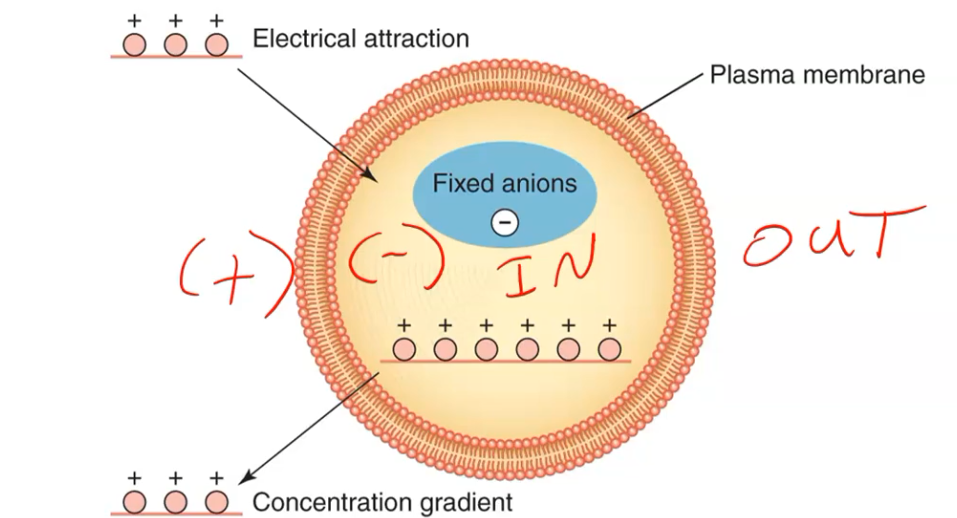
Why learn membrane potential before the nervous system?
Neuron physiology comes down to membrane potential.
What is the resting membrane potential (RMP)?
The membrane potential of a cell that is not producing impulses.
What is the RMP range of most cells, and what value do we use in this class?
The range is −65 to −85 mV. In class we use −70 mV.
What is voltage (V), and what acts as the capacitor in a cell?
Voltage is the charge difference across a capacitor. In a cell, the capacitor is the membrane.
How many mV are in 1 V, and why do we use mV for membranes?
1 V = 1,000 mV. We use mV because the charge differences across cell membranes are very small.
How is the membrane potential measured?
One electrode goes inside the cell and one outside. A voltmeter measures the charge difference between them.

What does a resting membrane potential of −70 mV mean?
The inside of the cell is 70 mV more negative than the outside.
What is the equilibrium potential?
The membrane voltage there would be if only one ion could diffuse.
Which ions are higher outside the cell, and which is higher inside?
Outside: Na⁺, Ca²⁺, Cl⁻
Inside: K⁺

Why can't K⁺ or Na⁺ cross the membrane by simple diffusion?
They're charged, so they need facilitated diffusion through channels. Each channel is specific to one ion.
What's the difference between efflux and influx?
Efflux means exiting the cell. Influx means entering the cell.
Why does K⁺ efflux make the inside of the cell more negative?
K⁺ is positive, so it carries positive charge out with it.
Walk through how the K⁺ equilibrium potential (E_K) is reached.
More K⁺ inside than outside → K⁺ diffuses out through K⁺ channels (facilitated diffusion) → positive charge leaves → inside becomes more negative → K⁺ reaches equilibrium at −90 mV (E_K)
Walk through how the Na⁺ equilibrium potential (E_Na) is reached.
More Na⁺ outside than inside → Na⁺ diffuses in through Na⁺ channels → positive charge enters → inside becomes more positive → Na⁺ reaches equilibrium at +66 mV (E_Na)
What happens to Na⁺ and K⁺ at rest, since some of their channels are always open?
Na⁺ constantly leaks in and K⁺ constantly leaks out.
What keeps the Na⁺ and K⁺ gradients from reaching equilibrium?
The Na⁺/K⁺ pump pumps Na⁺ back out and K⁺ back in. Together with the constant leaking, this helps set the RMP at −70 mV.
How does the Na⁺/K⁺ pump affect the charge inside the cell?
It pumps 3 Na⁺ out for every 2 K⁺ in, so more positive charge leaves than enters. This makes the inside more negative by about −3 mV.
What are fixed anions?
Negatively charged molecules trapped inside the cell that can't cross the membrane, mostly proteins.
How do leak channels make the inside of the cell more negative?
The membrane is more permeable to K⁺ than Na⁺, so K⁺ efflux is greater than Na⁺ influx.
What three factors together produce the RMP of −70 mV?
Fixed anions inside the cell
Leak channels (more permeable to K⁺ than Na⁺)
The Na⁺/K⁺ pump (3 Na⁺ out, 2 K⁺ in)
Which ion contributes more to the RMP, Na⁺ or K⁺, and why?
K⁺. It's more permeable, and E_K (−90 mV) is much closer to −70 mV than E_Na (+66 mV).

What makes up the CNS, and what is its main role?
The brain and spinal cord. It's responsible for integration.
What makes up the PNS?
Nerves: cranial nerves (from the brain) and spinal nerves (from the spinal cord).
What do nerves contain?
Axons.
What are the two cell types in the nervous system?
Neurons, the functional unit of the nervous system.
Glial cells (neuroglia), which support neurons.
Which are more numerous, neurons or glial cells?
Glial cells, about 5x more.
What is the function of neuroglia (glial cells)?
They support neurons and maintain homeostasis in the nervous system.
Which glial cells are in the CNS, and which are in the PNS?
CNS: astrocytes, microglia, ependymal cells, oligodendrocytes
PNS: Schwann cells, satellite cells
What do astrocytes do?
They're the most abundant glia. They support neurons, regulate the extracellular environment, and help form the blood-brain barrier.
What do microglia do?
They're phagocytes that act as the immune defense of the CNS.
What do ependymal cells do?
They line the brain ventricles and spinal cord central canal and help produce and circulate CSF.
What do satellite cells do?
They surround neuron cell bodies in PNS ganglia and support them.
Walk through how neurons gather and transmit information.
Gather information through receptors → respond by producing electrical impulses (action potentials) → transmit to the next cell using chemical messengers (neurotransmitters)
What is the anatomical classification of neurons based on?
The number of processes (nerve fibers) coming out of the cell body.
Name the anatomical neuron types by number of processes.
Pseudounipolar: one process.
Bipolar: two processes.
Multipolar: many processes.

Why is a unipolar neuron called "pseudounipolar"?
Its single process is neither a true dendrite nor a true axon.
What is the functional classification of neurons based on?
The direction the impulse travels relative to the CNS.
What's the difference between sensory and motor neurons?
Sensory: impulse travels toward the CNS.
Motor: impulse travels away from the CNS, toward a target.
What are the targets of somatic vs. autonomic motor neurons?
Somatic: skeletal muscle only.
Autonomic: anything other than skeletal muscle (smooth muscle, cardiac muscle, glands).
What are the two divisions of autonomic motor neurons?
Sympathetic and parasympathetic.
What is the main function of Schwann cells and oligodendrocytes?
They wrap around axons to form the myelin sheath.
Where do Schwann cells and oligodendrocytes myelinate axons?
Schwann cells: PNS.
Oligodendrocytes: CNS.
What is the main function of the myelin sheath?
It increases the speed at which the action potential travels along the axon (conduction velocity).
How does myelin formation differ between Schwann cells and oligodendrocytes?
Schwann cell: the whole cell wraps around the axon, so it makes only one myelin sheath.
Oligodendrocyte: sends out processes, each forming a myelin sheath, so it makes more than one.

What is the action potential?
The nerve impulse. It's a type of membrane potential.
What is excitability?
A neuron's ability to produce action potentials by discharging its membrane potential very quickly.
What is depolarization, and give an example.
The membrane potential becomes more positive. Example: Na⁺ influx through Na⁺ channels.
What is hyperpolarization?
The membrane potential becomes more negative than the RMP.
What two ion movements can cause hyperpolarization?
K⁺ efflux (positive charge leaves)
Cl⁻ influx (negative charge enters)
What is repolarization, and when can it occur?
The membrane potential returns back toward rest. It can only occur after the cell has been depolarized or hyperpolarized.
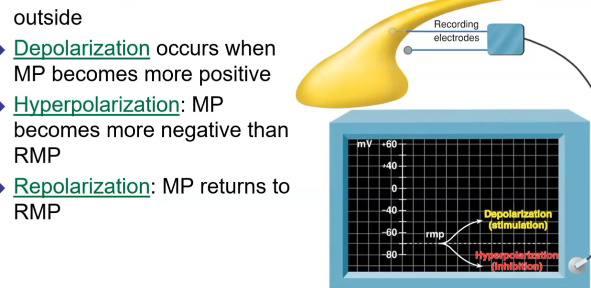
What are all membrane potential changes ultimately caused by?
Ions entering or exiting the cell through channels (facilitated diffusion).
How are ion channels similar to enzymes and substrates?
Each channel is specific to one ion, like a lock and key.
What are leakage channels?
Channels with no gates (or gates that are always open), so ions flow through constantly.
What opens voltage-gated channels?
A change in membrane potential, usually depolarization.
What are the three main voltage-gated channels, and what state are they in at rest (−70 mV)?
Voltage-gated Na⁺, K⁺, and Ca²⁺ channels. All three are closed at rest.
Which voltage-gated channel is the most complex, and why?
The voltage-gated Na⁺ channel, because it has two gates.
Is a "sodium channel" the same as a "voltage-gated sodium channel"?
No. Always say "voltage-gated" when referring to voltage-gated channels.
What are the two gates of the voltage-gated Na⁺ channel, and what state is each in at rest (−70 mV)?
Activation gate: closed
Inactivation gate (the "ball and chain"): open
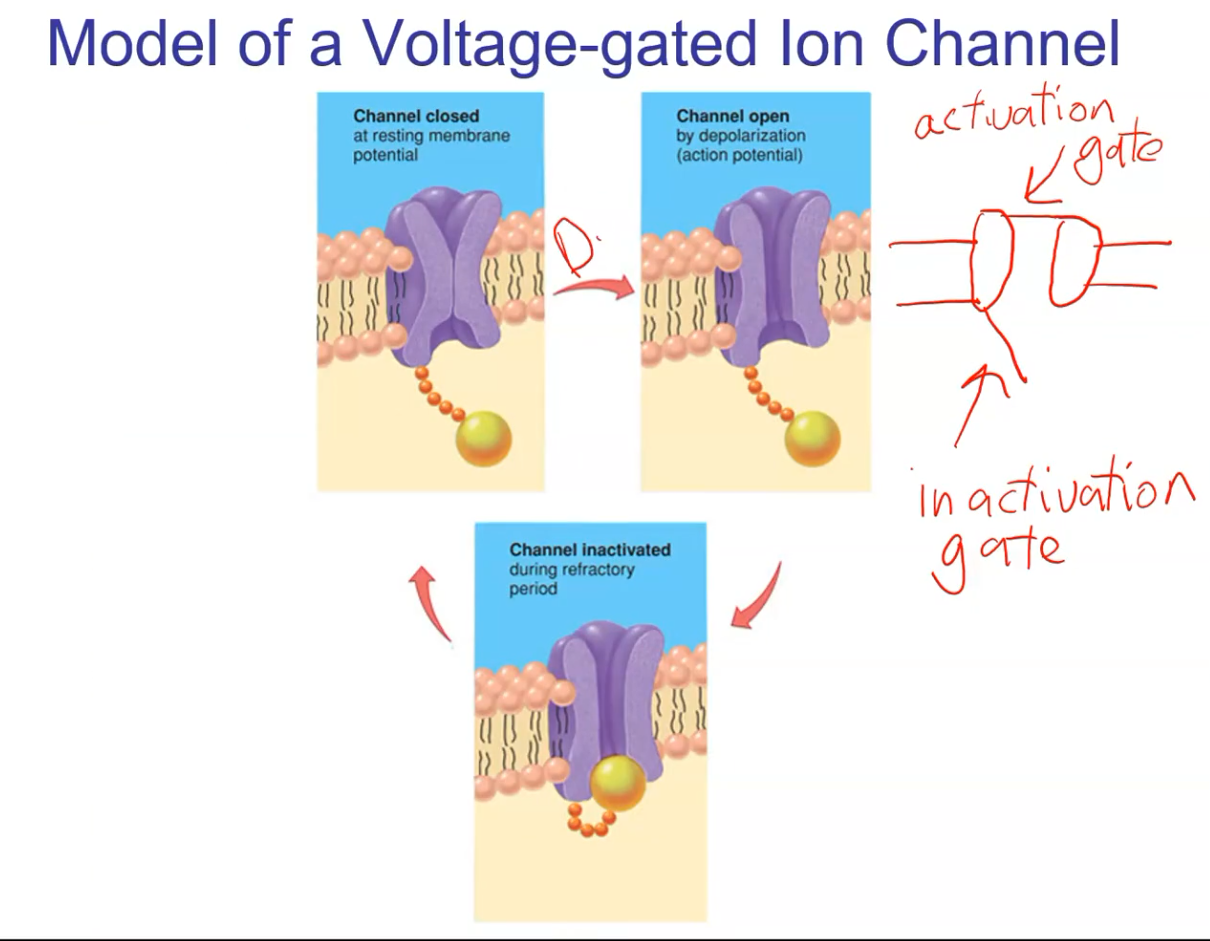
Walk through how the voltage-gated Na⁺ channel opens, starting from rest.
At rest (−70 mV) the activation gate is closed → depolarization brings the membrane to −60 mV → activation gate opens → sudden rush of Na⁺ influx → membrane potential rapidly becomes more positive, up to +30 mV.

Walk through what happens to the voltage-gated Na⁺ channel once the membrane reaches +30 mV.
At +30 mV the inactivation gate closes → no further Na⁺ influx, so +30 mV is the max → the cell can't reset the channel itself; it resets on its own after about 2 ms (timing) → activation gate closes and inactivation gate opens → back to the resting position.
Where does the action potential begin, and where does it travel?
It begins at the axon hillock and travels along the axon to the axon terminal, where the neuron communicates with the postsynaptic cell.
Which two channels does the action potential depend on?
Voltage-gated Na⁺ and voltage-gated K⁺ channels.
Walk through the action potential at one segment of the axon.
At rest (−70 mV) a stimulus opens a Na⁺ channel (not voltage-gated) → Na⁺ influx depolarizes the membrane to −60 mV → voltage-gated Na⁺ activation gate opens → rapid Na⁺ influx → membrane skyrockets to +30 mV → voltage-gated Na⁺ inactivation gate closes and voltage-gated K⁺ channel opens → rapid K⁺ efflux → membrane repolarizes down to −90 mV (E_K) → voltage-gated K⁺ channel closes → Na⁺/K⁺ pump restores gradients → back to −70 mV
Why is the max amplitude of the action potential +30 mV?
At +30 mV the voltage-gated Na⁺ inactivation gate closes, stopping further Na⁺ influx.
Why does the membrane drop all the way to −90 mV during an action potential?
The voltage-gated K⁺ channel has no inactivation gate. It stays open until K⁺ reaches equilibrium (E_K = −90 mV).
What brings the membrane from −90 mV back to −70 mV?
The Na⁺/K⁺ pump, by restoring the Na⁺ and K⁺ gradients.
If the Na⁺/K⁺ pump is always on, why doesn't it prevent the action potential?
The rapid Na⁺ influx and K⁺ efflux through voltage-gated channels overpower the pump. Its effect is only seen once both voltage-gated channels close.
What is the all-or-none principle?
An action potential either occurs or it doesn't. If the membrane reaches −60 mV, it fires. If not, no action potential.
Using the fly vs. big bug example, explain the all-or-none principle.
A fly is too light to depolarize touch receptors to −60 mV, so no action potential fires and it goes unnoticed. A big bug is heavy enough to reach −60 mV, so an action potential fires.
Does a stronger stimulus produce a bigger action potential? Why or why not?
No. All action potentials max out at +30 mV, because the voltage-gated Na⁺ inactivation gate always closes at +30 mV, regardless of stimulus strength.
If action potential amplitude never changes, how is stimulus intensity coded?
By the frequency of action potentials per second. A stronger stimulus produces more action potentials per second.
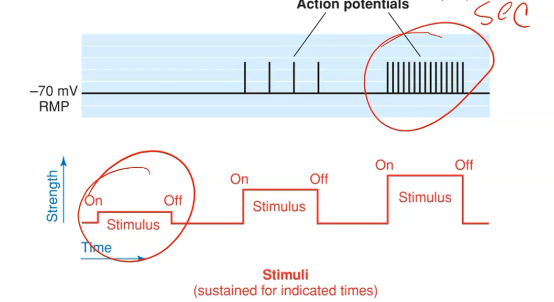
What unit measures action potential frequency, and what does it mean?
Hertz (Hz), the number of action potentials per second (e.g., 10 Hz = 10 APs/sec).
What is the "language" of the nervous system, and what tells the brain how strong a stimulus is?
The action potential is the language. Its frequency tells the brain the stimulus strength.
What is the refractory period?
The time when another action potential can't occur in the same segment of the axon, even if another depolarizing event happens.

What causes the refractory period?
The voltage-gated Na⁺ inactivation gate is closed. No Na⁺ can enter until the channel resets itself after a few milliseconds.

What is axon conduction?
The action potential traveling along the axon, from the axon hillock to the axon terminal.

Walk through how an action potential propagates along an unmyelinated axon.
Action potential at segment 1 opens voltage-gated Na⁺ channels → Na⁺ enters and spreads both backward (toward the cell body) and forward → forward Na⁺ depolarizes segment 2 to −60 mV → voltage-gated Na⁺ channels open in segment 2 → action potential at segment 2 → Na⁺ spreads back to segment 1, but it's in refractory period, so nothing happens → Na⁺ spreads forward to segment 3 → cycle repeats until the axon terminal.
Why does the action potential only travel forward and not backward?
The previous segment is in its refractory period (voltage-gated Na⁺ inactivation gate closed), so Na⁺ spreading backward can't trigger another action potential there.
What does it mean that the action potential is "self-propagating"?
Once it starts at segment 1, it triggers itself from one segment to the next until it reaches the axon terminal.
What is the action potential threshold, and why?
−60 mV, because that's the threshold for opening the voltage-gated Na⁺ channel, which starts the action potential.
Why can only axons generate and conduct action potentials, and not dendrites or cell bodies?
Only axons have both voltage-gated Na⁺ and voltage-gated K⁺ channels.
What two factors affect how fast an action potential travels along an axon?
Axon diameter (size).
Myelination.
How does axon diameter affect conduction speed, and what diameter do human axons have?
Larger diameter means faster conduction. Humans have small-diameter axons because there isn't enough space in the body for large ones.
What are the nodes of Ranvier?
Bare (unmyelinated) areas of the axon between myelin sheaths.
Why can't action potentials occur under the myelin sheath?
Myelinated areas have no voltage-gated Na⁺ or K⁺ channels.


Walk through saltatory conduction.
Voltage-gated Na⁺ channels open at a node → Na⁺ enters and spreads forward under the myelin → no action potential under the myelin (no voltage-gated channels) → Na⁺ reaches the next node and depolarizes it to threshold → action potential fires at that node → it "jumps" node to node, skipping myelinated areas → reaches the axon terminal faster
End of video 1 Ch. 7 Congrats!
Remaining Flashcards are video 2 of Ch7