OChem Test 4

0.0(0)
Studied by 0 people
call kaiCall Kai
learnLearn
examPractice Test
spaced repetitionSpaced Repetition
heart puzzleMatch
flashcardsFlashcards
GameKnowt Play
Card Sorting

1/10

flashcard set

Earn XP

Description and Tags

UGUGHHHHHHHHHHHHHHHH

11 Terms

1
New cards
<p>+ HX (X = Cl, Br, I)</p>

+ HX (X = Cl, Br, I)

Hydrohalogenation

Follows Markovnikov Addition
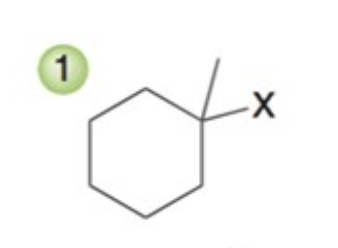
<p><strong>Hydrohalogenation</strong></p><p>Follows <u>Markovnikov</u> Addition</p>
2
New cards
<p>+ HBr, ROOR (peroxide) </p>

+ HBr, ROOR (peroxide)

Anti-Markovnikov Addition

Follows anti-Markovnikov addition (duh)

Is prone to rearrangement

If a chiral center is formed, we get a racemic mixture

<p><strong>Anti-Markovnikov Addition</strong></p><p>Follows <u>anti-Markovnikov</u> addition (duh)</p><p>Is prone to rearrangement</p><p>If a chiral center is formed, we get a racemic mixture</p>
3
New cards
<p>+ H<sub>3</sub>O<sup>+</sup></p>

+ H3O+

Acid-Catalyzed Hydration

Follows Markovnikov addition

If a chiral center is formed, we get a racemic mixture

This reactants and products are in equilibrium here and can be controlled
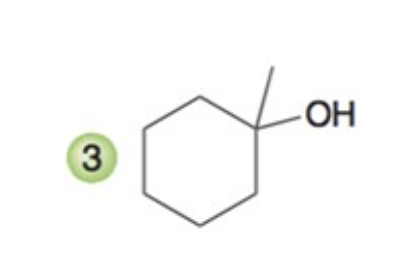
<p><strong>Acid-Catalyzed Hydration</strong></p><p>Follows <u>Markovnikov</u> addition</p><p>If a chiral center is formed, we get a racemic mixture</p><p>This reactants and products are in equilibrium here and can be controlled</p>
4
New cards
<p>+ 1.) Hg(OAc)<sub>2</sub>, H<sub>2</sub>O</p><p>2.) NaBH<sub>4</sub></p>

+ 1.) Hg(OAc)2, H2O

2.) NaBH4

Oxymercuration-Demurcuration

Follows Markovnikov addition

NO REARRANGEMENTS

Forms a mercurinium ion intermediate (triangle-looking bond)

<p><strong>Oxymercuration-Demurcuration</strong></p><p>Follows <u>Markovnikov</u> addition</p><p>NO REARRANGEMENTS</p><p>Forms a mercurinium ion intermediate (triangle-looking bond)</p>
5
New cards
<p>+ 1.) BH<sub>3</sub> THF</p><p>2.) H<sub>2</sub>O<sub>2</sub>, NaOH</p>

+ 1.) BH3 THF

2.) H2O2, NaOH

Hydroboration-Oxidation

Adds H and OH with anti-Markovnikov addition in a SYN fashion

If a chiral center is formed, a pair of enantiomers is formed by addition to either face of the alkene

<p><strong>Hydroboration-Oxidation</strong></p><p>Adds H and OH with a<u>nti-Markovnikov </u>addition in a <u>SYN</u> fashion</p><p>If a chiral center is formed, a pair of enantiomers is formed by addition to either face of the alkene</p>
6
New cards
<p>+ H<sub>2</sub>, Pt</p>

+ H2, Pt

Catalytic Hydrogenation

The addition of H2 across an alkene

Only SYN addition is observed

<p><strong>Catalytic</strong> <strong>Hydrogenation</strong> </p><p>The addition of H<sub>2 </sub>across an alkene </p><p>Only SYN addition is observed </p>
7
New cards
<p>+ Br<sub>2</sub></p>

+ Br2

Halogenation

The addition of two halogen atoms across an alkene

Only ANTI addition is observed

Forms a bromonium ion intermediate (triangle bond)

This is stereospecific, and the starting alkene determines the stereochem of the products

<p><strong>Halogenation</strong></p><p>The addition of two halogen atoms across an alkene</p><p>Only ANTI addition is observed</p><p>Forms a bromonium ion intermediate (triangle bond)</p><p>This is stereospecific, and the starting alkene determines the stereochem of the products</p>
8
New cards
<p>+ Br<sub>2</sub>, H<sub>2</sub>O</p>

+ Br2, H2O

Halohydrin Formation

Formed when halogenation is conducted in water, water acts as nucleophile that attacks the bromonium ion

The halide adds to the LESS SUBSTITUTED CARBON

The OH adds to the MORE SUBSTITUTED CARBON
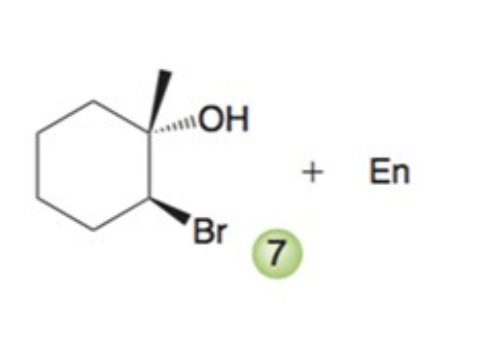
<p><strong>Halohydrin Formation</strong></p><p>Formed when halogenation is conducted in water, water acts as nucleophile that attacks the bromonium ion</p><p>The halide adds to the LESS SUBSTITUTED CARBON</p><p>The OH adds to the MORE SUBSTITUTED CARBON</p>
9
New cards
<p>+ 1.) RCO<sub>3</sub>H</p><p>2.) H<sub>3</sub>O<sup>+</sup></p>

+ 1.) RCO3H

2.) H3O+

Anti Dihydroxylation

A two step procedure where the peroxyacid (RCO3H) is the reagent and forms an epoxide (triangle bond), resulting in an ANTI product

<p><strong>Anti Dihydroxylation </strong></p><p>A two step procedure where the peroxyacid (RCO<sub>3</sub>H) is the reagent and forms an epoxide (triangle bond), resulting in an <u>ANTI</u> product </p>
10
New cards
<p>+ KMnO<sub>4</sub>, cold NaOH</p><p>OR </p><p>+ 1.) OsO<sub>4</sub></p><p>2.) NaHSO<sub>3</sub>, H<sub>2</sub>O</p>

+ KMnO4, cold NaOH

OR

+ 1.) OsO4

2.) NaHSO3, H2O

Syn Dihydroxylation

Adds OH and OH across the alkene in a concerted, SYN fashion

<p><strong>Syn Dihydroxylation </strong></p><p>Adds OH and OH across the alkene in a concerted, SYN fashion </p>
11
New cards
<p>+ 1.) O<sub>3</sub></p><p>2.) DMS</p>

+ 1.) O3

2.) DMS

Ozonolysis/Oxidative Cleavage

A one step process where alkenes are ‘cut’ in half

<p><strong>Ozonolysis/Oxidative Cleavage </strong></p><p>A one step process where alkenes are ‘cut’ in half </p>



