Hardy Weinberg Equations
 Call Kai
 Learn
Learn Practice Test
 Spaced Repetition
 Match
Match Flashcards
 Knowt Play
1/78

There's no tags or description
Looks like no tags are added yet.
Name | Mastery | Learn | Test | Matching | Spaced | Call with Kai | Chat |
|---|
No analytics yet
Send a link to your students to track their progress
79 Terms
population genetics
study of genetic variation within populations and the causes and consequences of this variation
evolution
change in allele and genotype frequencies over time
allele
one variant of a gene- Y or y
monomorphic
1 allele - no variation
mendel’s traits
2 alleles
polymorphic
more than 1 allele
polymorphism
a polymorphic gene has more than 1 allele
genotype
the genetic state/composition of an individual- YY or yy
genotype frequency
#of individuals with given genotype / total # of individuals in the population
example of genotype frequency
Gaa = NAA/NAA +NAa+ Na
how to calculate allele frequencies with genotype counts
take the individual genotypes apart into their alleles
AA has twice the amount plus the amount from Aa
total # of alleles
2 times total # genotypes= 2N
p
freq of A allele
q
freq of a allele
genotype count
exact tally of individuals.- you sample 100 plants and find that 25 are AA, 50 are Aa, and 25 are aa, your genotype counts are 25, 50, and 25
p + q
allele frequencies
f(A) = f(AA) + ½ f(Aa)
f(A)= allele frequency
f(AA)= frequency of AA genotype (homo)
f(Aa)= frequency of Aa genotype
hardy weinberg equilibrium
p2+2pq+ q2= 1
p2
f(AA)
q2
f(aa)
heterozyous f(Aa)
2 x (p x q)
Uses of HWE
describes the expected genotype frequencies resulting from random mating among gametes
provides mathematical model for evaluating evidence for evolutionary change
What type of model is HWE
Null- need non changing population
Certain assumptions needed to be met for HWE
no mutation
no migration
no selection
random mating
large population size (no drift)
chi square test
a statistical method used to compare observed data with data you would expect to get by chance, specifically for categorical data (counts or frequencies).
chi square equation
sum of all (O - E)^2 \ (div E):
when to reject statistical null
x2 > 0.05
when to accept statistical null
x2 < 0.05
the higher the x2 value
the lower the p value
p value < 0.05
statistically significant
reject null hypothesis
signs of evolution
not in HWE
p value > 0.05
due to chance
fail to reject null
no signs of evolution
in HWE
evolution in an equation
change in allele frequency over generations
mutation
changes in nucleotide sequence of dna
causes of mutation
dna damage
dna replication errors
consequences of mutations
not all contribute to evolutionary change
random
have a bad effect
types of mutations
large scale
small scale
Large-Scale (Chromosomal) Mutations
Deletion:
Duplication:
Inversion:
Translocation:
Small Scale Mutations
Substitution (Point Mutation): .
Silent Mutation:
Missense Mutation:
Nonsense Mutation:
Insertion and Deletion (Indels):
Frameshift Mutation
definition of small scale
These affect single nucleotides or small segments of a gene
definition of large scale
These alter large segments of a chromosome or the total number of chromosomes
mutation rate
μ
the fraction of alleles that mutate from one allele into another each generation
q’ = q + μp
new frequency of a = old frequency of a + new a alleles created by mutation
new a from mutation
μp
mutations are happening to the A alleles and there are p of those
mutation selection balance
mutation adds an allele
selection removes it
BALANCE- hence q= square root of μ
equilibrium frequency
q = square root of μ
what happens to q at equilibrium
delta q = 0
genetic drift
changes in allele frequencies due to random sampling effects between generations
where is drift strongest
SMALL POPULATIONS
bigger influence on the population if 5 out of 10 is affected then 5 out of 100
strength of drift
1 / 2N
n= population size
WITHIN POP- RGD () genetic variation
decreases
causes alleles to become lost or fixed
AMONG POPS- RGD () genetic variation
increases
each population can change in diff direction
RGD () inbreeding
increases
as drift removes alleles individuals become genetically similar
more sim are more like to mate
increases homozygosity
three situations of genetic drift
bottleneck
founder
continuously small populations
bottle neck
populations suddenly becomes very small
founder effect
few individuals start new population
continuously small populations
if pop stays small for many gen
drift stays strong
variation keeps decreasing
inbreeding increases
migration
movement of alleles or genotypes in and out of population
migration can be known as
gene flow
mirgation does what to allele frequencies
changes them
introduces outside alleles
make populations more similar
migration rate
m = # of migrants / total population size after migration
migration equation
delta p = m(p2-p1)
p1= frequency of allele A in original population
p2= frequency of allele A in migrant popuation
m= fraction of recipient population that is made up of migrants
natural selection
changes in allele frequencies due to differential survival and/or reproduction
types of ns
disruptive
directional
stablizing
distruptive selection
Favors both extreme phenotypes while selecting against intermediate or average forms.
Splits the peak of the trait distribution into two distinct peaks, potentially driving speciation or polymorphism
Stabilizing Selection
Favors intermediate phenotypes and selects against extreme variations
Narrows the bell curve and reduces overall genetic/phenotypic variance
Directional Selection
Favors individuals at one extreme of a phenotypic range, causing the population's trait distribution to shift in that single direction
Changes the average (mean) value of the trait over time
sexual selection
form of natural selection that occurs when there is competition for mating and or fertlization opportunity
sexual dimorphism
males and females of the same species look different
male vs female reproductive success
male- can i attract/ can i get mates
female- need resources to produce and care for offspring- HAVE LESS VARIATION IN REPRODUCTIVE SUCCESS
two types of sexual selection
intra
inter
intrasexual selection
within the same sex- competition
intersexual selection
between the sexes
primary sexual traits
needed for reproductive physiology, gametes, reproductive development
SEXUAL SELECTION DOES NOT ACT ON
secondary sexual traits
not essential for reproduction
not involved in gametes
competiton
SEXUAL SELECTION ACTS ON THIS
fitness
the relative likilhood that one genotype will contribute to the gene pool of the next generation compared with other genotypes
QUANTITATIVE MEASURE
relative fitness
absolute fitness / mean fitness population
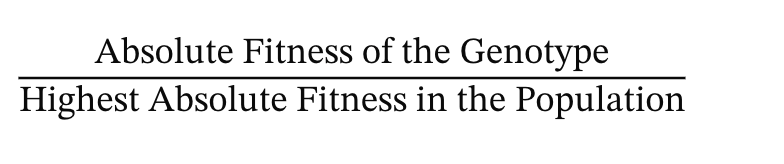
mean absolute fitness of population
f(AA)WAA + f(Aa)WAa+ f(aa)Waa
W equals
the absolute fitness- highest amount of offspring
everything else is divided by the largest number
process of allele frequency after selection
p0 and q0
HW
muliptly by fitness + calculate mean fitness
W with bar over
f1(AA), f1(Aa), f1(aa)
calculate new allele frequency
p1
compare old vs new
delta p = p1-p0