2024 AnaC BE
 Call Kai
 Learn
 Practice Test
 Spaced Repetition
 Match
 Flashcards
 Knowt Play
1/98

There's no tags or description
Looks like no tags are added yet.
99 Terms
D
An extensive property depends on the amount of matter present. The number of moles directly depends on mass/amount of substance. Options A, B, and C are intensive properties, which depend solely on the identity of the substance rather than the quantity
1. Which of the following is an extensive property of matter?
A. Density
B. Viscosity
C. Freezing point
D. Number of moles
D
Conductors allow the flow of electrical current. Metals conduct electricity via free-moving electrons, while electrolyte solutions conduct via free-moving ions. Options A, B, and C do not define this electrical transport property.
Metals and solutions of electrolytes are
A. Insulators
B. Polar
C. Negative
D. Conductors
A
Sublimation is the phase transition directly from solid to gas without passing through a liquid phase. Solid naphthalene or p-dichlorobenzene in mothballs sublimes into the surrounding air. Options B and C are incorrect as no liquid intermediate forms and no chemical reaction is required.
Mothballs are used as deodorizers and as pesticides. Upon exposing them in the air for a few hours, they disappeared. Which of the following best explains the scenario?
A. The mothballs underwent sublimation.
B. The mothballs underwent melting then vaporization.
C. The mothballs reacted with some component in the air.
D. None of the above.
D
Pure substances (elements and compounds) consist of a single chemical entity and cannot be separated into simpler substances by physical means. Options A, B, and C are mixtures, which can be physically separated into their constituent parts
Which of the following is described as having components that CANNOT be physically separated?
A. Mixture
B. Solution
C. Suspension
D. Pure substance
B
Carbon has an atomic number (Z) of 6, meaning 6 protons. The mass number (A) of Carbon-12 is 12, so the number of neutrons is 12 - 6 = 6. Options A, C, and D state incorrect counts of subatomic particles.
Which of the following is TRUE for C-12 isotope?
A. It has 6 neutrons and 7 protons.
B. It has 6 protons and 6 neutrons.
C. It has 6 neutrons and 12 protons.
D. It has 6 protons and 12 neutrons.
A
A hypothesis is a testable, tentative explanation for an observation or scientific problem. A procedure (B) is the set of experimental steps, a conclusion (C) is the final summary, and data (D) are recorded observations.
A prediction or a possible explanation to the question or problem which can be tested in an experiment is called
A. Hypothesis
B. Procedure
C. Conclusion
D. Data
B
Leading zeros are not significant. The first significant digit is 5. Taking four significant figures gives 0.051065, where the 5th digit (5) rounds the 4th digit (6) up to 7, resulting in 0.05107. Options A, C, and D have incorrect precision or rounding.
Express the number 0.051065 to four significant figures.
A. 0.051
B. 0.05107
C. 0.05106
D. 0.0511
D
Accuracy refers to how close measurements are to the true/accepted value (20.5 mL). Set D has an average of 20.275 mL, which is closest to 20.5 mL compared to the others
The volume of a liquid is 20.5 mL. Which of the following sets of measurement represents the value with good accuracy.
A. 19.2 mL, 19.3 mL, 18.8 mL, 18.6 mL
B. 18.9 mL, 19.0 mL, 19.2 mL, 18.8 mL
C. 18.6 mL, 17.8 mL, 19.6 mL, 17.2 mL
D. 20.2 mL, 20.5 mL, 20.3 mL, 20.1 mL
A
Chlorine is a Group 17 halogen with 7 valence electrons. Krypton, Helium, and Argon belong to Group 18 (noble gases) with stable, full electron shells.
Noble gases are inert because they have completed outer electron shells. Which of these elements is NOT a noble gas?
A. Chlorine
B. Krypton
C. Helium
D. Argon
D
What is the most common isotope of Hydrogen?
A. Hydrogen only has one isotope.
B. Deuterium
C. Tritium
D. Protium
C
Across a period from left to right, effective nuclear charge increases, causing electronegativity to increase. Atomic radius decreases (making A wrong) and ionization energy increases (making B wrong).
From left to right in a periodic table
A. Atomic radius increases
B. Ionization energy decreases
C. Electronegativity increases
D. None of the above

B
The balanced reaction is 4Ag+O2→2Ag2O. Balancing yields 4 Ag atoms and 2 O atoms on both sides. Options A, C, and D fail to balance oxygen or violate chemical notation rules.
Balance the following equation: Ag + O2 —→ Ag2O

A
Hg2Cl2 contains the dimeric mercury(I) cation (Hg22+), giving mercury an oxidation state of +1. Mercury (II) chloride corresponds to HgCl2.
Which is NOT an acceptable name for Hg2Cl2
A. Mercury (II) chloride
B. Mercury (I) chloride
C. Mercurous chloride
D. Dimercury dichloride
C
Nonpolar bonds feature equal or near-equal sharing of electrons, resulting in no net dipole moment. Having a dipole moment is a characteristic feature of polar bonds
Which of the following does NOT describe a nonpolar bond?
A. It is a bond between similar nonmetals.
B. It is a bond between different nonmetals.
C. It has a dipole moment.
D. All describe a nonpolar bond.

D
Using standard prefixes, "di-" means 2 phosphorus atoms (P2) and "mono-" means 1 bromine atom (Br), yielding P2Br. Options A, B, and C have incorrect stoichometric ratios
What is the chemical formula of diphosphorus monobromide?
A. PBr2
B. PBr
C. P2Br2
D. P2Br
D
Lewis theory defines an acid as an electron pair acceptor and a base as an electron pair donor. Option A defines a Lewis base, while B and C define Brønsted-Lowry bases and acids, respectively
Under the Lewis concept of acid and bases, an acid is
A. An electron pair donor
B. A proton acceptor
C. A proton donor
D. An electron pair acceptor

A
Milk of magnesia is a suspension of magnesium hydroxide (Mg(OH)2), which is basic/alkaline (pH≈10.5). Options B, C, and D are acidic solutions containing organic acids or hydrochloric acid
Which of the following is NOT an acid?
A. Milk of magnesia
B. Apple juice
C. Milk
D. Gastric juice

B
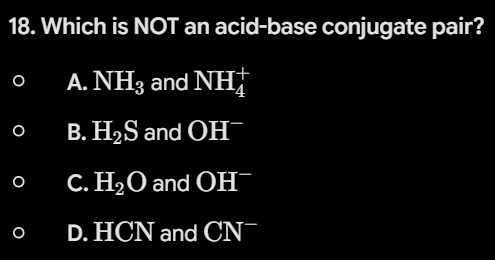
Which is NOT an acid-base conjugate pair?

A
When ammonium chloride (NH4Cl) hydrolyzes, the resulting solution is.
A. Acidic
B. Basic
C. Neutral
D. None of the choices.

A
Which of the following is the correct composition of aqua regia?


B
Sodium carbonate is also known as?
A. Baking soda
B. Soda ash
C. Caustic potash
D. Caustic soda

D
The standard pressure of the atmosphere at sea level is
A. 1 atm
B. 760 mmHg
C. 760 torr
D. All of the above
C
Helium is a monatomic noble gas with extremely weak intermolecular forces and a tiny atomic volume, behaving most like an ideal gas
Which of the following is the closest to being an ideal gas?
A. Oxygen
B. Nitrogen
C. Helium
D. Hydrogen

A
What happens to the volume of a fully inflated balloon when it is taken outside on a cold day?
A. Its volume decreases
B. Its volume increases
C. It remains the same
D. Its volume becomes equal to zero

D
What is the molar mass of an unknown gas if 1.60 grams of that gas occupies a volume of 2.24 L at STP?
A. 35.8 g/mol
B. 160 g/mol
C. 16.0 g/mol
D. 81.0 g/mol

D
What is the molarity of a solution containing 72.9 grams of HCl in enough water to make 500 mL of solution?
A. 2.0 g/mol
B. 4.05 g/L
C. 5.0 mol/L
D. 4.05 mol/L

C
The number 2.34 x 10^7 is the scientific notation for
A. 234000
B. 23400
C. 23400000
D. 2340000

C
When Chromium changes from an oxidation state of +3 to +6, Cr3+ or Cr(III) must
A. Gain 6 electrons
B. Lose 6 electrons
C. Lose 3 electrons
D. Gain 3 electrons


C
During the electroplating of silver, silver ions in solution
A. are oxidized at the anode
B. are oxidized at the cathode
C. are reduced at the cathode
D. remain in solution uncharged
A
Oxidation occurs at the anode in both galvanic and electrolytic cells.
In an electrolytic cell, oxidation occurs
A. at the anode
B. between the cathode and the anode
C. at either the cathode or the anode
D. at the cathode

C
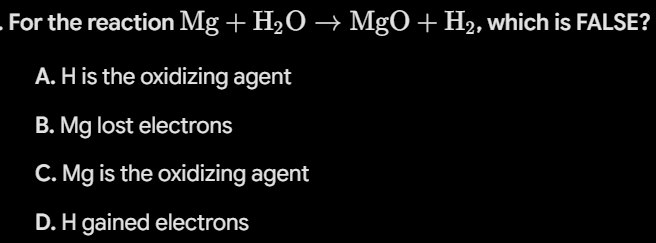
For the reaction Mg+H2O→MgO+H2, which is FALSE?
A. H is the oxidizing agent
B. Mg lost electrons
C. Mg is the oxidizing agent
D. H gained electrons

C
For the reaction Mg+H2O→MgO+H2, which is FALSE? (Repeated question in source document)
A. H is the oxidizing agent
B. Mg lost electrons
C. Mg is the oxidizing agent
D. H gained electrons


A
Which is also equivalent to 0.01% percent by weight?
A. 100 ppm
B. 10 ppt
C. 1 ppt
D. 1 ppb

B
What volume of 4M HCl is needed to prepare 1L of a 0.5 M dilute solution?
A. 0.0125 L
B. 0.125 L
C. 0.0875 L
D. 0.875 L

D
The water content of an 875.4-mg sample of cheese was determined with a moisture analyzer. What is the %w/w H2O in the cheese if the final mass was found to be 545.8 mg?
A. 35.23%
B. 30.69%
C. 31.45%
D. 37.65%


A
Determine the actual volume contained in a 50.0 mL volumetric flask given the following data: Mass of water 50.1227 g, density of water at 25°C 0.99707 g/mL.
A. 50.27 mL
B. 50.37 mL
C. 50.17 mL
D. 50.45 mL

D
What is the normality of a 5.0 M sulfuric acid?
A. 2.5 N
B. 5.0 N
C. 7.5 N
D. 10.0 N
C
Potassium hydrogen phthalate (KHP) is high purity, stable, non-hygroscopic, and widely used as a primary standard acid. Options A and B are liquid acids of variable purity/concentration.
Which of the following is a primary standard for use in standardizing bases?
A. Acetic acid
B. Sulfuric acid
C. Potassium hydrogen phthalate
D. Ammonium hydroxide

C
The maximum holding time for acid preserved samples that will be subjected to determination of metals is
A. 48 hours
B. 3 months
C. 6 months
D. 1 week
A
Glass containers can leach trace elements (such as boron, sodium, silica, or metals) into the sample, interfering with inorganic trace analysis
Glass container is not suitable for
A. inorganic trace analyses
B. oil and greases determination
C. microbiological analyses
D. All of the above
A
ISO/IEC 17025 specifies requirements for the competence, impartiality, and consistent operation of testing and calibration laboratories.
It specifies the competence, impartiality, and consistent operation of labs.
ISO 9000 focuses on general quality management, not specific lab technical competence.
AOAC and EURACHEM provide guidelines and methods but are not accreditation standards.
41. What is the main ISO Standard used by testing and calibration laboratories to gain accreditation and formal recognition of their competence to carry out tests and/or calibrations, including sampling?
A. ISO/IEC 17025
B. EURACHEM
C. AOAC
D. ISO 9000:2000
D
Hazardous waste labeling mandates complete details, including generator information, waste characteristics/volume, and packaging specification.
According to Revised DAO 04-36, the appropriate waste labels shall include
A. Generator ID Number
B. Volume of Waste
C. Container Material
D. All of the above
C
A 10 mL graduated pipet or burette offers high accuracy for fractional volumetric delivery around 8–9 mL. Beakers and large graduated cylinders provide low accuracy
Which of the following is the most accurate apparatus in measuring 8.55 mL of liquid?
A. 1 mL graduated cylinder
B. 100 mL graduated cylinder
C. 10 mL pipet
D. 50 mL beaker
D
Always add acid to water ("AAA"). Adding water to concentrated acid can cause severe heat generation, violent splashing, and exothermic boiling.
Which of the following is NOT a proper laboratory practice?
A. Wearing of masks and gloves
B. Drying of glassware after washing
C. Tying or braiding long hairs
D. Adding water to strong acid
A
Hexane dissolves many types of plastics. Glass bottles provide chemical inertness and prevent leaching or degradation
Which of the following is the most appropriate container for hexane?
A. glass bottle
B. amber bottle
C. plastic bottle
D. none of these
D
Method Detection Limit (MDL) is defined as the minimum concentration of a substance that can be measured and reported with 99% confidence that the analyte concentration is greater than zero
Minimum concentration of a substance that can be measured and reported with confidence that the analyte concentration is greater than zero refers to _
A. Lower Warning Limit
B. Method Detection Limit
C. Control Limit
D. Limit of Quantitation
D
The three essential components required to sustain a fire are fuel, an oxidizing agent (oxygen), and heat.
The fire triangle consists of which of the following?
A. Oxygen, Heat, Material
B. Air, Heat, Fire
C. Air, Fuel, Spark
D. Oxygen, Heat, Fuel
D
Fume hoods protect personnel by drawing fumes away, diluting flammable/toxic vapors, and maintaining negative air pressure.
Which is TRUE about laboratory hoods?
A. Provides further protection by diluting low flammable gases below explosion limits.
B. It protects you from being exposed to chemical fumes.
C. Must always be on.
D. All of the above.
A
ISO 9001 is the international benchmark standard dedicated specifically to generic Quality Management Systems across organizations.
Which of the following focuses on Quality Management Systems?
A. ISO 9001
B. ISO 17025
C. ISO 15189
D. GLP
C
Storing chemical containers on the floor creates tripping hazards and increases the likelihood of spills and damage
There is a definite correlation between orderliness and level of safety in the laboratory... Which of the following housekeeping rules should NOT be adhered to?
A. Never obstruct access to exits and emergency equipment.
B. Properly label and store all chemicals.
C. Store chemical containers on the floor.
D. Clean work areas, including floors, regularly.
D
Pharmaceutical/supplement manufacturing integrates Good Manufacturing Practice (GMP), hazard analysis (HACCP), and standard quality management systems (ISO 9001).
Consider that you are working with vitamin C tablet production, to which standard should your quality management subscribe?
A. GMP
B. HACCP
C. ISO 9001:2008
D. All of the above
The expression "like dissolves like" refers to the observation that solutes dissolve in solvents with similar intermolecular polarity.
A polar solute usually dissolves in a polar solvent and a nonpolar solute usually dissolves in a nonpolar solvent. This is.
A. Hund's rule
B. Henry's law
C. the solubility rule
D. the "like dissolves like" rule

D
A solution has 3×10⁻⁴ M copper 2+ content. How much is the copper 2+ content in ppm?
A. 3 ppm
B. 38 ppm
C. 9 ppm
D. 19 ppm
C
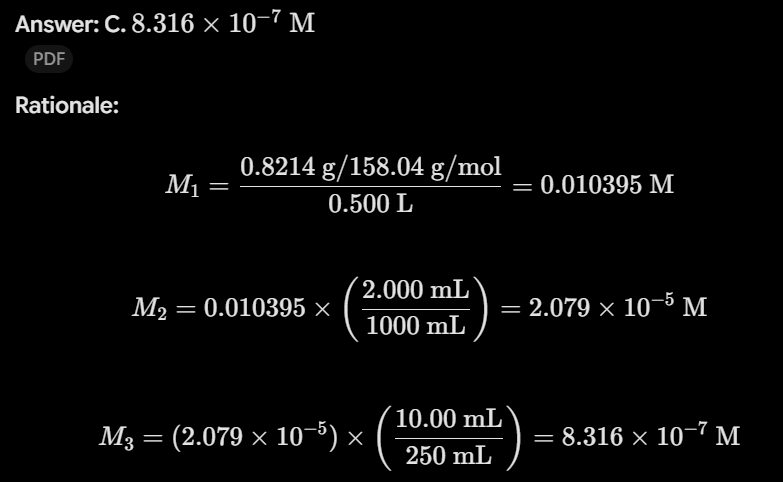
A sample of 0.8214 g of KMnO4 (158.04) was dissolved in water and made up to the volume in a 500 mL volumetric flask. A 2.000-mL sample was transferred to a 1000-mL flask and diluted. Next, 10.00 mL of the diluted solution was transferred to a 250-mL flask and diluted. What is the concentration (in molarity) of the final solution?
A. 0.1039 M
B. 2.079×10⁻⁵ M
C. 8.316×10⁻⁷ M
D. none of the above
C
Bleaching involves chemical oxidation of chromophores, forming new chemical bonds and altering molecular structures. Options A and D represent physical changes.
Which of the following is a chemical reaction?
A. an airconditioner cooling the air
B. none of these choices
C. bleaching your clothes
D. melting of ice

B
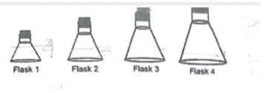
Each of these flasks contains the same number of molecules. In which container is the pressure highest?
A. Flask 2
B. Flask 1
C. Flask 3
D. Flask 4

D
Predict the products of the following acid-base reaction: NH3(aq)+HNO3(aq)
A. no reaction takes place
B. NH4OH (aq)
C. NH2OH (aq)+HNO2(aq)
D. NH4NO3(aq)

C
To avoid parallax error, readings for concave aqueous liquid surfaces are taken horizontally at eye level at the lowest point of the meniscus.
Which procedure is recommended for reading the level of an aqueous solution in a buret or graduated cylinder?
A. Keep the eye level with the top of the meniscus and record that reading.
B. Read both the bottom and top of the meniscus and average those readings.
C. Keep the eye level with the bottom of the meniscus and record that reading.
D. Look down at the meniscus at an angle to obtain the average reading directly.
B
Eliminating draft currents, mechanical vibrations, and tare offsets ensures accurate analytical measurements.
In order to ensure an accurate weighing when using the balances, one should
A. leave the object on the balance for several minutes to ensure a stable reading
B. not lean on the balance bench, close the draft doors on the balance and zero the balance prior to weighing
C. turn the balance off to clear any previous weighings from its memory
D. weigh the object several times on different balances and take the average of these weighings
B
Pouring rapidly increases splash risk and loss of liquid control. Controlled, steady pouring guided by a glass rod is standard laboratory procedure.
Which of the following is NOT part of the technique for pouring in a laboratory?
A. Connect the pouring spout and receiving container using a stirring rod
B. Pour fast enough to avoid spills
C. Pour and allow the liquid to run along the stirring rod
D. Hold containers at arms length, with elbows slightly bent
A
The Kjeldahl method quantitatively determines organic nitrogen, which is converted to crude protein content
The method that is widely used for the determination of the protein content of meat and animal food is the
A. Kjeldahl method
B. Mohr method
C. McBride method
D. Liebig method
C
Decanting the supernatant liquid first speeds up filtration and prevents clogging. Washing with multiple small portions of wash solution is thermodynamically more efficient than using a single large volume.
An analytical chemist needs to transfer his/her precipitants from the beaker to the filter paper. Which of the following would be the best procedure to adopt in order to ensure a quantitative transfer of the precipitate?
A. none of the choices
B. Most of the liquid above the ppt is decanted first, then bulk of ppt is transferred to filter paper through a stirring rod, the beaker is washed with big volumes of wash solution.
C. Most of the liquid above the ppt is decanted first, bulk of ppt is transferred through a stirring rod, wash the beaker several times with small volumes of wash solution.
D. Solution is shaken, the immediately filtered; beaker is washed with relatively big volumes of wash solution.
A
Oil and grease adhere to plastic surfaces, leading to low analytical recoveries. Glass bottles must always be used.
A water sample is collected for analysis of oil and grease. The analysis will not be done immediately. The sample should NOT be
A. collected in plastic bottle
B. preserved with sulfuric acid
C. refrigerated till analyzed
D. collected in all glass bottle
A
Immiscible liquids phase-separate based on density, with the lighter liquid floating on top
When two materials that have different densities, like oil and water, encounter one another, they will
A. separate according to their densities
B. exchange densities
C. mix uniformly
D. repel one another
D
Electrical conductivity (σ) is mathematically defined as the inverse/reciprocal of electrical resistivity (ρ).
Conductivity is defined as
A. The ability of a substance to conduct electric current, which is the same as resistivity.
B. The ability of a substance to repel electric current.
C. The ability of a substance to conduct variable resistance.
D. The ability of a substance to conduct electric current, which is the reciprocal of resistivity.
C
Due to open hydrogen-bonded crystalline lattice structures, ice has a lower mass density than liquid water at 4°C.
Even though all solid states of other materials are denser than the liquid states of materials, what is a unique property of water?
A. It is clear.
B. It is tasteless.
C. Solid water (ice) is less dense than liquid water (ice floats in water).
D. It can freeze

C
The following statements are true about electrical conductivity EXCEPT
A. a measure of a solution's capacity to conduct electricity
B. a measure of the total dissolved solids in a solution
C. increasing temperature has no effect on its value
D. is directly affected by temperature
D
Water autoionization (Kw) and chemical equilibria shift with temperature, altering the pH.
The following statements are true about pH EXCEPT:
A. the negative logarithm of hydrogen ions content in a solution
B. a measure of the acidity or alkalinity of a solution
C. a measure of the amount of hydrogen ions in solution
D. does not change when there are changes in temperature
D
The apparatus shows a condenser mounted vertically over a round-bottom flask.
Vapors rise into the column, cool down, and drip back into the flask.
This process allows a mixture to heat continuously without losing solvent
Why Other Options are Incorrect
Distillation requires a downward-angled condenser to collect liquid in a separate container.
Chromatography uses columns or paper sheets to separate mixtures by polarity.
Filtration requires a funnel and filter paper or a vacuum setup.
The apparatus shown below would be used to
A. distill a liquid
B. chromatograph a mixture
C. filter a precipitate
D. reflux a solution

B
Storing glass electrodes in distilled water leaches internal ions from the reference junction. Storage should be in a concentrated KCl buffer solution.
In maintenance and storage of pH meters, which of the following procedure shall NOT be done?
A. Mild soap solution may be used in general cleaning of the electrodes.
B. To keep the electrode bulb moist during storage, store the electrode in distilled water.
C. Blot the electrode dry after rinsing the pH electrodes.
D. Rinse pH electrodes in between measurements.
D
Explanation
Stray light interference: Keeping the compartment open allows ambient room light into the detector. This severely distorts absorbance readings and causes inaccurate measurements.
Proper procedure: The sample compartment must be closed completely during every reading to ensure only the instrument's light source passes through the sample.
Standard Operating Practices (A, B, and C)
Checking the holder (A): Prevents accidental blockage or initialization errors from a forgotten cuvette.
Initialization & stabilization (B): Allows lamps (deuterium/tungsten) to warm up for a stable light intensity.
Cleaning spillages (C): Prevents chemical corrosion of the sample chamber and optical components.
In operating a UV-Vis spectrophotometer, the following shall be done, EXCEPT for
A. Before turning on the power, check if the sample holder does not contain anything.
B. After turning on, allow the spectrophotometer to initialize and stabilize according to its user manual.
C. If there are any spillage that gets onto the instrument, immediately wipe it away.
D. Keep the sample compartment open during measurement.
C
Explanation
Airflow disruption: Storing chemical bottles inside a fume hood blocks the rear baffles and disrupts the laminar airflow. This can cause hazardous vapors to escape into the laboratory.
Increased hazard: Keeping excess chemicals in the hood increases the fuel load and severity of potential fires or explosions during experiments.
Proper storage: Volatile chemicals must always be stored in dedicated safety cabinets (e.g., flammables or acids cabinets).
Proper Fume Hood Practices (A, B, and D)
Decontamination (A): Prevents spreading hazardous or foul-smelling residues into the open lab environment.
Sash positioning (B): Keeping the sash closed when not in use maintains containment and conserves significant energy.
Exhaust verification (D): Always verify that the fan is running and airflow is sufficient before starting any work.
In using fume hoods, the following shall be done, EXCEPT for
A. Items contaminated with odorous or hazardous materials should be removed from the hood only after decontamination...
B. The hood shall be kept closed, except during apparatus set-up or when working within the hood.
C. The hood may be used as a permanent storage area for volatile chemicals when an appropriate storage cabinet is not available.
D. Ensure the exhaust is operating before using the hood.
B
When choosing a solvent for purification by crystallization, the main criteria focus on how the compound behaves in the solution across temperatures, and avoiding unwanted chemical reactions.
Solubility (A): The most critical factor. The ideal solvent must dissolve the solute well at high temperatures but poorly at low temperatures.
Reactivity (C): The solvent must be chemically inert and not react with the substance being purified.
Polarity (D): Evaluated directly alongside solubility, following the rule of "like dissolves like" to ensure proper solute-solvent interaction.
Vapor pressure (B): While a solvent's boiling point matters for practical handling and safe evaporation, vapor pressure itself is not a standalone fundamental criterion used to determine whether a solvent will successfully crystallize a specific material.
In purifying a material by crystallization choose the solvent according to the following EXCEPT
A. solubility
B. vapor pressure
C. reactivity
D. polarity
B
Key Facts
Beer-Lambert's Law states that absorbance (\(A\)) is directly proportional to both the concentration (\(c\)) of the absorbing species and the path length (\(b\)) of the sample (\(\mathbfit{A=\epsilon bc}\)).
Boyle's Law describes the inverse relationship between the pressure and volume of a gas.
Charles's Law describes the direct relationship between the volume and absolute temperature of a gas.
Avogadro's Law states that equal volumes of gases contain an equal number of molecules at the same temperature and pressure.
What is the law that states the linear relationship between absorbance and concentration of an absorbing species?
A. Boyles Law
B. Beer-Lambert's Law
C. Charles Law
D. Avogadro's Law
C
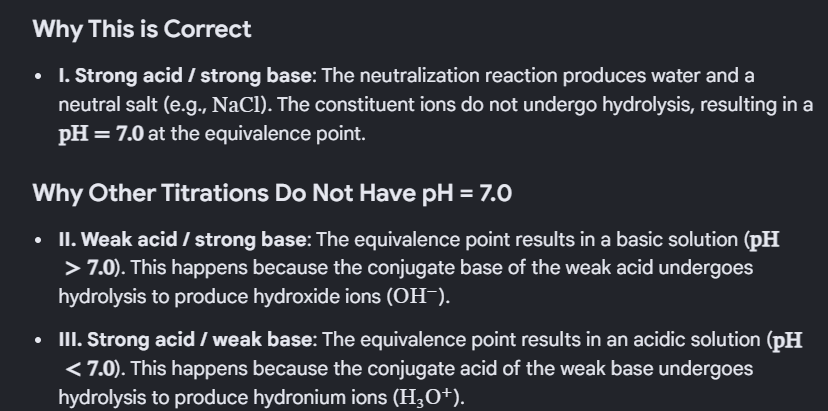
In which of these following titrations does pH=7.0 occur at the equivalence point?
I. Strong acid/strong base
II. Weak acid/strong base
III. Strong acid/weak base
A. II and III only
B. III only
C. I only
D. II only
A
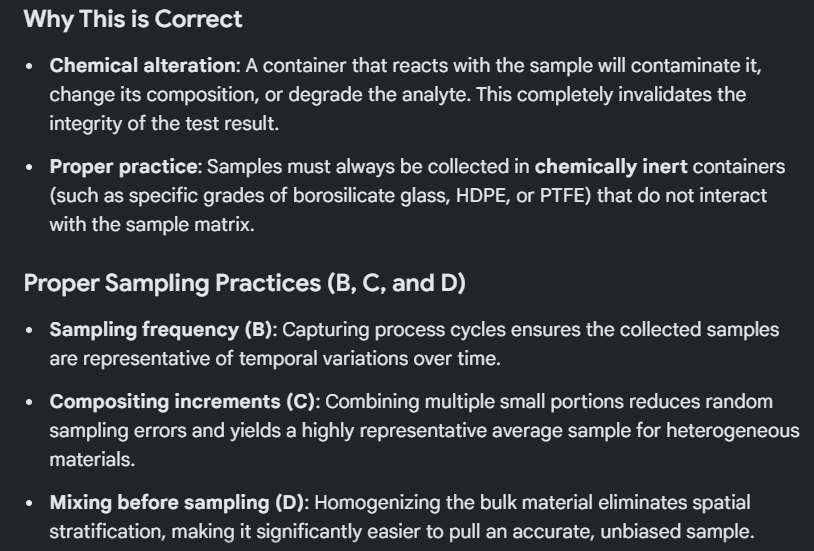
The following are good sampling practices EXCEPT:
A. Collect the sample in a container made of material that will chemically react with the sample.
B. Sample frequently enough to allow for the identification of process cycles.
C. Take several increments and composite them to form the sample.
D. If possible, mix the material before getting the sample.

A
In liquid-liquid extraction... add a drop of water to the top layer. If the drop dissolves in the top layer, the top layer is.
A. aqueous
B. denser
C. miscible
D. nonaqueous
A
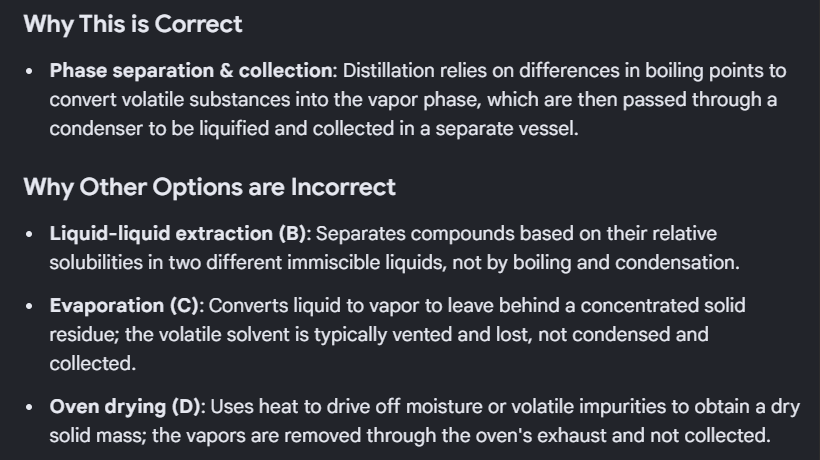
The process in which the sample is heated in the boiling point of the solvent and volatile analytes are concentrated in the vapour phase, condensed and collected.
A. Distillation
B. liquid-liquid extraction
C. evaporation
D. oven drying
Answer: A. Distillation

D
Glass container is NOT suitable for
A. oil and grease determination
B. microbiological analyses
C. all of the choices
D. inorganic trace analyses

B
The substance which does the dissolving and must be greater than 50% of the solution is called
A. solute
B. solvent
C. mixture
D. solution

A
Quantitative chemical analysis of weighing a sample, usually of a separated and dried precipitate is called
A. Gravimetric analysis
B. Elemental analysis
C. Volumetric analysis
D. Titrimetric analysis

B
Minimum concentration of a substance that can be measured and reported with 99% confidence that the analyte concentration is greater than zero refers to
A. Lower Warning Limit
B. Method Detection Limit
C. Lower Control Limit
D. Limit of Quantitation
C
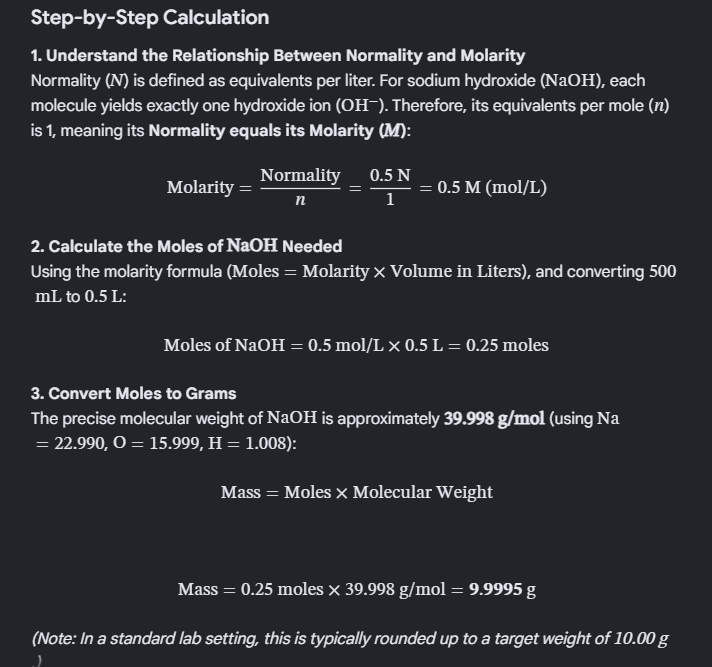
How many grams of sodium hydroxide is needed to prepare 500 mL of 0.5 N sodium hydroxide?
A. 13.8115 g
B. 15.7470 g
C. 9.9995 g
D. 10.2515 g
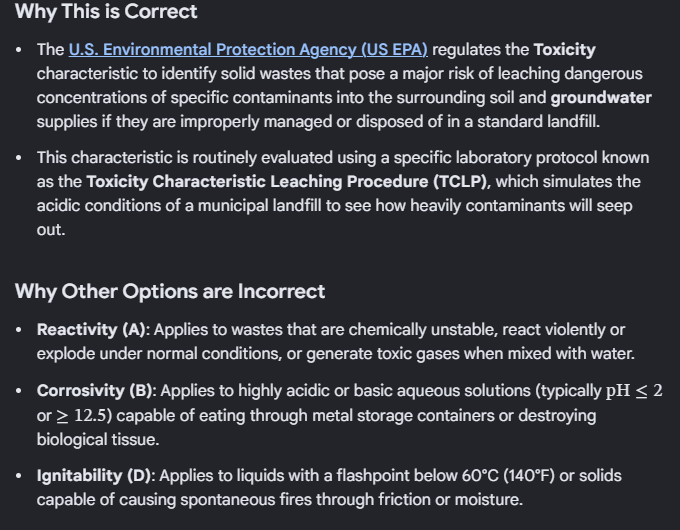
C
It is a hazardous waste characteristic which applies to wastes that have the potential to contaminate groundwater if improperly disposed of...
A. Reactivity
B. Corrosivity
C. Toxicity
D. Ignitability

A
In handling acid wastes, what type of proactive gloves should be used?
A. Rubber gloves
B. Cloth gloves
C. Disposable plastic gloves
D. Surgical gloves

A
According to Revised DAO 04-36, the appropriate waste labels shall include
A. all of the choices
B. Volume of Waste
C. Generator ID Number
D. Container Material

A
Which is TRUE about laboratory fume hoods?
A. all of the choices
B. Provides further protection by diluting low concentration of flammable gases below explosion limits.
C. It protects you from being exposed to chemical fumes.
D. Must always be on.

B
What is the type of chemical that can cause an allergic reaction in the airways following inhalation of the chemical?
A. Corrosive
B. Respiratory Sensitizer
C. Oxidizer
D. Carcinogen

C
Which of the following may be disposed of in the sink?
A. 0.1M H2SO4
B. 1 g/ml PCl4
C. none of the choices
D. 200 g/ml PCl4

A
In order to properly maintain chemical laboratory equipment one should perform the following EXCEPT
A. place the equipment in hot humid location
B. regular calibration of equipment
C. regular inspection of operational components
D. thorough cleaning with the proper materials

A
The method that is widely used for the determination of the protein content of meat and animal food is the
A. Kjeldahl Method
B. McBride Method
C. Liebig Method
D. Mohr Method

D
The dynamic range in analytical measurement refers to the range where
A. the instrument reading is constant
B. the detection limit lies
C. the sensitivity of the instrument is highest
D. Instrument reading linear to the input value

B
A student took 10 mL from each stock standard (Zn: 2000 ppm, Cd: 1500 ppm, Pb: 1000 ppm) into a 200 mL volumetric flask and diluted to total volume. What is the final concentration of each element?
A. 50 ppm Zinc, 32 ppm Cd, 25 ppm Pb
B. 100 ppm Zinc, 75 ppm Cd, 50 ppm Pb
C. 75 ppm Zinc, 75 ppm Cd, 50 ppm Pb
D. 100 ppm Zinc, 25 ppm Cd, 25 ppm Pb

A
A graphical representation of measuring signal as a function of quantity of analyte
A. Calibration Curve
B. Quality Control Chart
C. Absorbance Chart
D. None of the above

A
When water is heated in a beaker, bubbles of air form on the side of the glass before the water boils. This shows that
A. the solubility of gases in water decreases with increasing temperature
B. the solubility of gases in water increases with increasing temperature
C. the solubility of gases in water decreases with decreasing temperature
D. the solubility of gases in water increases with decreasing temperature

A
Sample Preparation technique used prior to instrumental analysis of metals
A. Acid digestion
B. Liquid-liquid extraction
C. sieving
D. clean-up

B
Used for vacuum filtration using filter paper.
A. Gooch crucible
B. Buchner funnel
C. Rotary evaporator
D. Rubber aspirator

C
Which of the following is NOT an acid-base conjugate pair?
A. HCN and CN-
B. H2O and OH-
C. H2S and OH-
D. NH3 and NH4+

A
The temperature at which solid and liquid coexist in equilibrium is called
A. Freezing point of liquid
B. Melting point of liquid
C. Freezing point of solid
D. All of the above