Chapter 16 Machining Operations and Tools
 Call Kai
 Learn
 Practice Test
 Spaced Repetition
 Match
 Flashcards
 Knowt Play
1/24

There's no tags or description
Looks like no tags are added yet.
25 Terms
Generating vs forming
Generating: part geometry determined by feed trajectory of cutting tool
straight turning, taper turning, contour turning, plain milling, profile milling
Forming: part geometry created by shape of cutting tool
form turning, drilling, broaching
Together:
thread cutting on lathe
slot milling
Turning
single point cutting tool removes mtl from rotating workpiece → cylindrical shape
performed on lathe
types:
facing
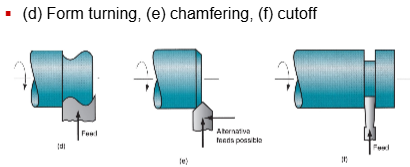
contour turning
chamfering
cut off
threading/boring/drilling
Engine lathe
headstock
houses main spindle → holds workpiece using chuck, collet, faceplate
tool post on carriage
tailstock
workpiece support (holds both dead center and live center)
Methods of holding workpiece in lathe
holding work btwn 2 centers / dog & dogplate
lathe centers used to support long length jobs → mounted in tail stock
live center (rotates) vs dead (doesnt)
chuck
3: all 3 jaws move in/out simultaneously
4: all 4 jaws move independently/rectangular shape
collet
round, square, hexagon
face plate
face plate & angle plate

Turret lathe
tail stock replaced w/ turret that holds up to 6 tools
tool post replaced by 4 sided turret to index 4 tools
Chucking machine
uses chuck in spindle to hold workpiece
no tail stock, not mounted btwn 2 centers
cutting tool actions controlled automatically
Bar machine (like chuck)
collet replaces chuck, permitting long bar stock to be fed through headstock
automatic screw machine is the same but smaller → hi production of screws
Boring
boring performed on inside diameter of existing hole
turning performed on outside
boring can be horizontal or vertical (orientation of axis of rotation)
Drilling
creates round hole in workpart
tool: drill or drill bit
machine: drill press
through vs blind hole
through: drill exits all the way through
blind: does not exit
Drilling order
center drill
drill
boring
reaming
Reaming tapping and counterboring

Countersinking, center drilling, spot facing

Drill press
upright drill press stands on floor
Work holding for drill presses
vise
general purpose work holder with two jaws
not accurate
fixture
workholding device custom designed to workpart
drill jig
similar to fixture but also provides means of guiding tool during drilling
Milling
machining operation in which work is fed past a rotating tool with multiple cutting edges
axis of tool rotation perpin to feed
types of milling:
peripheral: cutting axis parallel to surface
face: cutting axes perpindicular to surface'
can do sides or bottoms and pockets or contour

Climb cut/down vs conventional cut/up milling
down milling: same direction → better finishing
up milling: thin to thick & opp direction
preferred b/c of thin to thick
Planing vs shaping
both: both use single point cutting
planing: workpiece moves, large pieces (10 m)
chip breakers needed, long chips are good, more problems b/c of vibrations, heat, high friction
shaping: tool moves, smaller pieces (1-2 m)
Broaching
multiple tooth cutting tool moved linear relative to work in direction of tool axis
successive teeth smaller → larger
started hole required
good surface finish, close tolerances
expensive bc tooling
internal & external
Sawing
cuts narrow slit in work by a tool consisting of a series of narrowly spaced teeth
types:
power hacksaw
steel
cuts 1 direction
band saw
linear continuous motion of bandsaw blade
circular saw
rotating saw blade provides continuous motion of tool past workpart
Types of saw teeth
gullet: pathway for wood chips
straight tooth: copper and brass
raker: steel and cast iron
wave: thin sheet or wall

Filing
material removal with find wide teeth
small chips formed
finishing and deburring
types:
single: rows of parallel teeth
double: 2 series of parallel teeth
rasp: each tooth raised out of surface
removes more mtl in one pass
curved: parallel curves
smooth and nice finish
Burs
types:
high speed steel
carbide
rotary file
used for inside finishing
High speed machining
damper under machine needed bc of hi speed
chip breaker needed
DN ratio: bearing bore diameter multiplied by maximum spindle speed
for hi speed: 500k to 1mil
How to avoid chatter
add stiffness or damping
operate at speeds avoiding cyclical forces w/ frequencies close to natural freq of machine tool
cutting fluid