BCH4024 Douma Exam 4 - Lecture 9
 Call Kai
 Learn
Learn Practice Test
 Spaced Repetition
 Match
Match Flashcards
 Knowt Play
1/34

There's no tags or description
Looks like no tags are added yet.
Name | Mastery | Learn | Test | Matching | Spaced | Call with Kai | Chat |
|---|
No analytics yet
Send a link to your students to track their progress
35 Terms
What does epigenetics refer to?
Covalent modifications that change chromatin structure and gene accessibility without altering the DNA sequence.
What is the major type of DNA methylation in eukaryotes?
Methylation of the cytosine (C) in CpG sequences to form 5-methylcytosine.
What is a CpG island?
A region near a promoter that contains many C-phosphate-G sequences, often regulating gene expression.
How does DNA methylation affect transcription factor binding?
Methyl groups stick into the major groove of DNA and can block transcription factors from binding.
What is the typical effect of CpG island methylation?
Transcriptional silencing of the associated gene.
Which enzyme methylates DNA in eukaryotes?
DNA methyltransferase (DNMT).
How is eukaryotic gene regulation different from prokaryotic regulation?
In eukaryotes, the default gene state is OFF; genes must be activated to be transcribed.
What types of regulatory elements are found in eukaryotic genes?
Promoter proximal elements and enhancers.
What is a promoter proximal element?
A cis-acting element located near the promoter where activators can bind.
What is an enhancer?
A distal cis-acting element (can be upstream, downstream, or within introns) where multiple activators bind to stimulate transcription.
How can distant enhancers affect transcription initiation?
DNA is bent by architectural regulators (e.g., HMG proteins) to bring enhancers close to the promoter.
What are architectural regulators?
Proteins like HMG that bend DNA to facilitate interactions between enhancers and promoters.
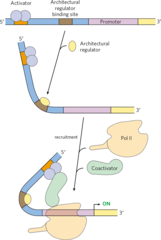
What are co-activators?
Proteins that bind to activators and mediate interactions with RNA Polymerase without binding DNA themselves.
Do co-activators bind DNA directly?
No, they facilitate protein-protein interactions between activators and RNA Polymerase complexes.
What protein complex acts as a bridge between activators and RNA Polymerase?
Mediator complex.
What types of DNA-binding domains exist in eukaryotic transcription factors?
Helix-turn-helix, zinc fingers, leucine zippers, among others.
What is a zinc finger domain?
A structure stabilized by a zinc ion that includes a beta sheet, a turn, and an alpha helix for DNA binding.
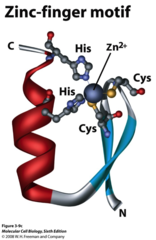
What amino acid residues is Zn2+ coordinated to?
4 Cysteine residues in nuclear hormone receptors, 2 Cysteine and 2 Histidine in classical zinc finger proteins.
What special feature allows some monomeric transcription factors to maintain specificity?
They contain multiple DNA-binding motifs (e.g., multiple zinc fingers) within a single polypeptide. Multiple zinc fingers substantially enhances binding.
What can zinc fingers also function as?
RNA-binding motifs
What is a leucine zipper?
A DNA-binding domain where two alpha helices from different subunits dimerize through hydrophobic interactions (especially leucines) and bind DNA.

Where are leucine zippers often found?
They are often found in proteins with a separate DNA-binding domain that is rich in basic (Lys or Arg) residues that can interact with the DNA backbone.
What is combinatorial control?
The concept that different combinations of DIMERIC transcription factors regulate gene expression uniquely in different cell types.
How do different cell types achieve different gene expression patterns?
By expressing different populations and combinations of transcription factors.
What part of a transcription factor binds DNA?
The DNA-binding domain (e.g., helix-turn-helix, zinc finger, leucine zipper).
What part of a transcription factor interacts with co-activators and chromatin remodelers?
The activation domain.
What is the function of the activation domain?
To recruit other proteins (e.g., HATs, co-activators, mediator, chromatin remodeling complexes) to stimulate transcription.
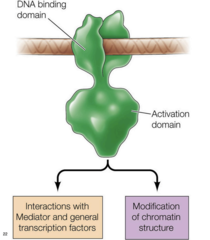
Which protein structure does NOT bind DNA directly?
Activation domain.
What are the two critical steps needed to open chromatin for transcription?
Histone acetylation (by HATs) and chromatin remodeling (by complexes like SWI/SNF).
What is SWI/SNF?
A well-known chromatin remodeling complex that uses energy to remodel chromatin so that nucleosomes are ejected near transcription start sites (reposition or remove nucleosomes).
What is a pioneering transcription factor?
A special transcription factor that can access and bind DNA in condensed, heterochromatic regions to initiate chromatin opening.
How do pioneering transcription factors help activate genes?
They recruit HATs and chromatin remodeling complexes to open chromatin structure.
Can the order of HAT and chromatin remodeling recruitment vary?
Yes, depending on the specific pioneering transcription factor.
Why does eukaryotic transcription require so many components?
Because the default state of genes is OFF, and multiple factors must coordinate to activate transcription efficiently.
What do general transcription factors do?
They help recruit RNA Polymerase to the promoter because RNA Polymerase cannot find promoters on its own in eukaryotes.