Learn: Capstone Lab Quiz 1
 Call Kai
 Learn
Learn Practice Test
 Spaced Repetition
 Match
Match Flashcards
 Knowt Play
1/93

There's no tags or description
Looks like no tags are added yet.
Name | Mastery | Learn | Test | Matching | Spaced | Call with Kai | Chat |
|---|
No analytics yet
Send a link to your students to track their progress
94 Terms
SOP means
Standard Operating Procedures (SOPs)
What does an SOP tell you?
- Procedures for dealing with spills, emergencies, and exposure incidents
- Methods for limiting employee exposure (PPE, etc.)
Is risk assessment qualitative or quantitative?
Qualitative
What are some factors we use for Risk Assessment?
- Pathogenicity
- Route of Transmission
- Agent Stability
- Infectious Dose
- Concentration
Pathogenicity
ability of a microorganism to cause disease
Route of Transmission
the anatomical and physiological path of transmission from an infected source to a human
Infectious Dose
the number of microorganisms or viruses needed to establish an infection
What do we do with risk assessment information?
Agents are split into four risk groups based upon their relative pathogenicity to healthy adult humans
Risk Group 1
Agents are not associated with disease in healthy adult humans
Risk Group 2
Agents are associated with human disease which is rarely serious and for which preventive or therapeutic interventions are often available.
Risk Group 3
Agents are associated with serious or lethal human disease for which preventive or therapeutic interventions may be available.
Risk Group 4
Agents are likely to cause serious or lethal human disease for which preventive or therapeutic interventions are not usually available.
Primary Containment
the protection of personnel and the immediate laboratory environment from exposure
Who does primary containment protect?
YOU (the researcher)
What are some ways we practice primary containment?
- Good microbiological technique
- Use of appropriate safety equipment
- PPE
Secondary Containment
the protection of the environment external to the laboratory from exposure
What are some ways we practice secondary containment?
- Facility design
- Operational practices
BSL-1 Labs are usually used for
- basic teaching
- research
BSL-2 Labs are usually used for
- primary health services
- diagnostic services
- research
BSL-3 Labs usually used for
- special diagnostic services
- research
GMT
good microbiological techniques
BSL-? --> GMT only
BSL-1
BSL-? --> GMT, PPE, biohazard sign
BSL-2
BSL-? --> Special clothing, controlled access, directional air flow
BSL-3
BSL-? --> Air lock entry, shower exit, special waste disposal
BSL-4
What BSL level is our capstone lab?
BSL-2
Wear PPE, Lab Coat, Gloves
You may not need protective eyewear
BSL?
BSL-1
- Eye protection is required, it's no longer optional
- Face/eye protection
- PPE is mandatory
- Has additional safety equipment (hoods, biosafety cabinets)
- Will include biosafety bins and infectious hazard bins
BSL?
BSL-2
- Has an ante-room (room you step into before entering the lab)
- Negative air flow
- Air's being pulled into the room, so if the air is contaminated, it can't slip out the door into the hallways
- Autoclave within the lab
BSL?
BSL-3
- Few select labs in the state/country
- Completely isolated environment
- Everything's completely sterile and separate
- Requires a UV room to sterilize
BSL?
BSL-4
Orange Bag
Biohazard Bag
Red Bag
Infectious Waste Bag
Can sharps go in the orange bags?
NO
Once an orange bag is treated and labeled, where can it go?
Into normal trash
What do infectious waste bags look like?
- Red color
- Tear/leak resistant
- Have universal biohazard symbol
What must be kept for all chemicals?
MSDS
MSDS =
Material Safety Data Sheet
Where are our MSDS?
In binders at the front of the room, which includes MSDS, SOP (Material Safety Data Sheet)
How can a biohazard bag go into the normal trash?
- Sterilize them in the autoclave for at least 90 minutes at 250 degrees F
- Once it comes out of the autoclave and it's sterilized, it can go into the regular trash can
By whom are professional standards of conduct/ethics created by?
They are developed by professional communities themselves for themselves --> doctors, lawyers, engineers, etc.
In order to do funded scientific research in the United States, is ethics training required?
Yes, they are required courses that one must take
What are some examples of violations of scientific integrity?
- Copying
- Sharing
- Stealing
- Lying
- Plagarism
What is plagirism?
The act of presenting another person's work or ideas as your own
What are some ways that scientists can go wrong when conducting experiements?
- Honest error in measuring, recording, and interpreting
- Lack of review
- Overinterpretation
- Lack of reproducibility
How can scientists keep themselves on the right track?
- Double and triple checking data
- Mentorship
- Having their work reviewed by senior authors
What are some consequences of when scientists go wrong?
- Loss of credibility
- Retraction of published work
- Loss of degree/job
Where do antibodies come from?
The immune systems of living systems
Immunology
The study of the structures of the immune systems
What is the adaptive immune response?
- Reacts to antigens
- Remembers an invader
- Highly specific to antigen
- Takes time to acquire
What do B cells do?
Produce antibodies in the bone marrow
What is the innate immune response?
- Requires no prior contact (unlike adaptive)
- Involves inflammatory process
What do antibodies do?
- Bind to antigens on pathogens
- Seek to disable the pathogen's activity
What is an antigen?
- Not part of the host
- Large polysaccharide or protein that lies on the surface of viruses and foreign cells
What 2 things trigger active immunity
Infection or vaccination
B cells are involved in what type of immune response?
Humoral immune response
T cells do what
Attack cells infected w/bacteria or viruses
T cells are involved in what type of immune response?
Cell-mediated immune response
What is an epitope?
The specific region on antigen to which the antibody binds
Epitope
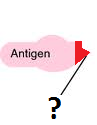
What shape does an antibody take on?
Y-shape
How many antigens can bind to a single epitope?
1 epitope is capable of binding only 1 antigen --> each antigen has a specific location
Antibody
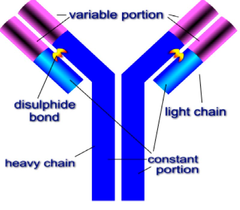
Where is the constant region of an antibody?
E
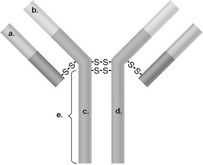
Where is the constant region of an antibody?
At the bottom of the Y-shape of the antibody
Why are antibodies big business?
Because they are used in so many ways, which include --> purification, protein visualization, and SDS-page
What are the big 3 applications of antibodies which make them "big business"
- Purification
- Protein visualization
- SDS-page
How do we make antibodies?
- In the lab
- By injecting an animal with an antigen
- This leads to the formation of antibodies
What are polyclonal antibodies?
A mixture of antibodies produced that recognize several different epitopes on an antigen
How are polyclonal antibodies made?
--> An antigen (e.g. protein) is injected into an animal
--> A mixture of antibodies is produced and isolated
--> Each antibody in the mixture recognizes a different, specific epitope within the protein.
What's cheaper/easier to produce, polyclonal or monoclonal antibodies?
Polyclonal antibodies
What are monoclonal antibodies?
Identical antibodies that are specific to the specific epitope of a protein
How are monoclonal antibodies made?
- Start with B cells
- Put through cell culture
- Decide which cell makes 1 kind of antibody
- Multiply that cell
- Create a cell culture that produces this singular antibody
Which provides stronger data, monoclonal or polyclonal antibodies?
Monoclonal
Which provides more specific data, monoclonal or polyclonal antibodies?
Monoclonal
What is the most promising class of drugs?
Monoclonal antibodies
If a drug ends in "-mab" what does that mean?
- It's expensive
- Highly efficacious
ELISA stands for
Enzyme Linked Immunosorbent Assay
What 2 types of antibodies do we use for ELISA testing?
- Primary antibodies
- Secondary antibodies
What is a primary antibody in ELISA testing?
They bind to the antigen in our sample, but we can't see it b/c it's so small
What is a secondary antibody in ELISA testing?
It binds to the primary antibody to see if the primary antibody is found on the constant region
Constant Region
Bottom portion of the Y
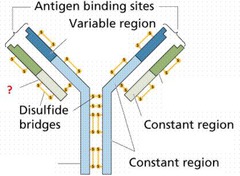
In ELISA testing, if the antigen is in our sample what happens?
- The primary and secondary antibodies bind
- A color change occurs
What causes/catalyzes a color change in ELISA testing?
- Enzyme
- Found in secondary antibody
What has an enzyme (used for possible color change catalysis)--the primary or secondary antibody?
Secondary
What is the drawback of ELISA testing?
- Not super sensitive
- Doesn't work instantly (can change over time)
Are antibodies sticky? Why is this important?
- Yes they're very sticky
- This enables them to stick to test tubes, blood, etc.
Why are blocking reagents used in ELISA testing?
- To fill in sticky sites
- To prevent non-specific binding
--> We want the antibody to stick to COVID and not the test tube
What does a positive control do?
It makes sure the test is working, should turn the positive result of the test
What can cause a false positive
- Pipetting error
- Contamination
- Recent vaccination
What is a false positive
Occurs when an assay determines a "positive" result for a target substance/disease that is not actually present in the sample
--> can be caused by cross-reactivity, sample handling, or technical errors
What is a false negative?
It occurs when a test determines that a substance/condition is not present when it actually is
What can cause a false negative
--> Testing the patient too early, they haven't been sick long enough to make antibodies
--> Switching patient samples
What type of assay does a pregnancy test use?
ELISA