Chapter 7 Kinetic model of particles in matter
 Call Kai
 Learn
 Practice Test
 Spaced Repetition
 Match
 Flashcards
 Knowt Play
1/13

There's no tags or description
Looks like no tags are added yet.
14 Terms
Kinetic model of particles in matter (4)
-the kinetic particle model of matter is made up of tiny particles that are in continuous motion
-there are attractive forces between particles of opposite charges in matter
-the particles have kinetic store due to their vibrating motion and the potential energy store due to attractive forces between them
-the sum of kinetic and potential energy stores is the internal store of matter
Internal energy (internal store)
-internal energy is an energy store that is made up of the total kinetic energy associated with the random motion of the particles and the total potential energy between the particles in the system
-Internal energy= total kinetic energy of particles (increases with temperature during heating) +total potential energy of particles (increases with separation(weaker forces of attarction) between the particles during change of state)
Kinetic particle model and the properties of solids, liquid and gases (877)
Why solids have the highest densities?
solids have the least volume as they are very closely packed in an orderly manner. Since density= mass/volume, since volume is lesser, the density increases

use of kinetic model of particles to explain the properties of substances

temperature and average kinetic energy
-temperature rises with the average kinetic energy of the particles in a body and vice versa
-according to kinetic theory, the temperature of a matter is a measure of the average kinetic energy of its particles inside it (‘average’ refers to a group of particles and not a single particle)
changes in state
-Changes in state —-> Temperature remains constant
The constant temperature at which:
-a solid melts is called its melting point
-a liquid solidifies or freezes is called its freezing point
-a liquid boils is called its boiling point
-a gas condenses is called its condensation point
When particles spread further apart (increase separation and potential energy)---> change in state
lose thermal energy → thermal energy transferred out of substance
gain thermal energy → thermal energy transferred into substance

energy transfer during heating
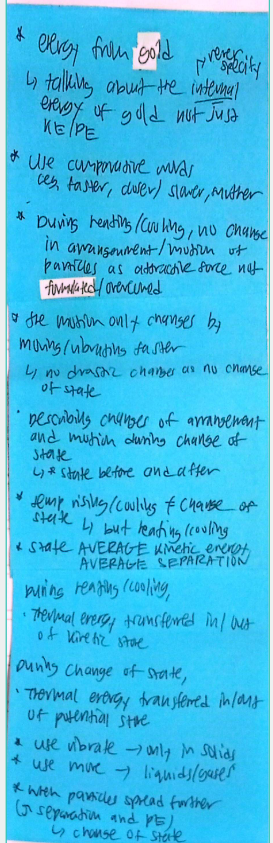
during AB, thermal energy is transferred in/out of kinetic store
no change in arrangement and motion as attarctive forces not overcome
only particles move/vibrate faster/slower → no drastic changes as no change of state
during BC, have change in motion and arrangement
**must state before and after

Why is temperature a constant during change of state?
-During the process of melting, solidification, boiling and condensation, energy transfer is related to the potential energy component of the particles only. Since there is no change in the average kinetic energy of the particles, the temperature remains the same (constant)
particles did not use thermal energy to increase/decrease temp
thermal energy is gained/lossed, transferred in/out of potential store
to allow work done to overcome/formulate the intermolcular attractive forces between particles
no change in average kinetic energy → temp remains constant
heating and cooling curves

Describing chages in motion/energy/temp of particles, during heating/cooling

describing melting/boiling/condensation/soldification
thermal energy is gained/lossed, transferred in/out of potential store
to allow work done to overcome/formulate the intermolcular attractive forces between particles
the average separation of particles increases/decreases → potential energy increases/decreases
no change in average kinetic energy → temp remains constant
Describing expansion/contraction

important reminders

postit notes