PLANT PATHOGENS
 Call Kai
 Learn
 Practice Test
 Spaced Repetition
 Match
 Flashcards
 Knowt Play
1/12

There's no tags or description
Looks like no tags are added yet.
13 Terms
Q: What is plant pathology?
A: The study of plant disease and how pathogenic agents cause disease in plants. Understanding plant pathology helps improve crop yields.
Q: How much crop loss do plant pathogens cause annually?
A: Approximately 10-30% yield loss annually.
Q: What are the five major groups of plant pathogens?
A:
Fungi
Oomycetes
Viruses
Bacteria
Nematodes
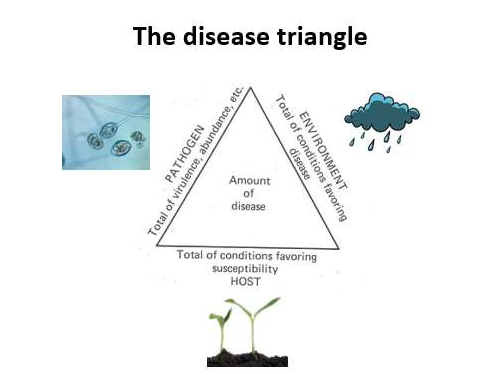
Q: What is the disease triangle?
A: Disease occurs when:
A susceptible host is present
A virulent pathogen is present
Environmental conditions favour disease development
Q: What is a biotroph?
A: A pathogen that requires living host tissue and keeps host cells alive while extracting nutrients.
Q: What is a necrotroph?
A: A pathogen that kills host cells using toxins and then feeds on the dead tissue.
Q: What is a hemibiotroph?
A: A pathogen that initially behaves as a biotroph before switching to a necrotrophic phase.
Q: What are common plant disease symptoms?
A:
Necrosis
Chlorosis
Wilting
Stunting
Hypertrophy
Etiolation
Abscission
Q: How do plant diseases spread?
A:
Air-borne
Soil-borne
Seed-borne
Mechanical transmission
Vector transmission (aphids, fungi, protists, nematodes)
Q: What are the stages of plant disease epidemiology?
A:
Penetration
Infection
Colonisation
Sporulation
Disease spread