AQA A Level Chemistry - Acids and Bases
 Call Kai
 Learn
 Practice Test
 Spaced Repetition
 Match
 Flashcards
 Knowt Play
1/65

There's no tags or description
Looks like no tags are added yet.
66 Terms
define acid (in bronsted lowry terms)
proton donor
define base
proton acceptor
what is a strong acid?
one where the H+ ions fully dissociate
what are the strong acid dissociation equations?
HA → H+ + A-
HA + H2O → H3O+ + A-
diprotic: H2SO4 → HSO4 - + H+
HSO4 - → SO4 - + H+
what are the common strong acids?
HCl
HNO3
H2SO4
what are acids commonly composed of?
always hydrogen
bonded to an electronegative atom like O, F, Cl
if a compound has multiple hydrogen atoms, only the atoms directly bonded to an electronegative atom will dissociate (i.e. those bonded to C cannot)
what are weak acids?
those where the H+ ions are only partially dissociated
what are the weak acid dissociation equations?
CH3COOH/HA + (aq) ←→ H+ + CH3COO- (aq)
HA ←→ H+ + A-
HA + H2O ←→ H3O+ + A-
what are the common weak acids?
CH3COOH (ethanoic acid)
other carboxylic acids
what is the difference between a base and an alkali?
base - accepts protons
alkali - base that donates OH- ions in aqueous solution
all alkalis are bases, not all bases are alkalis
what are strong bases?
those that are fully dissociated in aqueous solution (OH- fully)
what are some examples of strong bases?
KOH
NaOH
what is the base dissociation equation for a strong base (NaOH)?
NaOH → Na+ + OH-
what are weak bases?
those that partially dissociate in aqueous solution
what is the most common weak base?
NH3
what is the base dissociation equation for NH3?
NH3 + H2O ←→ NH4+ + OH-
what is the general equation for a neutralisation reaction?
acid + base → salt + water
how will neutralisation reactions of weak and strong acids/bases differ?
those with one weak element will be slower than with one strong
however, if it is the same concentration and volume of a strong/weak acid reacting with constant base, they will both neutralise it completely as the weak acid will just continually slowly dissociate
define pH
logarithmic scale of H+ concentration
10x increase in concentration when you go down by 1 pH
what is the equation for pH?
pH = -log [H+]
[H+] = 10-pH
how does water dissociate?
H2O ←→ H+ + OH-
slight dissociation - compared to concentration of water (which is very concentrated) it is negligible/basically 0
always equal of H+ and OH- in water
what is the ionic product of water?
equilibrium constant for dissociation of water
Kw = [H+][OH-]
units of mol2dm-6
holds true for solutions of acids/bases in water
how can the ionic product of water be represented in pure water?
Kw = [H+]²
as pure water is always neutral (but not always pH 7) so [H+] = [OH-]
how does the pH of pure water vary?
varies with temperature
at 25C, pH is 7
as temperature increases, pH decreases and Kw increases but this is still neutral pH
because dissociation of water is endothermic
what is Kw at 25C?
1×10-14
how would you calculate the pH of a strong base?
use Kw and [OH-] to calculate [H+] as dissolved in water
and [alkali] = [OH-] if monobasic
then sub into pH equation
also pKw = -logKw
what is Ka?
acid dissociation constant
what is the equation for Ka?
Ka = [H+][A-]/[HA] moldm-3
how can the Ka equation be simplified for weak acids?
at equilibrium Ka = [H+]eq[A-]eq/[HA]-[H+]eq
assume H+ and A- are formed in equal amounts, H+ produced by dissociation of water is negligible; the dissociation of weak acids is so small and [HA] so great that [HA]eq = [HA]start
therefore Ka = [H+]² /[HA]
how would you work out pH of weak acids and pKa?
use Ka equation; Ka= [H+]² /[HA]
then pH equation
pKA = -logKa
how is Ka found for a specific acid?
experimentally using standard solutions of HA and a pH meter
what is the equation to help with pH dilution calculations?
C1V1 = C2V2
what is a titration curve?
graph of pH against volume of acid/base added - shape differs depending on whether it’s a strong or weak acid/base
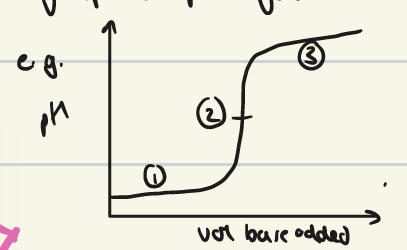
explain the shape of this general titration curve
1 - slight rise in pH; as acid is in great excess, so increases in [OH-] do not alter pH much and pH rises slower
2 - sharp rise in pH: pH increases rapidly when a small amount of base is added as it swings from excess of acid to excess of base
in this region, the equivalence point occurs - when [H+]=[OH-] - midpoint of vertical section
can be calculated as volume of substance being added required to neutralise substance of known volume
3 -slight rise: little additional change in pH as base is in great excess
what does a strong acid/strong base titration curve look like?
vertical range 3-10

what does a strong acid/weak base titration curve look like?
vertical range 3-8
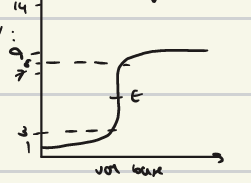
what does a weak acid/strong base titration curve?
vertical range 6-10

what does a weak acid/weak base titration curve look like?
no vertical range

what are pH indicators?
weak acids where HIn (acid) is 1 colour and In- is another
HIn ← → H+ + In-
when [HIn] = [In-], end point has been reached
most indicators change colour over roughly 2pH, with the endpoint being in the middle
this means that different indicators are used for different titrations as the equivalence point for titration needs to be in the pH range/close to indicator endpoint
what are the respective colours of phenolpthalein?
acid - colourless
alkali - pink
what are the respective colours of methyl orange?
acid - red
alkali - yellow
what are the respective colours of thymol blue?
acid - red
alkali - yellow
what are the respective colours for bromothymol blue?
acid - yellow
alkali - blue
what are the respective colours of methyl red?
acid - red
alkali - yellow
what is the endpoint pH range for phenolpthalein?
8.3-10
what is the endpoint pH range for methyl orange?
3.1-4.4
what is the endpoint pH range for thymol blue?
1.2-2.8
what is the endpoint pH range for bromothymol blue?
6-7.6
what is the endpoint pH range for methyl red?
4.4-6.2
what types of titrations is phenolphthalein suitable for?
strong strong
weak acid strong base
what types of titrations is methyl orange suitable for?
strong strong
strong acid weak base
what types of titration is thymol blue suitable for?
none
what types of titration is bromothymol blue suitable for?
strong strong
strong acid weak base
what types of titration is methyl red suitable for?
strong strong
strong acid weak base
how would you measure pH in a weak- weak titration?
pH probe as no vertical region
what is a buffer solution?
a solution that can resist changes in pH when small amounts of acid or base are added, or there is slight dilution
what is an acidic buffer made of?
weak acid and conjugate base
conjugate base either added directly via salt, or NaOH added to react with acid to produce it
how does an acidic buffer work if a small amount of acid is added?
extra H+ ions have been added
the position of equilibrium in HA ←→ H+ + A- shifts to the left to remove the added H+ ions
maintains constant pH
large amount of conjugate base means decrease in A- is insignificant
how does an acidic buffer work if a small amount of base is added?
extra OH- have been added
these react with H+ ions in solution removing some
the position of the HA ←→ H+ + A- equilibrium shifts to the right
replaces H+
maintains pH
HA + OH- → A- + H2O
how is a basic buffer solution formed?
weak base and its salt
almost always ammonia
how does an basic buffer work if a small amount of acid is added?
added H+ are removed by reacting with NH3
forming ammonium
NH3 + H+ ←→ NH4+
equilibrium shifts right
how does an basic buffer work if a small amount of base is added?
OH- ions react with some of the H+ ions in the buffer to form water
H+ + OH- → H2O
equilibrium shifts left to replace the H+
how do you find pH of an acidic buffer?
use Ka = [H+][A-]/[HA]
where H+ is what you are finding
Ka is of weak acid
A- is from fully ionised salt
HA is weak acid
what are some considerations when finding pH of acidic buffers?
if finding H+, can use moles of A- and HA as it is the ratio that is important not concentration
may have volume and solid, volume and volume - in this case volumes dilute each other so must be included/considered
extra equation for buffer - pH = pKa + log (X-/HX)
how do you calculate new pH when acid/base added to buffer solution?
find:
mol HA start
mol A- start
mol H+ added (or OH)
mol HA after
mol A- after
[H+]
pH
what are some uses of buffers?
blood is a pH buffer and removes dissolve CO2
H+ + HCO3- ←→ CO2 + H2O
extra H+/CO2 is removed by equilibrium moving
shampoos have buffers to prevent being too acidic/basic and damaging hair/skin