M6 Sheppard- Bacterial genomics I + II - Features of bacterial genomes + Population Genomics of bacterial pathogens.
 Call Kai
 Learn
 Practice Test
 Spaced Repetition
 Match
 Flashcards
 Knowt Play
1/11

There's no tags or description
Looks like no tags are added yet.
12 Terms
what are the different kinds of sequencing?
first generation:
sanger sequencing (shotgun method)- hierarchical or whole genome
very accurate reads, but low throughput and expensive
second generation (sequencing by synthesis):
454 pyrosequencing
long, fast reads, but can produce errors with repeated nucleotides
illumina sequencing
high throughput and cheap → led to the huge decrease in sequencing cost due to bridge amplification, but short read → requires short read WGS analysis methods
third generation (long read):
pacific biosciences SMRT sequencing
oxford nanpore technology MinION + PromethION
these sequence individual molecules (instead of needing many identical fragments to get a detectable signal) so desynchronisation isn’t an issue
this means much longer reads can be achieved, but the error rate is higher
this is often combined with illumina sequencing (hybrid assembly) to increase the depth and confidence of WGS analysis
how can we analyse whole genome data from short read sequencing?
used for illumina sequencing (very short reads)
mapping:
forwards and reverse reads are aligned to a reference genome, identifying variants between the consensus and the reference at certain bases
assembly:
genomes are reconstructed from raw read data using de novo assembly based on overlapping bases between reads
two main types:
overlap-layout-consensus (OLC) method- similar to mapping, but without a reference genome scaffold
de Bruijn graph method (more commonly used)- dividing sequences into all possible k-mers (k being a number of bases), and looking for all overlapping k-mers between reads to find Eulerian cycles (successive, non repetitive) in a de Bruijn graph
what are the pros and cons of mapping to analyse whole genome sequences?
most importantly, the use of a reference genome is problematic, as it can’t identify novel genes that aren’t found in the reference

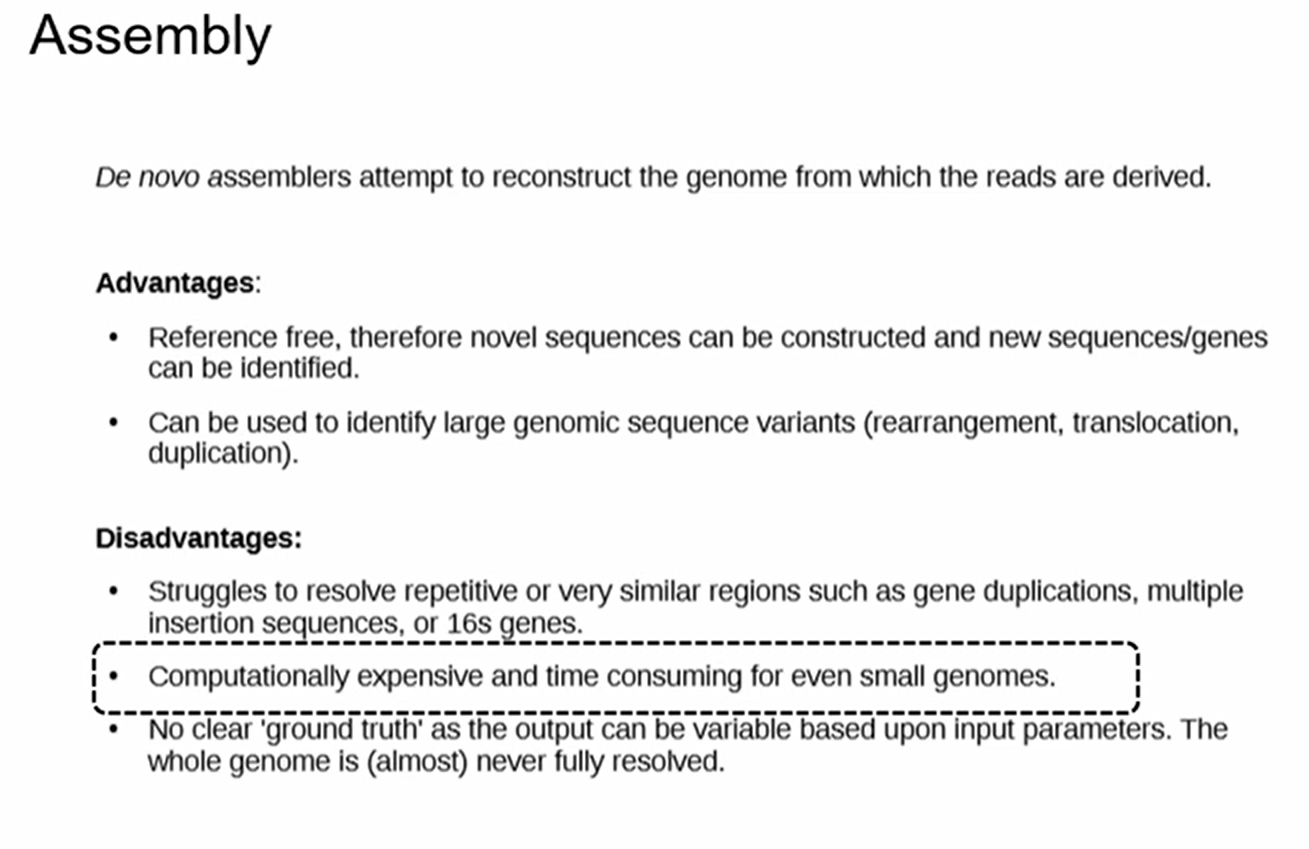
what are the pros and cons of assembly to analyse whole genome sequences?
most importantly, it doesn’t require a reference genome but this makes it more computationally intensive
what are the limitations of short read (illumina) sequencing?
sequence regions with low complexity (eg. long repetitive regions) cannot be resolved in short read analysis because the read is shorter than the length of the region → we can never sequence a complete closed genome
illumina is often combined with long read (nanopore) sequencing in hybrid assembly to solve assembly problems

what are the pros and cons of long read (nanopore) sequencing?
most importantly, solves many assembly problems of short reads (eg. in repetitive regions/intermittent identical repeats, because each read is longer and can have greater coverage of the region), but is error prone
it is often combined with illumina (short read) in hybrid assembly for depth + confidence of WGS

how is sequence data annotated before deposition into databases?
this is how we relate the sequence data to the biology of the organism itself → particularly because we can compare genomes
we annotate the:
location (forward/reverse strand, start + end coordinates)
feature type (coding sequence, tRNA/rRNA, repeat etc)
attributes (predicted product, function, evidence, database matches, etc)
we search other sequence databases using these open reading frames (ORFs) as queries to identify known functions of related genes, conserved functional domains, etc- to aid annotation
this is done using basic local alignment search tool (BLAST)
how does genome size and base content correlate with bacterial lifestyle?
free living bacteria tend to have large genomes with many genes to survive in a diverse environment → these also tend to have greater G + C content
obligate bacteria (eg. symbionts, even to the extent of mitochondria) tend to have small genomes, having lost many genes to their host → these also tend to have greater A + T content
facultative bacteria (eg. facultative/opportunistic pathogens) have intermediate genomes

how/why do bacterial genomes vary dramatically?
there is a lot of variability in genome size (correlated with lifestyle)
a bacterial species does not have a single, fixed list of genes (two strains of the same species only share 2/3 of their genome on average) → they all share a core genome (<50% of the genes), but have variable accessory genomes
gene order and direction can also be highly variable (disrupting the synteny/conserved gene order)
there is a lot of variability in GC/AT content ratios (→ can be used to identify atypical regions eg. HGT)

what are the different explanations for structured variation in bacterial populations?
the phylogenetic trees of bacterial species can suggest that certain strains have become adapted to a particular host (eg. because certain lineages only have one hsot), but this isn’t necessarily true and we have to use neutral evolution as a null model to explain this first
neutral diversification with transmission barriers:
the lineages would be able to freely colonise any host and expand to occupy the niches
but there are coincidental, random transmission barriers that modulate what lineages happen to colonise different hosts
this can appear like there was selection that only permitted one lineage to survive in the host
ecotypes (selection in a given environment):
multiple lineages colonise a host
one lineage acquires a host-adaptive trait, causing a selective sweep, out-competing all other colonising strains and so becoming adapted to this specific host
because of HGT, instead there can be horizontal gene sweeps causing convergence at a particular locus in divergent lineages
what are the genetic mechanisms of bacterial adaptation?
bacterial evolution is dominated by the relative rates of two processes:
mutation:
DNA replication errors/DNA damage produce novel SNPs, rearrangements and deletions of various sizes
mutations are almost always deleterious, but in certain cases (eg. opportunistic pathogens surviving in a strongly antibiotic-selected population), hypermutation rates can be encouraged to promote pathogenicity
horizontal gene transfer:
genetic material is acquired from an external source (eg. a similar/distinct strain), and incorporated into the genome by recombination
different bacterial populations/species have a spectrum of degrees of HGT vs clonality
how can we detect/distinguish genomic signatures of adaptation in bacteria?
to distinguish whether genetic variation is due to selection or just neutral evolution, the null model (eg. selective sweeps appear the same as bottlenecking, balancing selection appears the same as population subdivision)
dN/dS methods (analysing the ratio of mutations at synonymous, dS, to non-synonymous sites, dN) → dN/dS < 1 = purifying selection suppressing, dN/dS > 1 = positive selection for sequence changes (not super useful)
looking for functional homology in the genetic causes of pathogenicity within a strain (compared to non-homology in related non-pathogens/ancestors)
homoplasy/convergent evolution of pathogenic traits in different strains (eg. in a particular host) indicates adaptation (to that host environment)
epistasis- genes that covary (tend to occur together) over large genetic distances indicate selection against recombination/linkage disequilibrium that separates genes based on distance