Lesson 3 - Modern Microbiology
 Call Kai
 Learn
 Practice Test
 Spaced Repetition
 Match
 Flashcards
 Knowt Play
1/14

There's no tags or description
Looks like no tags are added yet.
15 Terms
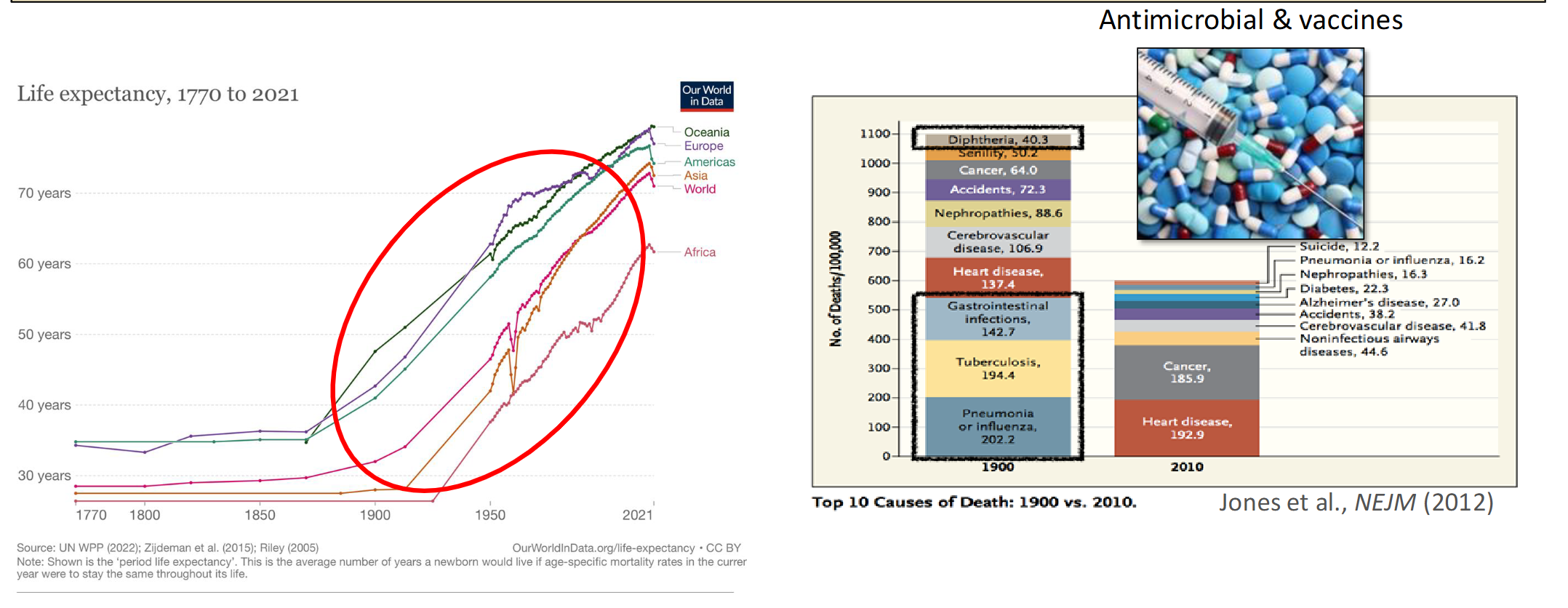
What was the turning point for human mortality throughout history?
Improved sanitation and hygiene: Reduced the spread of infectious diseases through cleaner water, waste management, and better hygiene.
Discovery of antimicrobial drugs and vaccines: Helped prevent and treat infectious diseases, further reducing mortality.
What was the World War I & 1918 Flu Pandemic?
January 1918-December 1920, two back-to-back influenza pandemics (a.k.a. “Spanish Flu”)
WWI hastened the pandemic (crowded clinics, trenches, global population movement, malnourishment)
Infected 500 million people worldwide, 50-100 million died (3-5% of the world’s population)
Doctors relied on chemical antispetics
The 1918 influenza pandemic highlighted the devastating consequences of infectious diseases before antibiotics were available.

What did Sir Alex Fleming Discover?
1928: Alexander Fleming discovered that Penicillium mould inhibited the growth of Staphylococcus bacteria, leading to the discovery of penicillin.
1940s: Mary Hunt discovered a more efficient penicillin-producing strain (Penicillium rubens) on a cantaloupe.
1941: Penicillin's effectiveness was demonstrated in a human patient.
WWII: Pfizer began manufacturing penicillin for widespread use.
1950s: Synthetic antibiotics were being produced.

How was Penicillin tested and what did it cure?
Florey and Chain (Oxford) purified penicillin and cured mice infected with staphylococci or streptococci
Human trials proved successful, and penicillin saved countless lives in WWII
Fleming, Florey and Chain received the 1945 Nobel Prize in Physiology and Medicine

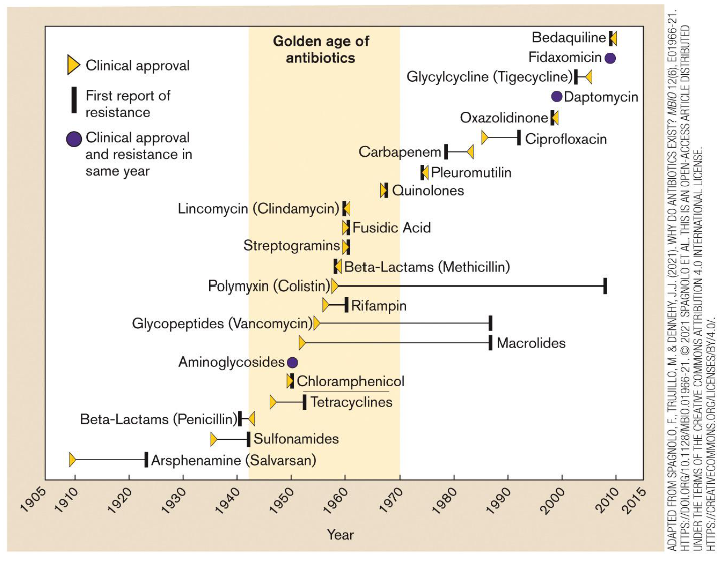
What was the Golden Era of Antibiotic Discovery?
A period approximately spanning the 1940s–1960s when many major antibiotic classes were discovered and introduced.
Many antibiotics were discovered decades before their clinical introduction.
The rate of discovery of new antibiotic classes subsequently declined.

Recap: Why do we care to Research Microbes?

What are the five major cellular targets of antibiotics, and what are examples of each?
Cell wall synthesis: Inhibit peptidoglycan synthesis.
Cell membrane integrity: Disrupt bacterial membranes.
Protein synthesis: Inhibit translation.
Nucleic acid function: Inhibit DNA or RNA synthesis.
Intermediary metabolism: Inhibit folate synthesis.
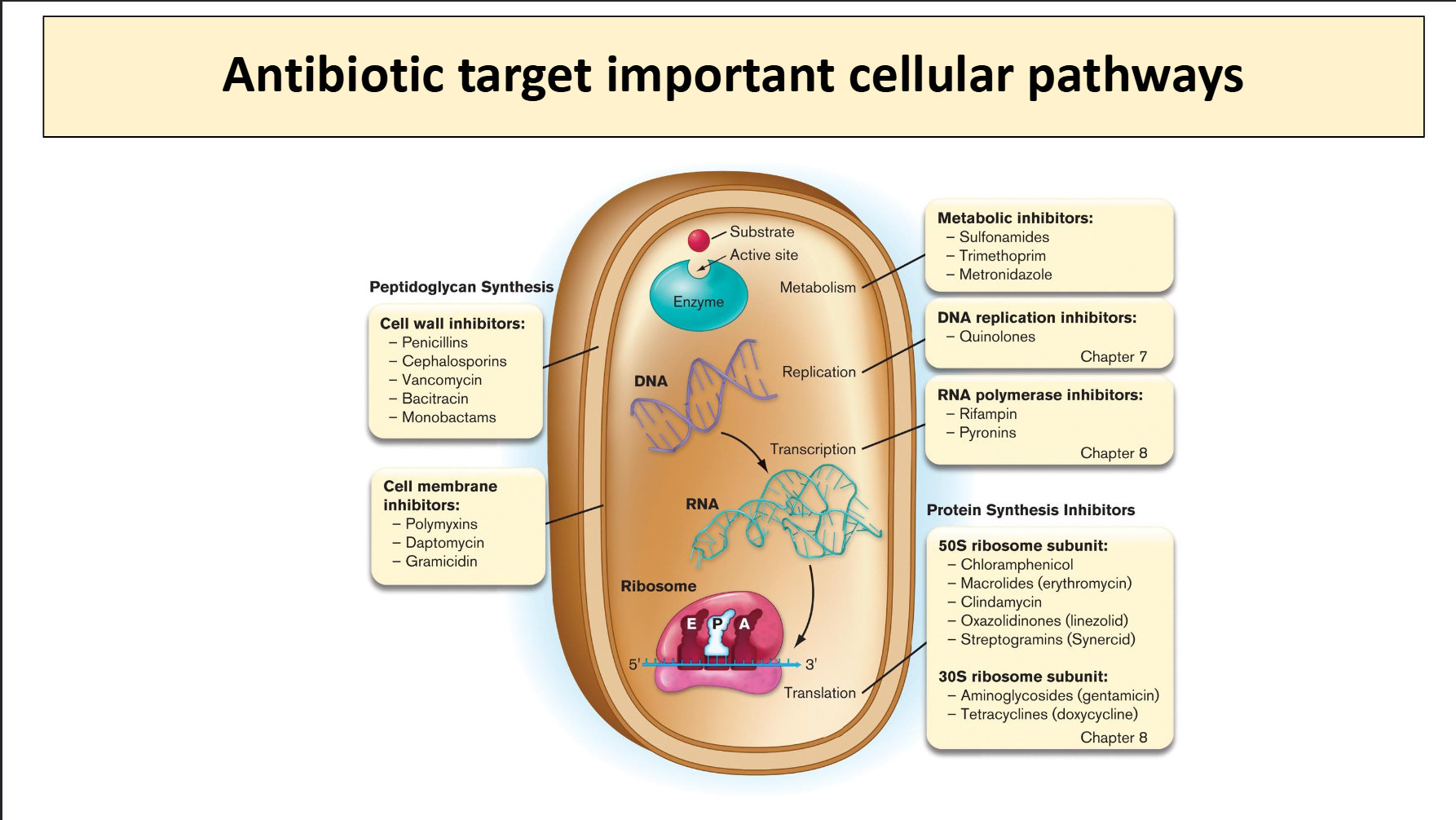
What is the difference between antibiotics that target the 30S and 50S ribosomal subunits?
30S (small subunit): Responsible for decoding mRNA.
Tetracyclines: Block tRNA binding.
Aminoglycosides: Cause misreading of mRNA.
50S (large subunit): Responsible for peptide bond formation and protein elongation.
Chloramphenicol: Inhibits peptide bond formation.
Macrolides: Interfere with protein elongation.
Both inhibit bacterial protein synthesis (translation).
What is antimicrobial resistance (AMR), and why is it a growing concern?
AMR occurs when microorganisms become resistant to antimicrobial drugs that previously inhibited or killed them.
Increasing antibiotic use creates selective pressure favouring resistant bacteria.
Resistance can emerge relatively soon after an antibiotic is introduced.
This reduces antibiotic effectiveness and contributes to a growing global health crisis.
What are the major global health and economic impacts of antimicrobial resistance (AMR)?
Over 5 million deaths worldwide were associated with bacterial AMR in 2019.
AMR costs Canada approximately $2 billion annually in medical care.
E. coli and S. aureus were the leading pathogens associated with resistance in 2019.
AMR is a worldwide crisis with substantial projected future mortality.
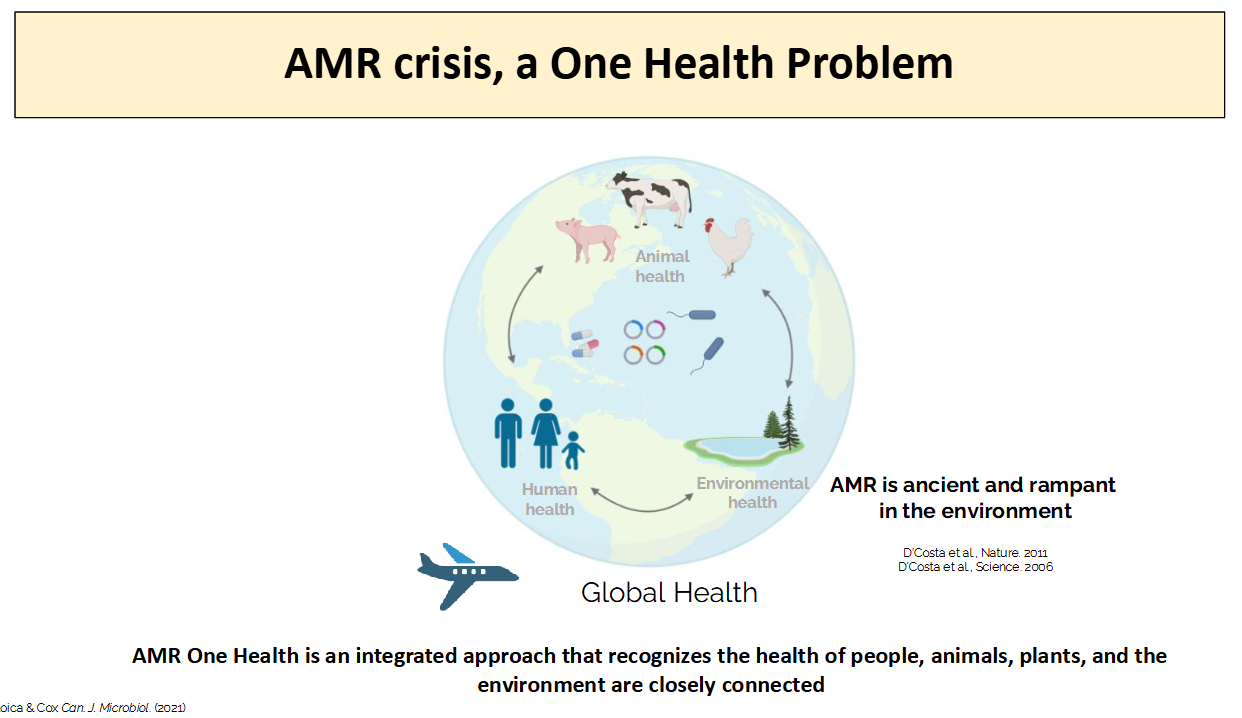
One Health recognizes that human, animal, plant, and environmental health are interconnected.
AMR affects humans, animals, and the environment, making it a global health concern.
Why do infectious diseases remain a concern despite advances in sanitation, vaccines, and antibiotics?
Emergence and re-emergence of infectious diseases: New diseases emerge and previously controlled diseases return (e.g., HIV/AIDS, Ebola, SARS-CoV-2).
Changing susceptibility to infections:
Compromised immune systems (e.g., HIV/AIDS, chemotherapy, immunosuppressants, organ transplants, aging).
Microbiome disruption (e.g., prolonged antibiotic treatment, stress, malnourishment).
Examples: Fungal infections and Clostridioides difficile.

How do population density, globalization and climate change/global warming contribute to the spread of infectious diseases?
Population density: More people living in close proximity increases opportunities for disease transmission.
Globalization: Increased international travel and population movement facilitate the spread of infectious diseases across countries and continents.
Climate change alters environmental conditions, potentially affecting the geographic distribution and transmission of infectious diseases.
Changing temperatures can influence where disease-carrying organisms can survive.
As a result, infectious disease risks may change across different regions.
How has the focus of microbiology research evolved over time?
Historically (over 150 years), microbiology primarily focused on microorganisms causing human infectious diseases.
Technological advancements (e.g., microscopy, bacterial culturing, genetics, molecular biology) expanded microbial research.
Scientists recognized that most microorganisms do not cause disease and are essential to life in the biosphere.
This led to new specialties, including environmental microbiology, microbial ecology, microbiome research, and industrial microbiology.
What is known about the relationship between the human microbiome and health?
Gut microbiome composition and function have been linked to metabolic disorders, mental health disorders, cancers, and neurodegenerative diseases.
Antibiotic use can disrupt the microbiome.
The microbiome contains enormous microbial diversity, much of which remains poorly characterized and understood.
Important: Associations between the microbiome and disease do not necessarily establish causation.
What role do microorganisms play in food production and fermentation?
Microorganisms are used in fermentation to produce various foods and beverages.
Microbial metabolism produces compounds that contribute to food flavour, aroma, and texture.
Examples include yogurt, cheese, and bread.
This demonstrates the beneficial applications of microorganisms beyond causing disease.
