AU26 Economics 2001.01 Chapter 7: Perfect Competition and The Invisible Hand
 Call Kai
 Learn
Learn Practice Test
 Spaced Repetition
 Match
Match Flashcards
 Knowt Play
1/16

There's no tags or description
Looks like no tags are added yet.
Name | Mastery | Learn | Test | Matching | Spaced | Call with Kai | Chat |
|---|
No analytics yet
Send a link to your students to track their progress
17 Terms
Invisible Hand
describes how self-interested individuals in a free market unintentionally benefit the wider public good
directs consumers and producers to maximize their surplus, leading to the highest level of social welfare
Who created the metaphor “Invisible Hand”?
Adam Smith
Adam Smith
Scottish economist and philosopher
- father of modern economics
reservation value
the absolute limit—the highest a buyer will pay or the lowest a seller will accept for a good or service
social surplus
same thing as total surplus
- ecPS+CS
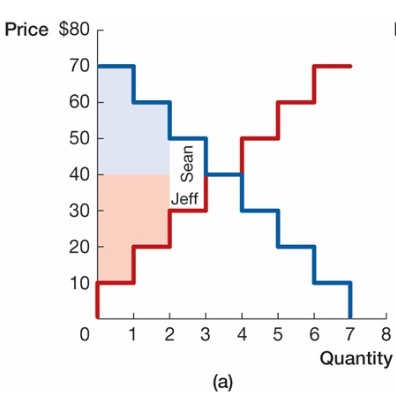
step curve
used to represent supply or demand when a market has a small, number of buyers or sellers rather than a smooth, continuous population
economic loss
any quantifiable financial or monetary damage suffered by an individual, business, or organization
break even
the precise level of production or sales where total revenue equals total costs, resulting in zero net profit or loss
deadweight loss
the reduction in social (total) surplus resulting from a market intervention
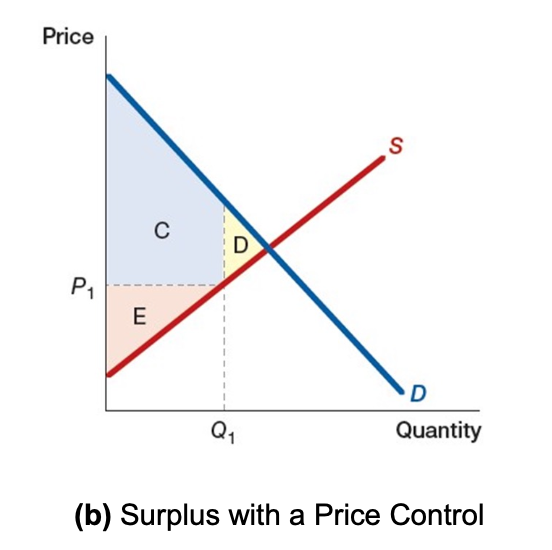
price control
act to restricy efficiency
market economy
prices direct flow of resources, provide incentive for participants
command economy
central agency direct resources, provides incentives
equity
ownership value in an asset or business
efficiency
occurs when an economy allocates scarce resources to maximize production and consumer satisfaction while minimizing waste
perfectly competitive markets
pareto efficency
when no one can be better off without making someone else worse off
close to the definition of equlbrium, but different terms
coordination problem
bringing together self-interested economic agents to form markets
How do we bring buyers and sellers together to make transactions?
incentive problem
how to motivate agents to participlate in markets
How do we motivate people to participate in economic activity?