des - software process models
 Call Kai
 Learn
Learn Practice Test
 Spaced Repetition
 Match
Match Flashcards
 Knowt Play
1/98

There's no tags or description
Looks like no tags are added yet.
Name | Mastery | Learn | Test | Matching | Spaced | Call with Kai | Chat |
|---|
No analytics yet
Send a link to your students to track their progress
99 Terms
Process
A series of steps taken to produce an intended output
Activities
Constraints
Resources
The 3 things that is involved in ‘Steps’
Tools
Techniques
The 2 things involved in ‘Process’
Process
Prescribes all major activities
Process
Uses resources and is subject to a set of constraints (ex. schedule, no. of people working)
Process
Can have subprocesses with hierarchy or links
Process
Each activity in this has an entry and exit criteria
Process
Activities are organized in sequence, so timing is clear
Process
Each process has guiding principles, including goals of each activity
Process
Constraints can apply to an activity, resource, or product
Process
Imposes consistency and structure on a set of activities
Process
Guides us to understand, control, examine, and improve the activities
Process
Enables us to capture our experiences and pass them along
Process Model
Description of a process at a given level
Process Model
An anticipation of what the process will look like
Process Model
What the process shall be (It will be determined during actual system development)
Process Model
Forms a common understanding
Process Model
Finds inconsistencies, redundancies, omissions. It also finds and evaluates appropriate activities for reaching process goals.
Process Model
Tailors a general process for a particular situation
Waterfall
Prototyping
V-Model
Incremental
Iterative
Spiral
RUP
Agile
8 common software process models
Waterfall Model
One of the first process models ever proposed. It is simple and easy to explain to customers.
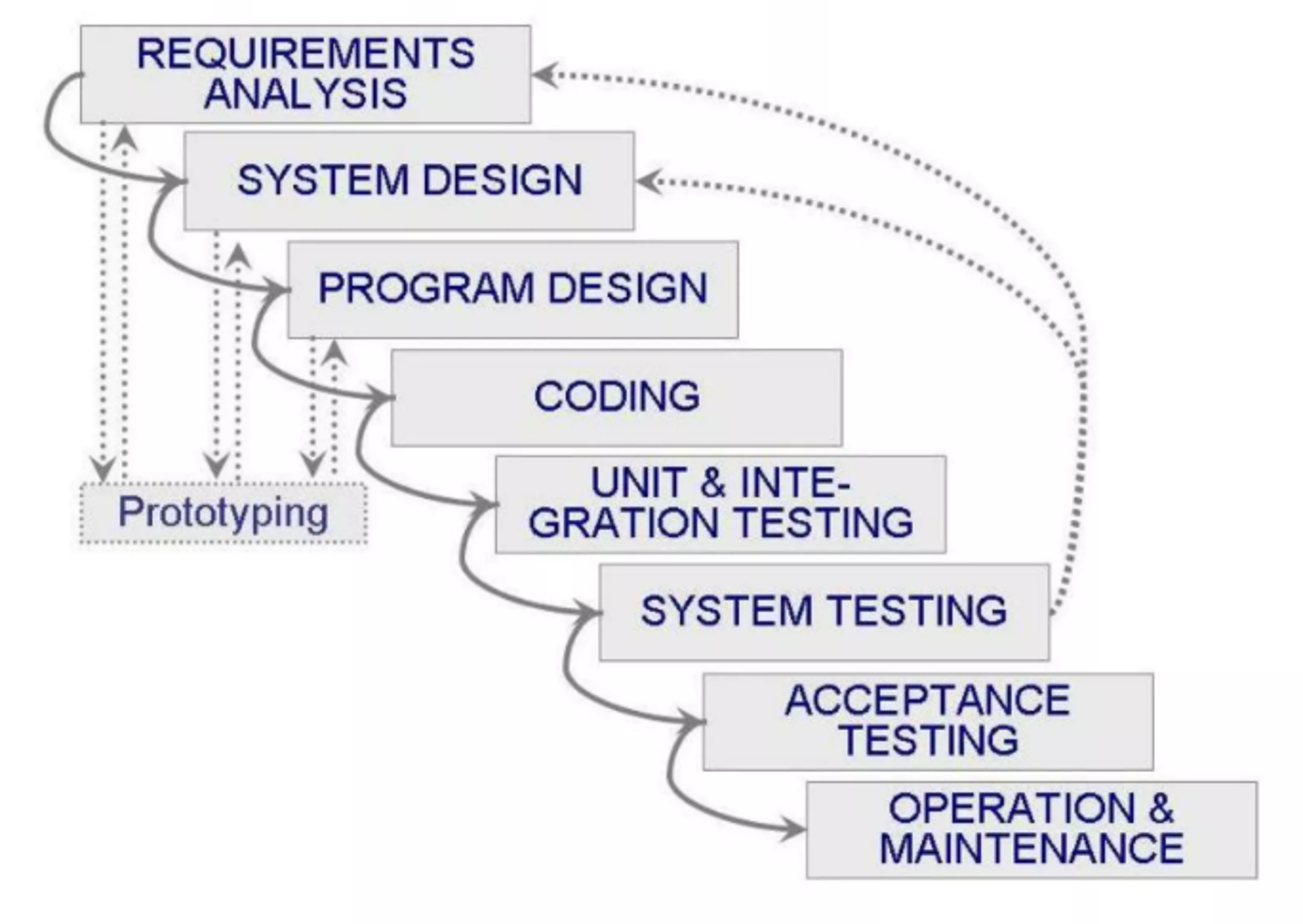
Requirements → System Design → Program Design → Coding → Unit & Integration Testing → System Testing → Acceptance Testing → Operation & Maintenance
The SDLC in a waterfall model
Waterfall Model
It presents a very high-level view of the development process and a sequence of process activities
Artefacts
In a waterfall model, each major phase is marked by milestones and deliverables otherwise known as ___
Waterfall Model
This model has no iterations and provides no guidance on how to handle changes to products and activities during development. It assumes requirements are frozen and cannot be changed.
Waterfall Model
Views software development as a manufacturing process rather than a creative process
Waterfall Model
This model has no iterative activities that lead to creating a final project. And customers would wait long before the final product
Prototype
This is a partially developed product
Prototype
This model helps developers assess alternative design strategies (design prototype) and users understand what the system will be like (user-interface prototype)
Prototype
This model is useful for verification and validation
Prototype
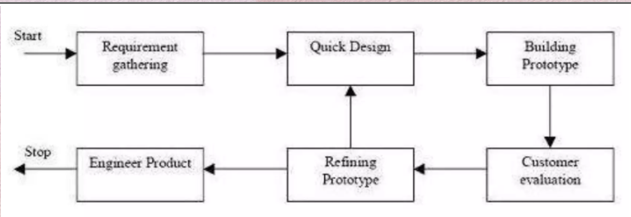
Waterfall Model with Prototyping
Prototype
Interacting with users and stakeholders at their respective phases
Prototype
Having a working model leads to better understanding and having quicker user feedback leads to better solutions.
Prototype
Errors can be detected much earlier and missing, ambiguous, complex functionality can be identified easily.
Prototype
It validates the requirements and leads to quick implementation of incomplete, but functional application
Prototype
Leads to implementing and then repairing the system a lot of time. This method can increase the complexity of the system and its scope may expand beyond original plans.
Prototype
Can cause the application to not be used as the full system was designed incomplete or can have inadequate problem analysis
Prototye
Use this model when the desired system has lots of user interaction (eg., online systems, or web interfaces).
Prototype
Use this system when end users constantly work with the system.
Feedback → Incorporate in the Prototype → Useable System
V-Model
A variation of the waterfall model.
V-Model
It uses unit testing to verify procedural design
Integration testing to verify architectural (system) design
Acceptance testing to validate the requirements.
V-Model
In this model, if problems are found during verification and validation, the left side of the V can be re-executed before testing on the right side is re-enacted
V-Model
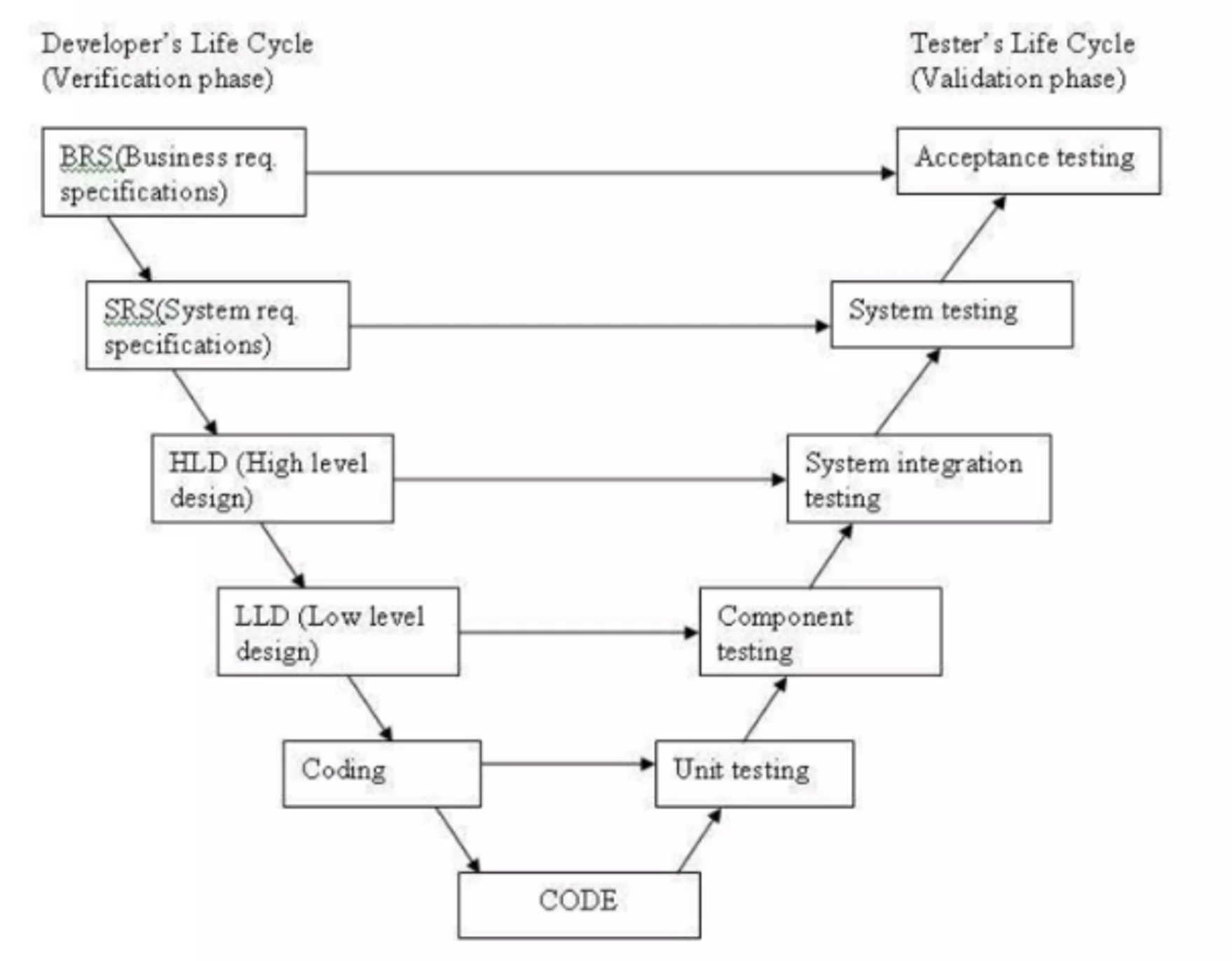
V-Model
Requirements like BRS and SRS begin the life cycle, just like in waterfall. But, in this model, a system test plan is created before development starts.
System Test Plan
This plan focuses on meeting the functionalities specified in the requirements gathering
High-Level Design (HLD)
This phase of the V-Model focuses on system architecture and design. It provides an overview of the solution, platform, system, product, and service/process.
During this phase, an integration test is created as well to test the pieces of the software systems ability to work together.
Low-Level Design (LLD)
This phase of the V-Model is where the actual software components are designed. It defines the actual logic for each and every component of the system.
In this phase, component tests are created as well. We also create class diagrams with all the methods and relations between classes.
Coding
This is at the very bottom of the V-Model. Module design is converted into code.
V-Model
Simple and easy to use, but also has testing activities and test designs before coding starts, which saves a lot of time and leads to a higher chance of success over the waterfall model.
V-Model
Has proactive defect tracking, which means defects are found at an early stage. It avoids the downward flow of defects.
V-Model
Works best for small projects where requirements are easily understood
V-Model
This model is very rigid and is the least flexible among all models.
V-Model
Software is developed during the implementation phase, so no early prototypes are produced. If any changes happen midway, then the test documents along with requirement documents has to be updated.
V-Model
Since there are no prototypes involved in this model, there is a very high risk involved in meeting customer expectations.
Only choose this model if there is a high confidence in the customer.
Incremental Model
In this model, the whole requirement has various builds. It has multiple development cycles which is why its also called sometimes as the “multi-waterfall cycle”
Incremental Model
This model has cycles which are smaller, more easily managed modules.
Modules are phases, and subsequent releases (which are also modules) adds function to the previous release. The process continues until the complete system is achieved.
Incremental Model
First Module → Working Version of Software → Working software early on during the SDLC
Incremental Model
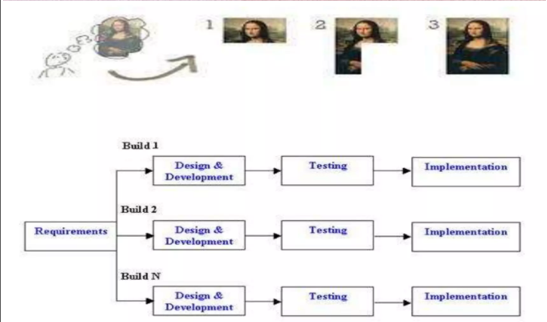
Incremental Model
It generates working software quickly and early during the software life cycle. It’s more flexible and costs less to change scope and requirements. It is easier to test and debug as it’s a smaller iteration
Incremental Model
Model where customers can respond to each build. It lowers initial delivery cost and makes it easier to manage risk as risky pieces are identified and handled during its iteration
Incremental Model
This model needs good planning and design and a clear and complete definition of the whole system before it can be broken down and built incrementally
Incremental Model
One disadvantage of this model is the price. Its total cost is higher than the total cost in the waterfall model.
Iterative Model
Doesn’t require a full specification of requirements at the start. The development begins by specifying and implementing just part of the software, which is then reviewed in order to identify further requirements.
The process is then repeated, producing a new version of the software for each cycle of the model
Iterative Model

Iterative Model
Only creates a high-level design of the application before beginning the actual product and defines the design solution for entire product.
Iterative Model
Design a system and build a skeleton version of that, and then evolve the design based on what had been build. Basically building and improving the product step by step
Iterative Model
It tracks defects at early stages, and has reliable user feedback. Less time on documenting, and more on designing
Iterative Model
Each phase of an iteration is rigid with no overlaps. The system architecture might become expensive or design issues may arise since not all requirements are gathered up front for the entire life cycle
Spiral Model
This model is similar to the incremental model but is more focused on risk analysis
Spiral Planning
This model has 4 phases: Planning, Engineering, Risk Analysis, and Evaluation.
A prototype is produced at the end of the risk analysis phase.
Engineering Phase
This phase in the Spiral Model determines goals, alternatives, and constraints
Risk Analysis
This phase in the Spiral Model evaluates alternatives and risks
Spiral Model
This model has a high amount of risk analysis. Hence, avoidance of risk is enhanced making it good for large and mission-critical projects. It doesn’t work as well as it does on smaller projects.
Spiral Model
This model has strong approval and documentation control. Functionalities can be added at a later date. And software is produced early in the software life cycle.
Spiral Model
This model can be costly. And it requires a highly specific set of expertise as it has high risk analysis. The project’s success is highly dependent on the risk analysis phase.
Rapid Application Development (RPD) Model
It is a type of incremental model where components/functions are developed in parallel as if they were mini projects.
Rapid Application Development (RPD) Model
Developments are time-boxed, delivered, and then assembled into a working prototype. It quickly gives customers something to see and use, and to provide feedback regarding the delivery and the requirements.
Business Modeling
This is a phase in the RDP Model where information flows between various business functions
Data Modelling
This is a phase in the RDP Model where information flows lead to data objects
Process Modeling
This is a phase in the RDP Model where the created Data Objects in the previous phase, is created to achieve some specific business objective + description.
CRUD of data objects.
Application Generation
This is a phase in the RDP Model where automated tools are used with the process models. Code + Actual System
Testing and Turnover
This is a phase in the RDP Model where new components and all interfaces are tested
RDP Model
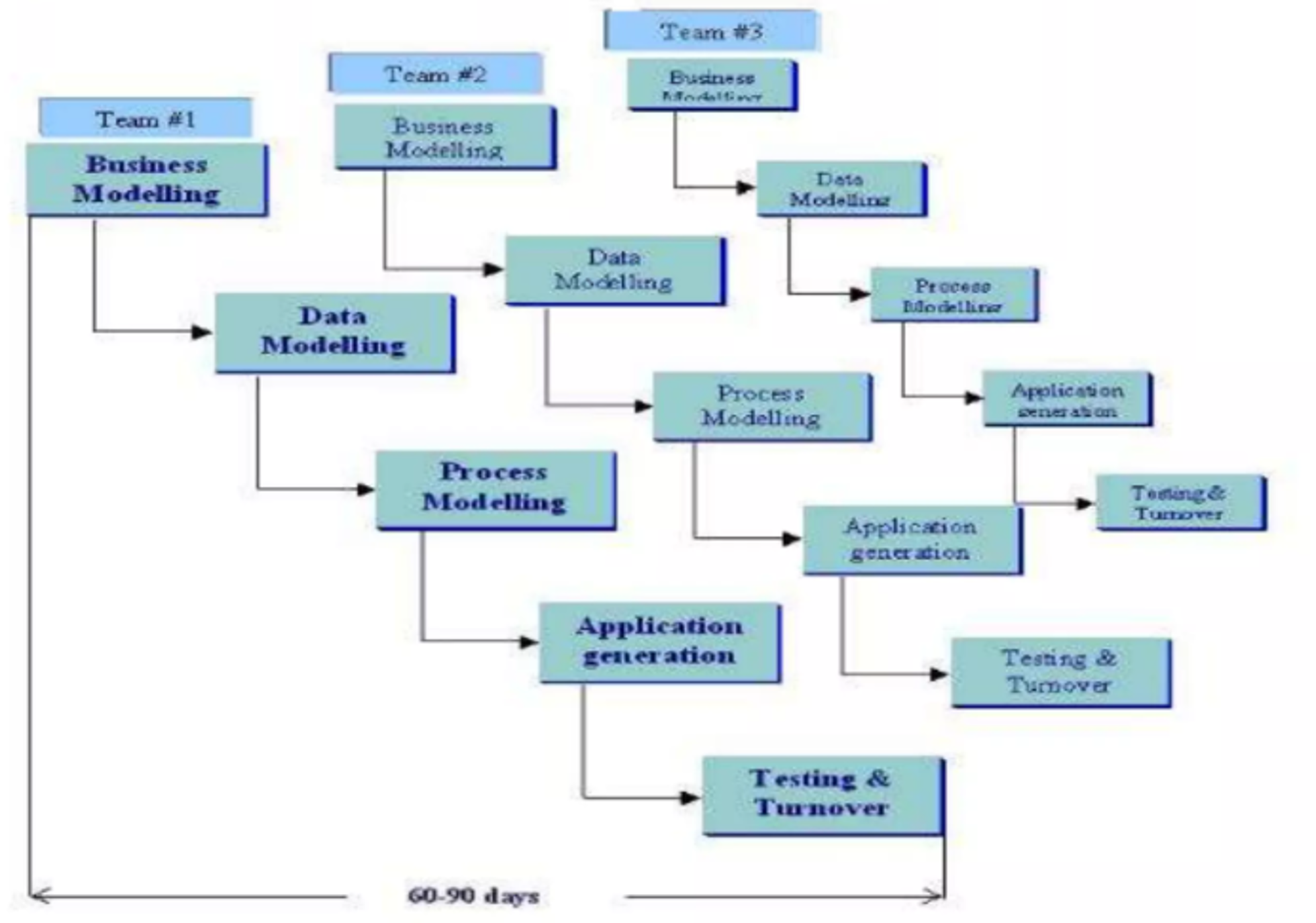
Rapid Application Development (RPD) Model
This model reduces development time and increases the reusability of components.
Rapid Application Development (RPD) Model
This model encourages customer feedback and initial reviews occur quickly in the life cycle. The integration testing in the beginning also solves a lot of integration issues
Rapid Application Development (RPD) Model
This model depends on a strong team (highly skilled developers/designers) and individual performances for identifying business requirements.
Rapid Application Development (RPD) Model
This model has a high dependency on modeling skills. Systems that can be modularized can be built using RAD.
Rapid Application Development (RPD) Model
Inapplicable to cheaper, smaller projects as the cost of the modeling and automated code generation is very high
Agile Model
A type of incremental model where the software is developed in incremental, rapid cycles.
Agile Model
Small incremental releases with each release building on previous functionality. Each release is thoroughly tested to ensure software quality is maintained. it is used for time critical applications
Extreme Programming (XP)
Currently one of the most well known agile development life cycle model
Agile Model

Agile Model
Ensures customer satisfaction by rapid, continuous delivery of useful software. People and interactions are emphasized rather than process and tools. Customers, developers, and testers constantly interact with each other.
Agile Model
Working software is delivered frequently (weeks rather than months). Face-to-face conversation is the preferred form of communication.
Agile Model
Continuous attention to technical excellence and good design. Regular adaptation to changing circumstances, where even late changes in requirements are welcomed.
Agile Model
in some software deliverables, especially large ones, it is difficult to assess the effort required at the beginning of the SDLC.
Agile Model
There is lack of emphasis on necessary designing and documentation and the project can easily get taken off track if the customer representative is not clear on the final outcome they want.
Agile Model
Only senior programmers are capable of decision-making during the development process. Hence, creating a space where newbie programmers are unwelcomed in unless they have experienced resource.