Botany exam 1
 Call Kai
 Learn
 Practice Test
 Spaced Repetition
 Match
 Flashcards
 Knowt Play
1/102

There's no tags or description
Looks like no tags are added yet.
103 Terms
closed mitosis
mitosis occurs within the confined nuclear membrane, primitive
open mitosis
mitosis occurs in an open cytoplasmic environment due to the disappearance of the nuclear membrane, derived
phycoplast
system of microtubules that develops between two daughter nuclei, parallel to plane of cell division, occur in chlorophyceae
furrowing
more ancestral cell division
phragmoplast
A spindle-shaped system of microtubules that arises between two daughter nuclei at telophase and within which the cell plate is formed during cell division, or cytokinesis. Found in all green algae except members of the class Chlorophyceae and in all plants.
coleochaete
genus of green algae in class Charophyceae, has asymmetrical flagellar root system, many mitochondria to power flagella
isogamy
sexual reproduction when the gametes are similar in size; found in some algae and fungi. most primitive
anisogamy
The condition of having dissimilar motile gametes.
oogamy
Sexual reproduction in which one of the gametes (the egg) is large and nonmotile, and the other gamete (the sperm) is smaller and motile. Most derived
asymmetric roots
most primitive root system, associated with MLS

double root
Most derived root system
motile/flagellated
most ancestral form of motility
sessile
most derived form of motility
zygotic life cycle
Meiosis to four haploid cells, which divide by mitosis to produce either more haploid cells or a multicellular individual that eventually gives rise to gamete. Haploid Dominant

gametophyte life cycle
Meiosis resulting in the formation of haploid gametes from a diploid individual; the gametes fuse to form a diploid zygote that divides to form another diploid individual. Diploid Dominant

sporophyte life cycle

Homoplasy
character state similarity not due to common descent
Proteobacteria
photosynthetic prokaryote, purple or green bacteria, bacteriachlorophyll, ancestral photosystem, carotenoid, anaerobic
aerobic
CO2 + H2O >light> CH2O (sugar) +O2
anaerobic in the presence of sulfer
2H2S + CO2 > CH2O +2S + H2O
H2S is the electron donor – NO oxygen
prochlorophytes
photosynthetic prokaryote, contain chl a, b, and carotenoids, NO phycobilins, aerobic, major group of photosynthetic bacteria
prochlorococcus
photosynthetic prochlorophyte, smallest known photosynthetic organism, 40-50% of phytoplankton biomass, produces 50% of O2 on earth
stromatolites
Layered chalk deposits, produced from colonies of cyanobacteria bind calcium-rich sediments
trichome
An outgrowth of the epidermis, such as a hair, scale, or water vesicle.
mucilaginous sheath
binds groups of cells or filaments together
heterocyst
A transparent, thick-walled, nitrogen-fixing cell that forms in the filaments of certain cyanobacteria
vegitative cell
the normal, photosynthetic cells that are formed under favorable growing conditions
nitrogen fixation
only cyanobacteria evolve O2 during photosynthesis, fix N2, nitrogenase is inactivated by O2
mechanisms to separate nitorgenase from oxygen
spacial heterocyst or fix nitrogen in the dark (found in non-heterocystic cyanobacteria)
neurotoxins
block neuron transmission in muscles, found in anabaena and oscillatoria
hepatotoxins
inhibit protein phosphatase, cause liver bleeding, found in drinking water from anabaena, oscillatoria, and nostoc
cyanobacteria movement
excretes mucilage or has helix fibers to send waves of contraction. NO flagella/cilia
spirulina
common in lakes with high pH, commercial food source, high in vitamins, proteins, and essential fatty acids
hormogonia
short pieces of trichome found in filaments. detaches from parent filament and glides away, form of asexual reproduction
akinete
thick-walled resting spore, resistant to unfavorable environmental conditions
haploid life cycle
reproduce by binary fission
chlorophyceae
class of protists including mostly freshwater, few marine and terrestrial. most have flagellated cells
chlamydomonas
genus of protists in chlorophyceae, has an eye spot and stores starch
volvox
reproduce both asexually and sexually, zygotic, spheroid with 500-60,000 flagellated cells, always oogamous- spherical colonies
hydrodictyon
“water net”, nonmotile, asexual and sexual reproduction, Pyrenoids, vacuole, chloroplasts, uni- multinucleate
oedigonium
Filamentous, freshwater, zygotic, oogamy lifecycle
fritschiella
Branched parenchymatous, can be connected by plasmodesmata
ulvophyceae
closed mitosis, motile cells, sexual reproduction, alternation of generations and sporic meiosis, marine,
ulva
sea lettuce
siphonous, Order siphonales
includes Codium “dead mans fingers”, caulerpa, halimeda, penicillus, and Acetabularia. some have calcified cell walls
Acetabularia
“mermaids wine glass” filamentious siphonous, thallus, gametic life cycle, coenocytic, nucleus is base. Class Ulvophyceae
coenocytic
multinucleate cell, multipule nuclear divisions
Stone worts (due to their calcified walls)
What is a common name for organisms in the order Charales?
class charophyceae
can be unicellular, cololnial, filamentious, or parenchymatous formes, both fresh and salt water
sporopollenin
a layer of durable polymer, forms thick cell wall
Sexual conjugation or asexually
How do desmids reproduce?
Cellulose plates, zygotic meiosis and asexual reproduction, mutualism with corals
Dinoflagellates have what characteristics?
Red tides are caused by what?
Dinoflagellates- sudden bloom due to nutrient-dense areas, many dinoflagellates are toxic, so they cause fish kills
Stramenopiles
Have tinsel flagellum and whiplash flagellum; also called Heterokonts
Diatom
Cell walls are frustules, they're made of silica, and have pennate or centric symmetry. Contain ch a and c, fucoxanthin, stores lips and chrysolaminarin
fucoxanthin
a brown accessory pigment
kelp life cycle
Sporic meiosis, heteromorphic
Sieve tubes
a column of phloem cells in Giant Kelp (Macrocystis)
What life cycle does rockweed have?
Gametic life cycle, also known as Fucas
Ectocarpus characteristics?
Type of brown algae (Phaeophyta), stores starch, has isomorphic sporic meiosis - has unilocular and pleurilocular sporangia
What life cycle does Sargassum have?
gametic
What phylum is red algae in?
rhodophyta
It has 3 generations- Gametes, carpospores, and tetraspores
What is unique about the red algae life cycle?
green algae relation to plants
molecular evidence, stores chlorophyll, accessory pigments, and starch. cellulose in cell walls
derived traits of plants
alternation of generations, always heteromorphic with increasing dominance of sporophytes, walled spores produced in sporangia, mutlicellular gametangia, mutlicellular dependent embryos, apical meristems
antheridium
sperm, male gametophyte in bryophytes
archegonium
egg, female gametophyte in bryophytes
evolution of green plants
plants invade land during silurian period
What do guard cells do in bryophytes
They surround the stomata- mosses have poorly developed stomata and some only have 1 guard cell.
Seta
The elongated stalk of a bryophyte sporophyte.
Yes- it relies on the gametophyte for nutrients
Is the sporophyte dependent on the gametophyte in bryophytes?
Bryidae has it, Sphagnidae does not
Which class of mosses has the peristome, and which one doesn't?
Ophioglossum - Adder's-Tongue fern
What is an example of a eusporangiate fern?
Circinate venation in fiddleheads
Just means it's coiled, Also protects leaf tip in early development
pteridophyta
What phylum are ferns in?
leptosporangiate
what clade are 97% of ferns in
carboniferous
what period did ferns emerge in
ophioglossum- adder’s tongue fern, whisk ferns
what is an example of a eusporangiate fern
No they're independent
Is the sporophyte dependent on the gametophyte in ferns?
Psilotum, scales instead of leaves, no roots, has protostele
What is the genus and unique characteristics of whisk ferns?
Equisetum, sporangia on sporangiophores, reduced megaphylls, hollow, rigid, silicon stems “scouring brushes”
What is the genus name and unique features of horsetails?
elaters
aid in the dispersal of spore in liverworts
sporangiophores
What are the sporangia on short stalks in equisetum called?

It is a nourishing layer
What is the purpose of the tapetum in sporangia development in ferns?
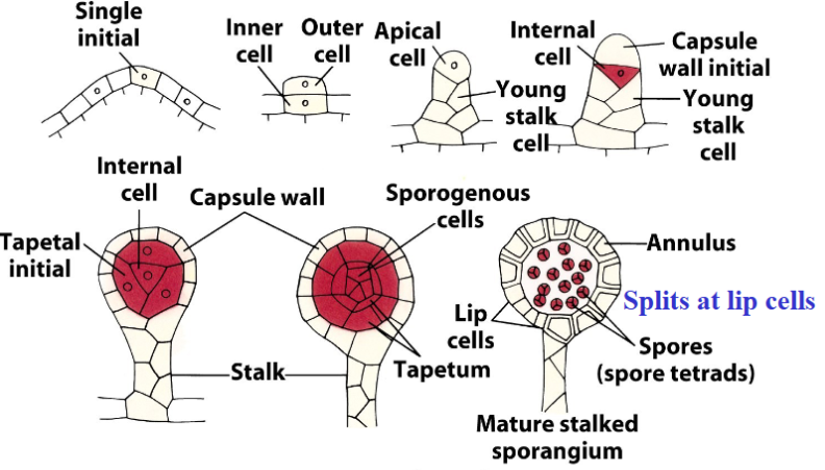
Ring around wall
What is the annulus in fern leptosporangia development?
Pyrenoids- they're the only land plants with pyrenoids
in the chloroplasts of hornworts
Columella
Central strand in hornworts, also in mosses
The sporophytes- this is important because this is link to evolution to vascular plants
Where do somata occur in hornworts?
bryophyte reproduction
gametophyte dominant, sporophyte dependent
lycophyte reproduction
sporophyte dominant, sporophyte and gametophyte independent
chlamydomonas, volvox, hydrodictyon, oedogonium, fritschiella
name genuses in class chlorophyceae of protists
ulva
name genuses in the class ulvophyceae of protists
spirogyra, desmids, stonewarts
name genuses in class charophyceae in protists
diatoms
name a stramenopile
Homospores
What kind of spores do lycophytes have?
Selaginella
Which club moss genus is heterosporous?
Ligule
hair-like structure in the strobilus of selaginella
What is a sporophyll?
a leaf that bears sporangia
Megaspore and microspore
Which 2 spores do Selaginella have?
Help push the embryo down so it can get more nourishment from gametophyte.
What does the suspensor in a lycophyte do?