Chemistry unit 1
 Call Kai
 Learn
Learn Practice Test
 Spaced Repetition
 Match
Match Flashcards
 Knowt Play
1/96

There's no tags or description
Looks like no tags are added yet.
Name | Mastery | Learn | Test | Matching | Spaced | Call with Kai | Chat |
|---|
No analytics yet
Send a link to your students to track their progress
97 Terms
Atom
the smallest part of an element that can exist
Compounds are formed from…
Elements by chemical reactions
Chemical reactions always involve…
The formation of one or more new substances
Chemical reactions often involve…
A detectable energy change
Compounds contain…
Two or more elements chemically combined in fixed proportions
Compounds can only be separated into elements by…
Chemical reactions
A mixture consists of…
Two or more elements or compounds not chemically combined together
The chemical properties of each substance in the mixture are…
Unchanged
Mixtures can be separated by…
Physical processes
The 5 physical processes
Filtration
Crystallisation
Simple distillation
Fractional distillation
Chromatography
Physical processes do not involve… and no new…
Do not involve chemical reactions and no new substances are made
Filtration

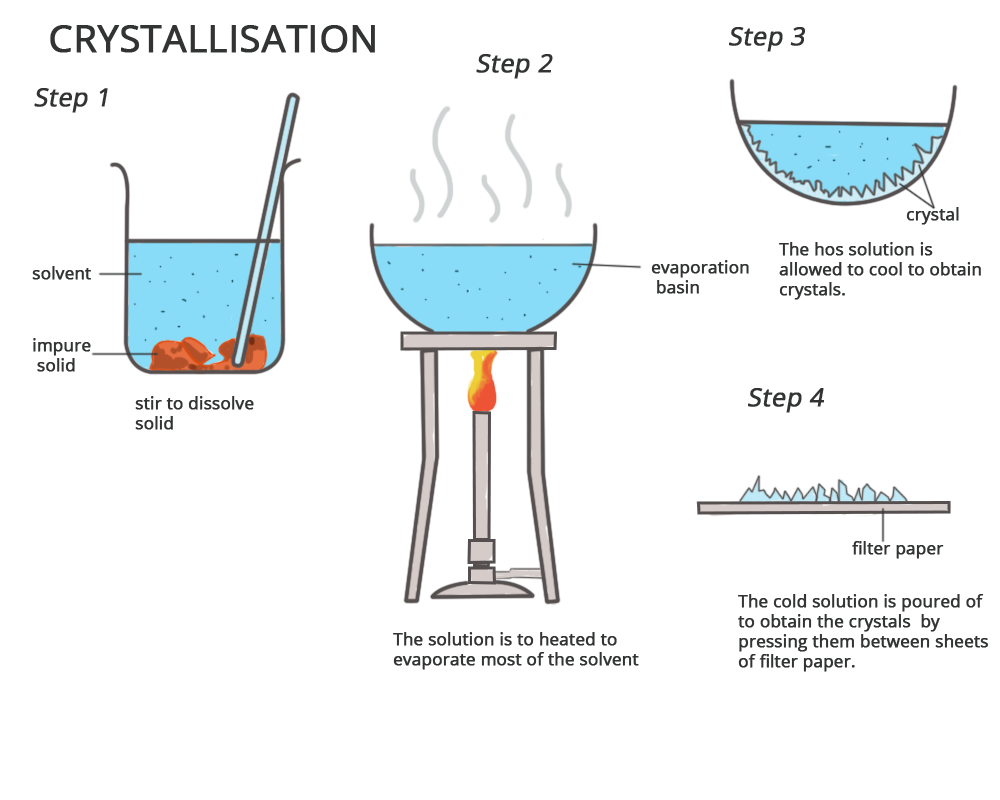
Crystallisation
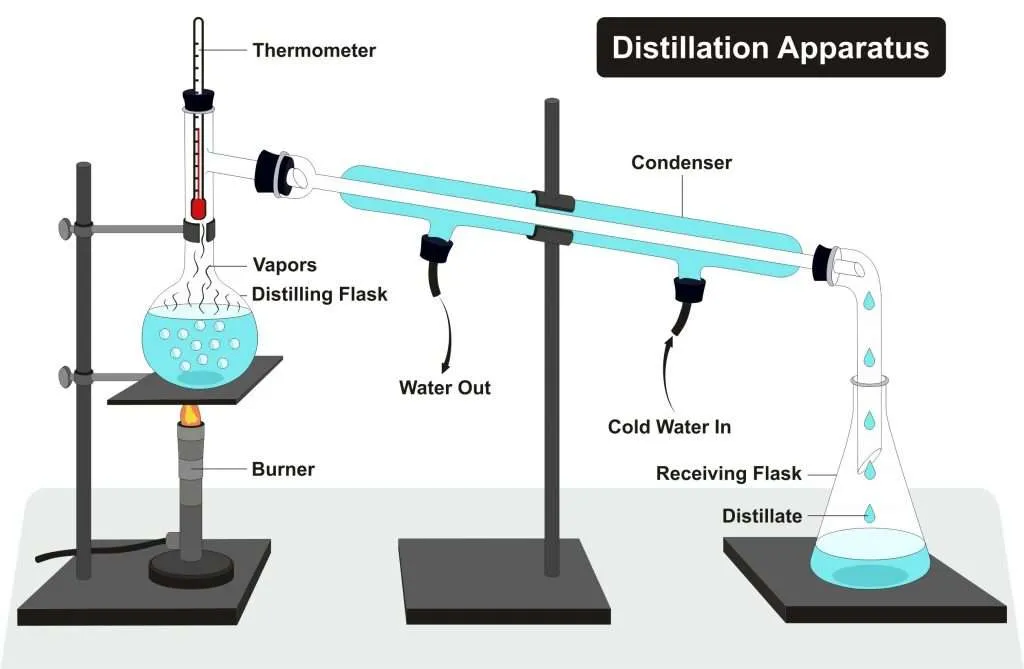
Simple distillation
Fractional distillation

Filtration method
Filtration is used to separate an insoluble solid from a liquid.
Involves a circle of filter paper folded to make a cone and placed into a filter funnel.
The filtrate is the liquid which passes through the filter paper and the residue is the solid left on the filter paper.
Crystallisation method
Is used to produce solid crystals from a solution.
A solution is placed in an evaporating basin and heated with a Bunsen burner.
The volume of the solution decreases because some of the water has evaporated. Solid particles begin to form in the basin.
After the remaining solution has cooled down, filter the excess liquid and leave the crystals to dry.
Simple distillation method:
Is used to separate a solvent from a solution. Simple distillation works because the dissolved solute has a much higher boiling point that the solvent.
When the solution is heated solvent vapour evaporates from the solution. The gas moves away and is cooled and condensed. The remaining solution becomes more concentrated in solute as the amount of solvent in it decreases,
Fractional distillation method:
Is used to separate different liquids from a mixture of liquids.
It works because the different liquids have different boiling points.
When the mixture is heated vapours rise through a column which is hot at the bottom and cold at the top.
Vapours condense when they reach a part of the column that is below the temperature of their boiling point.
The liquid flows out of the column.
Paper chromatography:
Is used to separate mixtures of soluble substances. Food colouring, ink, dye
Solvent
The liquid in which the solute dissolves to form a solution
Solution
Mixture formed by a solute and a solvent
Solute
The dissolved substance in a solution
Development of the atom
First → tiny spheres
Then discovery of the electron → led to plum pudding model
Next alpha particle scattering experiment → led to the nuclear model
Finally → Bohr suggested that electrons orbit the nucleus at specific distances
Then → Chadwick discovered neutrons
First model of the atom
Atoms were thought to be tiny spheres that could not be divided
Plum pudding model
The atom is a ball of positive charge with negative electrons embedded in it.
Alpha particle scattering experiment
Led to the conclusion that atoms are mainly empty space and the mass is concentrated at the nucleus, which is charged.
Nuclear model
Mostly empty space and the mass of the atom is concentrated at the nucleus which is charged,
Bohr’s adaptation
Suggested that the electrons orbit the nucleus at specific distances.
Later experiment led to the idea that…
The positive charge of any nucleus could be subdivided into a whole number of smaller particles, each particle having the same amount of positive charge. These particles were given the name proton.
James Chadwick’s experimental work
Provided the evidence to show the existence of neutrons within the nucleus.
This was about 20 years after the nucleus became an accepted scientific idea.
Relative electrical charge
Proton: +1
Neutron: 0
Electron: -1
In an atom, the number of electrons is equal to the number of…
Protons in the nucleus
Do atoms have an overall electrical charge?
Atoms have no overall electrical charge.
Atomic number =
Number of protons
All atoms of a particular element have the same number of…
Protons
Atoms are very small having a radius of about…
0.1nm (1 × 10 ^ -10 m)
The radius of a nucleus is less than about
1/10 000 of that of the atom
Almost all of the mass of an atom is in…
The nucleus
Relative masses
Proton: 1
Neutron: 1
Electron: very small
The sun of the protons and neutrons in an atom is its…
Mass number
Atoms of the same element can have different numbers of…
Neutrons
Atoms of the same element with a different number of neutrons are called…
Isotopes of that element
Relative atomic mass calculation:
(mass x %) + (mass x %)
100
Electronic structure:
The electrons in an atom occupy…
The lowest available energy levels.
Period
→
Group
^
How many electrons can fit on each shell
2, 8, 8
Elements with a full outer shell go in Group…
0
Ions are…
Atoms which have an overall charge (because they have lost or gained electrons)
Positive ions have … electrons
Lost electrons
Negative ions have … electrons
Gained electrons
The elements in the periodic table are arranged in order of
Atomic (proton) number
Due to elements being arranged in order of atomic number…
Elements with similar properties are in the same group.
It is called the periodic table because…
Similar properties occur at regular intervals.
Elements in the same group have…
The same number of electrons in their outer shell (this gives them similar chemical properties)
Before protons, neutrons and electrons were discovered; scientists arranged the elements in order of…
Their atomic weights
The early periodic tables were incomplete and some elements were placed in inappropriate groups if…
The strict order of atomic weights was followed
Mendeleev overcame some of the problems by…
Leaving gaps for elements that he thought had not been discovered and in some places changed the order based on atomic weights
Elements with properties predicted by Mendeleev were discovered and filled the gap…
Isotopes made it possible to explain why the order based on atomic weight was not always correct.
Elements that react to form positive ions are…
Metals
Elements that do not form positive ions are…
Non-metals
The majority of elements are…
Metals
On the periodic table metals are..
Bottom left
On the periodic table non-metals are…
Top right
Elements in group 0 are called…
Noble gases
Noble gases are…
Unreactive
Do not easily form molecules because their atoms have stable arrangements of electrons.
Noble gases have … electrons in their outer shell
8
EXCEPT helium which only has…
2
What happens to the boiling points of noble gases with increasing relative atomic mass (going down the group)
Increase
The elements in group 1 are called…
Alkali metals
Alkali metals have characteristic properties because…
Of the single electron in their outer shell
In group 1, the reactivity of the elements … going down the group
Increases
Reaction of lithium and water
Reacts vigorously to produce hydrogen and lithium hydroxide
Reaction of sodium and water
React vigorously to produce hydrogen and sodium hydroxide
Reaction of potassium and water
Burns violently with sparks and a lilac flame
Produces hydrogen and potassium hydroxide
Reaction of lithium and oxygen
Burns with a strongly red tinged flame
Producing a white sold called lithium oxide
Reaction of sodium and oxygen
Burns with a strong orange flame
Produce a white solid, sodium oxide
Reaction of potassium and oxygen
Burns vigorously with a lilac flame
Produces a white solid, potassium oxide
Reaction of lithium and chlorine
React rapidly to produce white lithium chloride
Reaction of sodium and chlorine
Reacts rapidly to form white sodium chloride
Reaction of potassium and chlorine
Reacts rapidly to produce white potassium chloride
Group 7 elements are called…
Halogens
Halogens have similar reactions because…
They all have seven electron in their outer shell
Halogens are non-metals and…
Consist of molecules made of pairs of atoms
Halogens react with metals to form…
Ionic compound in which the halide carries a -1 charge
Halogens react with non-metals to form
Covalent compounds where there is shared pair of electrons
In group 7, the further down the group, the higher its…
Relative molecular mass (the size of the molecule)
Melting point
Boiling point
In group 7, the reactivity… going down the group
Decreases
Reactivity decrease going down the group because…
Halogens react by gaining an electron to achieve a full outer shell (when they act like this their name ends in -ide)
As you go down, the number of shells increases, the element attracts electrons from other atoms less, so doesn’t react as easily
Conclusion: increased distance + increased shielding
Decrease in reactivity means…
A more reactive halogen (one higher up the group) can displace a less reactive halogen from an aqueous solution of its salt.
Why do group 1 elements increase in reactivity going down the group?
As we move down Group 1, the distance between the positive nucleus and negative outer electron increases.
As this distance increases, the outer electron is less attracted to the positive nucleus.
Also, the outer electron is shielded. Which also decreases the attraction between the nucleus and outer electron,
Transition elements
Metals with similar properties, which are different from those of the group 1 elements.
Properties of group 1 metals:
Soft
Relatively low melting points
Low density
React rapidly with oxygen, chlorine and water
When they react they form ions with 1+ charge
Properties of transition metals:
Harder and stronger
Have higher melting points
Have higher densities
Much less reactive: react slowly with oxygen and chlorine
Form ions with different charges
Form coloured compounds
Act as catalysts
Why are elements not instantly widely accepted?
Time is needed for peer review