Chem Unit Three (CH5&6)
 Call Kai
 Learn
 Practice Test
 Spaced Repetition
 Match
 Flashcards
 Knowt Play
1/84

There's no tags or description
Looks like no tags are added yet.
85 Terms
Pressure
Force per unit area exerted against a surface
760
1 atm = ____mm hg
760
1 atm = ____ torr
101,325
1 atm = ____ Pa
Manometer
Measures the pressure of a gas sample
Combined Gas Law
What is this equation?

Standard Pressure and Temperature (STP)
A set of reference conditions where temperature is 0°C (273.15 K) AND pressure is 1 atm.
22.4 Liters
At STP, 1 mole of any gas will have a volume of _____
Ideal Gas Law
PV = nRT
PV = nRT
What is the Ideal Gas Law equation?
Partial Pressure
The pressure that a particular gas would exert if it were alone in the container
Dalton’s Law of Partial Pressure
For a mixture of gases in a container, the total pressure exerted is the sum of the pressures that each gas would exert if it were alone.
PTotal = PA + PB + PC +….
What is the equation for Dalton’s Law of Partial Pressures?
Gases consist of particles constantly moving through space in random directions at various speeds.
Gas particles have no volume.
There are no attractive forces between gas particles.
The average kinetic energy of gas particles is proportional to the temperature in kelvins.
Molecular collision are elastic; when molecules collide they may exchange Kinetic energy, but the total kinetic energy remains constant.
Molecules collide with the walls of their container; these collisions constitute the pressure of the gas.
What are the 6 assumptions of Ideal Gas Kinetic Molecular Theory? (Long Answer)
low pressures and high temps
Gas behavior is closest to ideal at ___________
Intermolecular Forces (IMF)
Attractive forces that exist between molecules.
Intermolecular Forces (IMF)
The strength of ___________ between molecules determines whether any sample of matter is a gas, solid, or a liquid.
Condensation
Gas state to a liquid state
Solidification
Liquid state to a solid state
London Dispersion Forces
Intermolecular Forces (IMF) that exists as a result of instantaneous dipoles/temporary polarization.
Dipole-Dipole Interactions
Intermolecular Forces (IMF) that come from the electrostatic attraction between oppositely charged ends of neighboring dipoles.
Hydrogen Bonding
Intermolecular Forces (IMF) which consists of noncovalent force of attraction between the partial positive on a hydrogen bonded to a N, O, or F and the partial negative charge from a long pair on a nearby N, O, or F.
(0.0821 LxAtm/molxK)
What is the ideal gas constant?
True
True or False: All molecules have dispersion forces?
very high
Ionic bonds have _______ energy
very weak
London dispersion forces have _______ energy
Surface Tension
Resistance of a liquid to an increase in its surface area
Kinetic
______ energy increases as temperature increases
Vapor Pressure
The partial pressure of the vapor in equilibrium with the liquid
Boiling Point
The temperature at which the vapor pressure of a liquid equals the atmospheric pressure
Normal Boiling Point
The temperature at which the vapor pressure of a liquid equals 760 mmHg
Nature and strength of the intermolecular forces
Molecular size and shape
What are the 2 factors affecting Boiling Point?
Phase
Any part of a system that looks uniform throughout
Phase Change
A change from one physical state to another
Condensation
Gas ——> liquid
Evaporation or vaporization
Liquid ——> Gas
Deposition
Gas —→ Solid
Sublimation
Solid —→ Gas
Crystallization, solidification, or freezing
Liquid —→ Solid
Melting or Fusion
Solid —→ Liquid
Sublimation curve
The curve that represents the boundary between solid and gas
Fusion Curve
The curve that represents that boundary between solid and liquid
Vaporization Curve
The curve that represents the boundary between liquid and gas
Triple Point
When the 3 curves meet on the phase diagram
Critical Point
The point at which the boundary between liquid and gas blurs
Solution
A homogenous Mixture
Solute
A minor component being dissolved
Solvent
A major component doing the dissolving (usually water)
Aqueous Solution
A solution in which the solvent is water
Solubility
The maximum amount of a solute that dissolves in a given amount of solvent at a given temperature.
Dilute
Weak; little solute dissolved in solvent
Concentrated
Strong; Lots of solute dissolved in solvent
Saturated Solution
Solution with the maximum amount of solute dissolved
Unsaturated Solution
Solution with less than the maximum amount of solute dissolved
Supersaturated solution
Solution with more than the maximum amount of solute dissolved
Nature of the solvent and the solute
Temperature
Pressure
What are the 3 solubility factors?
Percentage (%)
Concentration is expressed as a ______
Parts per million (ppm) or parts per billion (ppb)
For very dilute solutions, concentration can be expressed in ______ or _______
Weight of solute per weight of solution (w/w)
Volume of solute per volume of solution (v/v)
Weight of solute per volume of solution (w/v)
What are the terms in which concentration can be caluclated?
Molarity = (Mol solute/L solution)
What is the equation for molarity?
M1V1 = M2V2
What is the equation for dilution?
Electrolyte
A solution that has dissolved ions in it and can conduct electricity
Nonelectrolyte
A solution that cannot conduct electricity
Strong electrolyte
Ionic compounds fully ionize
Weak electrolyte
Ionic compounds only partially ionize
Polar
_____ covalent molecules dissolve in water
Nonpolar
______ covalent molecules do NOT dissolve in water
Colloid
A solution in which the solute particle diameter is between 1nm and 1000nm
Solutions
Particle size: 0.1 - 1.0
Filterable with paper: No
Homogenous: Yes
Settles on standing: No
Behavior to light: Transparent
Colloids
Particle size: 1-1000
Filterable with paper: No
Homogenous: Borderline
Settles on standing: No
Behavior to light: Tyndall Effect
Suspensions
Particle size: Greater than 1000
Filterable with paper: Yes
Homogenous: No
Settles on standing: Yes
Behavior to light: Translucent or opaque
Tyndall Effect
Scattering of light by particles in a colloid or fine suspension
Brownian Motion
Random movement of particles suspended in a fluid or other medium
Colligative Property
A property that depends on the number of particles dissolved in the solution, but not on the type of particles
Freezing Point Depression
Boiling Point Elevation
Osmosis
What are the 3 important Colligative Properties
ppm = (solute/solution) x106
What is the equation for ppm?
ppb = (solute/solution) x 109
What is the equation for ppb
% = (solute/solution) x 100
What is the equation for percentage of concentration?
Increases
As temperature increases, solubility of solids in liquids _______
Decreases
As temperature increases, solubility of gas in liquids _______
Increases
As pressure increases, solubility of gases in liquid ________
(P1 V1/n1 T1) = (P2 V2/n2 T2)
What is the combined Gas Law equation
Fully Ionized
What level of Ionization?

Partially Ionized
What level of Ionization?
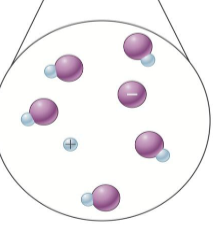
No Ionization
What level of Ionization?