Flash Photography - Laboratory
 Call Kai
 Learn
 Practice Test
 Spaced Repetition
 Match
 Flashcards
 Knowt Play
1/6

There's no tags or description
Looks like no tags are added yet.
7 Terms
45–degree lighting
uses one or more lights positioned at 45–degree angles. If only one light is used, a white or silver reflector can be placed on the opposite side of the evidence to reflect some of the light back toward the evidence, reducing shadows.
is used for photographing the average item of evidence where the objective is to show the item’s shape and size.

Direct reflective lighting
is reflected directly off the subject into the lens. This is done by placing the subject at a 10–degree angle from the lens to film plane and placing the light source at a 10–degree angle from the subject. The light source reflects at a 20–degree angle into the lens.
is used to minimize shadows within the evidence. However, this method creates very high contrast and does not show the dimensional shape or texture of the evidence. Also, the light source may need to be diffused to prevent hot spots

Oblique lighting
uses a light source positioned at a low angle. is usually used to show detail by creating shadows on the surface of the evidence.
is commonly used when photographing impressions, tool marks and certain types of fingerprints. A very low oblique angle of lighting can be used to dusty footwear impressions and indented writing.

Bounce lighting
uses light bounced off a white or reflective surface. The bounce surface may be positioned at different locations (above or to one side of the subject) to create the desired effect. This usually produces even non–glare lighting with low contrast.
Diffused lighting
uses an opaque material placed between the light source and the subject to soften the light. This usually results in even lighting with reduced reflections and hot spots. The opaque material can be as simple as a section of a white bed sheet or an empty water bottle, or can be a commercial device designed for laboratory photography
is usually used for photographing evidence with shiny or reflective surfaces.

Transmitted lighting
ses light that shines through the evidence toward the camera’s lens. The background becomes shadow–free. The angle of the transmitted lighting can be adjusted from 90–degrees to 45–degrees for the desired effect.
is used for photographing transparent or translucent subjects. It is effective in photographing evidence such as a fingerprint on a drinking glass.

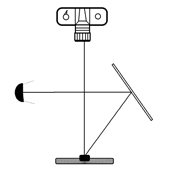
Front directional lighting
allows you to send light straight down onto the evidence. A clear piece of glass is placed between the subject and lens at a 45–degree angle. The light source is positioned parallel to the film plane and 45–degrees to the glass. While the light is transmitted through the glass, some is reflected downward directly on the subject.
