games and economic behavior exam 2
 Call Kai
 Learn
Learn Practice Test
 Spaced Repetition
 Match
Match Flashcards
 Knowt Play
1/104

There's no tags or description
Looks like no tags are added yet.
Name | Mastery | Learn | Test | Matching | Spaced | Call with Kai | Chat |
|---|
No analytics yet
Send a link to your students to track their progress
105 Terms
write out the profit/payoff function for the relevant player
Xavier’s and Yvonne’s are the only two restaurants in a small town. Yvonne’s charges Py per customer, and each customer costs $2 to serve. If Xavier’s charges Px per customer, Yvonne’s serves Qy=44−2Py+Px customers. What is Yvonne’s profit function?
Py(44 - 2Py +Px) - 2(44 - 2Py + Px)
write out the profit/payoff function for the relevant player
South Korea and Japan are the only builders of Very Large Crude Carriers. Korea builds qK ships at a cost of $30 million per ship. If Japan builds qJ ships, the price (in millions of dollars) is P=180−qK−qJ. What is Korea’s profit function?
(180 - qk - qj)qk - 30qk
write out the profit/payoff function for the relevant player
Monica and Nancy run a business as partners. Monica puts in effort m, and Nancy puts in effort n. They split the business’s profits of 4m+4n+mn (in tens of thousands of dollars) equally. Monica’s effort costs her m2 (in tens of thousands of dollars). What is Monica’s payoff function?
(1/2)(4m + 4n + mn) - m^2
expand the payoff function
Py(44 - 2Py +Px) - 2(44 - 2Py + Px)
Profity= -2Py² + 48Py + PxPy - 2Px - 88
expand the payoff function
(180 - qk - qj)qk - 30qk
ProfitK = 150qk - qk² - qjqk
expand the payoff function
(1/2)(4m + 4n + mn) - m^2
ProfitM = 2m + 2n + 0.5mn - m²
factor the payout function
Py(44 - 2Py +Px) - 2(44 - 2Py + Px)
ProfitY = (Py -2)(44 - 2Py + Px)
factor the payout function
(180 - qk - qj)qk - 30qk
ProfitK = qk (150 - qk - qj)
factor the payout function
(1/2)(4m + 4n + mn) - m^2
ProfitM = m(2 + 0.5n - m) + 2n
find the derivative with respect to x
−2x² +4x +7
-4x + 4
find the derivative with respect to x
-x² + 5
-2x
find the derivative with respect to x
17yx− x²
17y - 2x
find the derivative with respect to x
6x−3x² +2zx−bx+4z
6 - 6x + 2z - b
find the derivative with respect to x
3bx−x² +y² −2yzx
3b - 2x - 2yz
At which value of x does the expression attain its global maximum?
−2x² +4x+7
x = 1
At which value of x does the expression attain its global maximum?
−x²+5
x = 0
At which value of x does the expression attain its global maximum?
17yx−x²
x = 17y /2
At which value of x does the expression attain its global maximum?
6x−3x²+2zx−bx+4z
x = 1 + 1/3z - b/6
At which value of x does the expression attain its global maximum?
3bx−x²+ y² −2yzx
x = 3b/2 -yz
find each players best response rule
Xavier’s and Yvonne’s are the only two restaurants in a small town. Yvonne’s charges Py per customer, and each customer costs $2 to serve. If Xavier’s charges Px per customer, Yvonne’s serves Qy=44−2Py+Px customers.
Py = 12 + Px/4
Px = 12 + Py/4
find each players best response rule
South Korea and Japan are the only builders of Very Large Crude Carriers. Korea builds qK ships at a cost of $30 million per ship. If Japan builds qJ ships, the price (in millions of dollars) is P=180−qK−qJ.
qk = 75 - qj/2
qj = 75 - qk/2
find each players best response rule
Monica and Nancy run a business as partners. Monica puts in effort m, and Nancy puts in effort n. They split the business’s profits of 4m+4n+mn (in tens of thousands of dollars) equally. Monica’s effort costs her m2 (in tens of thousands of dollars).
m = 1 + n/4
n = 1 + m/4
find the derivative with respect to x
9x - 3x² - 4bx + 2bz
9 - 6x - 4b
find the derivative with respect to x
-x² + 9
-2x
at which value of x does the expression attain its global maximum
10x - 4x² + 1
x = 1.25
at which value of x does the expression attain its global maximum
2bx - x² + z² -4yzx
x = b - 2yz
Xoana's and Yorick's are the only two barbershops in Bremond. Xoana's charges Px per customer, and each customer costs $6 to serve. If Yorick's charges Py per customer, Xoana's serves Qx = 90 - 3Px + Py customers. Xoana's profit function is ProfitX (Px) = (-540 - 6Py) + (108 + Py)Px - 3Px². What is Xoana's best response rule?
Px = 18 + Py/6
Clover's and Willow's are the only two tearooms in a canal town. Willow's charges Pw per customer, and each customer costs $5 to serve. If Clover's charges Pc per customer, Willow's serves Qw = 100 - 2Pw + Pc customers. Willow's profit function is ProfitW (Pw) = (-500 - 5Pc) + (110 + Pc)Pw - 2Pw². What is Willow's best response rule?
Pw = 55/2 + Pc/4
Keswick and Jericho are the only makers of slate tiles. Jericho makes qj tiles at a cost of $12 per tile. If Keswick makes qk tiles, the price (in dollars) is P = 96 -qk -qj. Jericho's profit function is ProfitJ (qj) = (84 - qk)qj - qj². What is Jericho's best response rule?
qj = 42 - qk/2
Selkirk and Tarbert are the only makers of wind turbines. Tarbert makes qt turbines at a cost of $50 per turbine. If Selkirk makes qs turbines, the price (in dollars) is P = 190 - qs - qt. Tarbert's profit function is ProfitT (qt) = (140 - qs)qt - qt². What is Tarbert's best response rule?
qt = 70 - qs/2
Milena and Nevin run a business as partners. Milena puts in effort m, and Nevin puts in effort n. They split the business's profits of 12m + 10n + 2mn equally. Milena's effort costs her m². Milena's payoff function is ProfitM(m) = 5n + (6 +n)m - m². What is Milena's best response rule?
m = 3 + n/2
Mauro and Ngozi run a business as partners. Mauro puts in effort m, and Ngozi puts in effort n. They split the business's profits of 4m + 16n + 2mn equally. Ngozi's effort costs her n². Ngozi's payoff function is ProfitN(n) = 2m + (8 + m)n - n². What is Ngozi's best response rule?
n = 4 + m/2
solve for x and y
x=20−y/4, y=20−x/4
x= 16
y=16
solve for x and y
x=2+y/2, y=2+x/2
x= 4
y= 4
solve for x and y
x=4y+6, y=2x−152
x = 86
y = 20
find the nash equilibrium
Xavier’s and Yvonne’s are the only two restaurants in a small town. Yvonne’s charges Py per customer, and each customer costs $2 to serve. If Xavier’s charges Px per customer, Yvonne’s serves Qy=44−2Py+Px customers (in hundreds per month). Xavier’s serves Qx=44−2Px+Py customers, and each costs it $8 to serve.
xavier: 19.20
yvonne: 16.80
find the nash equilibrium
South Korea and Japan are the only builders of Very Large Crude Carriers. Korea builds qK ships and Japan builds qJ, each at a cost of $30 million per ship. The price (in millions of dollars) is P=180−qK−qJ.
SK: 50
Japan : 50
find the nash equilibrium
Monica and Nancy run a business as partners. Monica puts in effort m, and Nancy puts in effort n. They split the business’s profits of 4m+4n+mn (in tens of thousands of dollars) equally. Monica’s effort costs her m2 and Nancy’s costs her n2 (in tens of thousands of dollars).
m = 4/3
n = 4/3
Xavier’s and Yvonne’s are the only two restaurants in a small town. Yvonne’s charges Py per customer, and each customer costs $2 to serve. If Xavier’s charges Px per customer, Yvonne’s serves Qy=44−2Py+Px customers (in hundreds per month). Xavier’s serves Qx=44−2Px+Py customers, and each costs it $8 to serve. How many customers (in hundreds) per month does Yvonne’s serve at the Nash equilibrium?
29.6
South Korea and Japan are the only builders of Very Large Crude Carriers. Korea builds qK ships and Japan builds qJ, each at a cost of $30 million per ship. The price (in millions of dollars) is P=180−qK−qJ. What is Korea’s profit at the Nash equilibrium?
2500
Monica and Nancy run a business as partners. Monica puts in effort m, and Nancy puts in effort n. They split the business’s profits of 4m+4n+mn (in tens of thousands of dollars) equally. Monica’s effort costs her m2 and Nancy’s costs her n2 (in tens of thousands of dollars). What is Monica’s payoff at the Nash equilibrium?
40/9
Xavier’s and Yvonne’s are the only two restaurants in a small town, and each customer costs $2 to serve at either one. Xavier’s charges Px per customer and serves Qx=44−2Px+Py customers (in hundreds per month); Yvonne’s charges Py per customer and serves Qy=44−2Py+Px customers. Suppose the two restaurants cooperate: each charges the same price, P, chosen to maximize their total profit.
Write out their total profit function and expand it.
total profit function : (P-2)(88-2P)
expanded: -2P² + 92P - 176
Xavier’s and Yvonne’s are the only two restaurants in a small town, and each customer costs $2 to serve at either one. Xavier’s charges Px per customer and serves Qx=44−2Px+Py customers (in hundreds per month); Yvonne’s charges Py per customer and serves Qy=44−2Py+Px customers. Suppose the two restaurants cooperate: each charges the same price, P, chosen to maximize their total profit.
Suppose instead their total profit function were Πx+y(P)=136P−2P²−960. Which price P maximizes their total profit?
34
what is x + y
x= 2y + 28
y = 10 + x/5
106
what is x + y
x= 15 - y/2
y = 15 - x/2
20
Xuri's and Yonah's are the only two food carts in Giddings. Xuri's charges Px per meal, sells Qx = 16 - Px + Py meals, and each meal costs it $4 to make. Yonah's charges Py per meal, sells Qy = 24 - 2Py + Px meals, and each meal costs it $4 to make. The best response rules are Px = 10 + Py/2 and Py = 8 + Px /4 . At the Nash equilibrium, what is Px + Py ?
28
Kerala and Jaffna are the only growers of cardamom. Kerala grows qk tons at a cost of $12 per ton; Jaffna grows qj tons at a cost of $6 per ton. The price (in dollars) is P= 90 - qk - qj. The best response rules are qk = 39 - qj/2 and qj = 42 - qk/2. At the nash equilibriu what is qk + qj
54
Gwyn and Hal run a business as partners. Gwyn puts in effort g, and Hal puts in effort h . They split the business's profits of 2g + 9h + 3gh equally. Gwyn's effort costs her g² and Hal's costs him h² . The best response rules are g = ½ + 3h/4 and h= 9/4 + 3g/4. At the Nash equilibrium, what is g +h ?
11
Xamira's and Yeshe's are the only two nail salons in Ledbetter. Xamira's charges Px per customer, serves Qx = 34 - 2Px + Py customers, and each customer costs it $8 to serve. Yeshe's charges Py per customer, serves Qy = 50 - Py + Px customers, and each customer costs it $4 to serve. The Nash equilibrium is Px = 22, Py = 38 . How many customers does Yeshe's serve at the Nash equilibrium?
34
Kennet and Jonquil are the only builders of garden sheds. Kennet builds qk sheds at a cost of $10 per shed; Jonquil builds qj sheds at a cost of $22 per shed. The price (in dollars) is P = 100 - qk - qj. The Nash equilibrium is qk = 34 , qj = 22. What is the price of a shed at the Nash equilibrium?
44
Mirela and Nando run a business as partners. Mirela puts in effort m, and Nando puts in effort n. They split the business's profits of equally. Mirela's effort costs her m² and Nando's costs him n². The Nash equilibrium is m = n = 2. What is Mirela's payoff at the Nash equilibrium?
10
Xiaoli's and Yeva's are the only two coffee carts in Wellborn. Each cup costs $6 to make. Xiaoli's charges Px per cup and sells Qx = 50 - 2Px + Py cups; Yeva's charges Py per cup and sells Qy = 50 - 2Py + Px cups. Suppose the two coffee carts cooperate: each charges the same price, P, chosen to maximize their total profit. What is their total profit function, expanded?
Profitx+y (P) = 112P - 2P² - 600
Madhu and Nnamdi run a business as partners. Madhu puts in effort m, and Nnamdi puts in effort n. They split the business's profits of 6m + 6n + 1/2mn equally. Madhu's effort costs him m² and Nnamdi's costs him n². Suppose the partners cooperate: each puts in the same effort,e , chosen to maximize their total payoff. What is their total payoff function, expanded?
ProfitM+N(e) = 12e - 3/2e²
Thistle and Umber, the only makers of clay pipes, cooperate: each makes the same number of pipes, q , chosen to maximize their total profit. Their total profit function is ProfitT+U(q) = 80q - 4q². What is q?
10
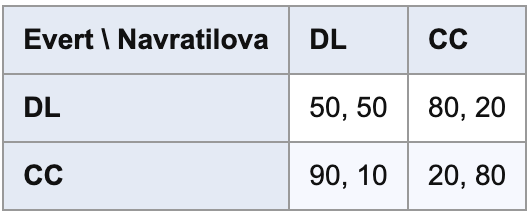
what is Evert’s expected payoff from DL in terms of q?
E(DL)=50(q)+80(1-q)

what is Evert’s expected payoff from CC in terms of q?
E(CC)=90(q)+20(1-q)

what is Navratilova’s expected payoff from DL in terms of p?
E(DL)=50(p)+10(1-p)

what is Navratilova’s expected payoff from CC in terms of p?
E(CC)=20(p)+80(1-p)

Which equation is solved to find Evert’s exploitation-proof p?
10 + 40p = 80 - 60p

What is Evert’s exploitation-proof p?
p = 0.7

Which equation is solved to find Navratilova’s exploitation-proof q?
80 - 30q = 20 + 70q
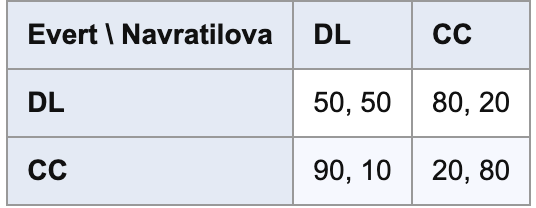
What is Navratilova’s exploitation-proof q?
q = 0.6

Which equation must be solved to make Navratilova (the column player) indifferent?
what is p?
60p + 10 = 80 - 40p
p = 0.7

Which equation must be solved to make Evert indifferent?
what is p?
60 - 30q = 20 + 70q
p = 0.4

What is Bluffer's expected payoff from Check?
90q + 30(1-q)

What is Offense's expected payoff from Pass?
30q + 5(1-q)

To make Keeper indifferent solve (a)
the mixed strategy nash equilibrium is (b)
this means that ( c )
(a) 55p + 20(1 - p) = 35p + 50(1 - p)
(b) (0.6[Left] + 0.4[Right], 0.3[DL] + 0.7[DR])
(c ) Shooter kicks left 60% of the time and kicks right 40%; Keeper dives left 30% of the time and dives right 70%

To make pitcher indifferent solve (a)
the mixed strategy nash equilibrium is (b)
this means that ( c )
(a) 10q + 35(1 - q) = 80q + 5(1 - q)
(b) (0.75[Fastball] + 0.25[Curve], 0.3[SF] + 0.7[SC])
(c ) Pitcher throws a fastball 75% of the time and throws a curve 25%; Batter sits on the fastball 30% of the time and sits on the curve 70%

suppose driver plays with probability p. which equation must be solved to make officer indifferent?
solve for p
3p + 11(1-p) = 4p + 2(1-p)
p = 0.9

suppose officer plays patrol with probability q. which equation must be solved to make driver indifferent?
solve for q
8q + 8(1-q) = 2q + 10(1-q)
q = 0.25

what is the nash equilibrium
(0.9 [Pay] + 0.1[Skip] , 0.25[Patrol] + 0.75[Idle]
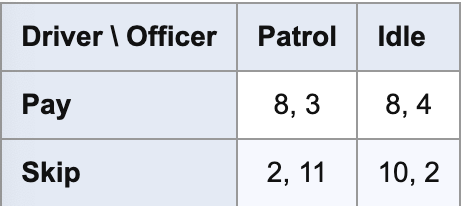
officer’s expected payoff from patrol at equilibrium?
3.8

officer’s expected payoff from Idle at the equilibrium
3.8
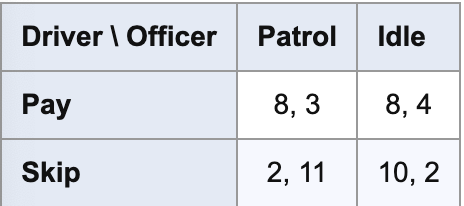
driver’s expected payoff from skip at the equilibrium
8
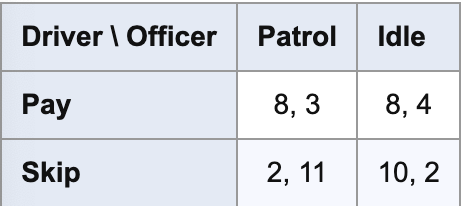
the equilibrium payoffs (driver, officer)
(8, 3.8)

James and Dean now drive at each other at higher speeds. A collision costs each of them 10. What is the new mixed-strategy Nash equilibrium
(0.9[C] + 0.1[T] , 0.9[C] + 0.1[T]

James and Dean now drive at each other at higher speeds. A collision costs each of them 10. what is each player’s expected payoff at the equilibrium
(-0.1, -0.1)

James and Dean now drive at each other at higher speeds. A collision costs each of them 10. what is each player’s payoff if they alternate between (swerve, straight) and (straight, swerve)
(0,0)

James and Dean now drive at each other at higher speeds. A collision costs each of them 10. Suppose each player randomizes 50-50. What is the expected payoff to each?
(-2.5, -2.5)

what is the mixed strategy nash equilibrium
(0.6[SO] + 0.4[Enter] , 0.25[SO] + 0.75[Enter]

at this equilibrium, fernwood’s expected payoff is
2.2

if each player instead stays out with probability 0.3, what is Fernwood’s expected payoff
-0.5
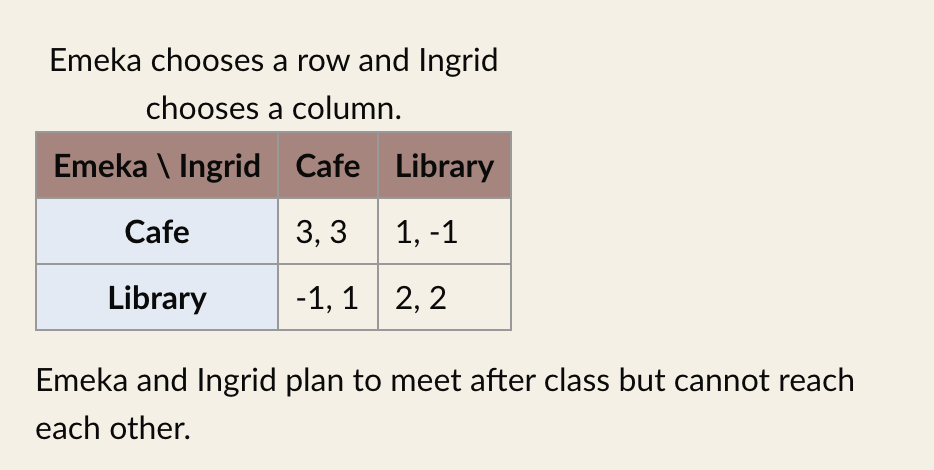
what is the mixed strategy nash equilibrium
(0.2[cafe] + 0.8[Library] , 0.2[cafe] + 0.8[library]

at this equilibrium, ingrid’s expected payoff is
1.4
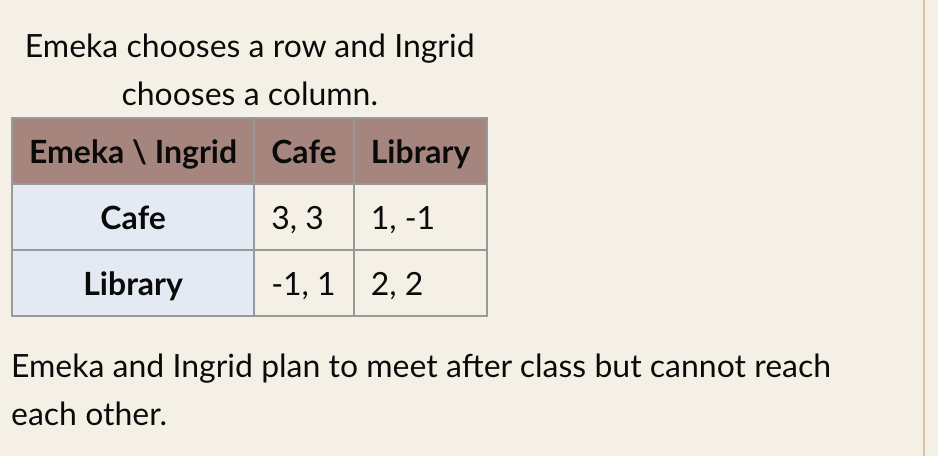
compared with the two pure strategy equilibria, the mixed-strategy equilibria is…
worse for both players than either pure strategy equilibria

to make shipper indifferent solve
16q + 9(1-q) = 10q + 13(1-q)
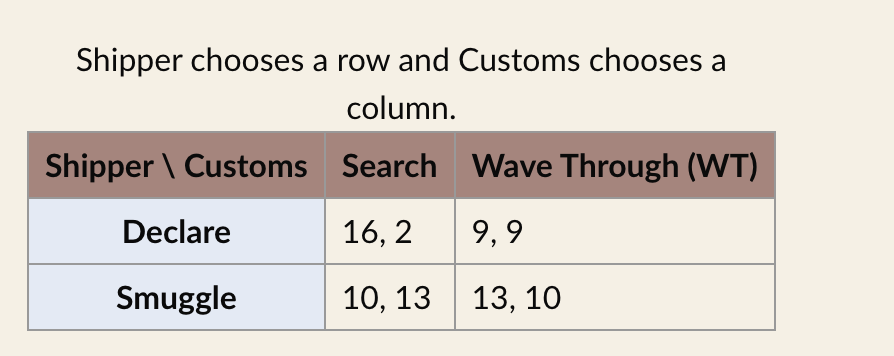
the mixed strategy nash equilibria is
90.3[Declare] + 0.7[smuggle] , 0.4[search] + 0.6[WT}

what are the equilibrium payoffs
(11.8 , 9.7)

to make manager indifferent solve
13p + 18(1-p) = 16p + 16(1-p)

the mixed strategy nash equilibrium is
(0.4[work] + 0.6[shirk] , 0.25[check] + 0.75[trust]

the equilibrium payoff is
(11.5 , 16)

over what range of p does Revolver yield a higher expected payoff for Professor Plum than Knife?
p > 0.375
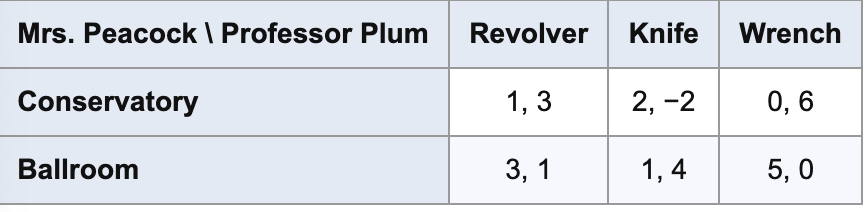
over what range of p does revolver yield a higher expected payoff than wrench
p < 0.25

Colonel Mustard gets a higher expected payoff from Wrench than from Trophy when
p > 3.5

Colonel Mustard gets a higher expected payoff from Wrench than from Poison when
p < ¼
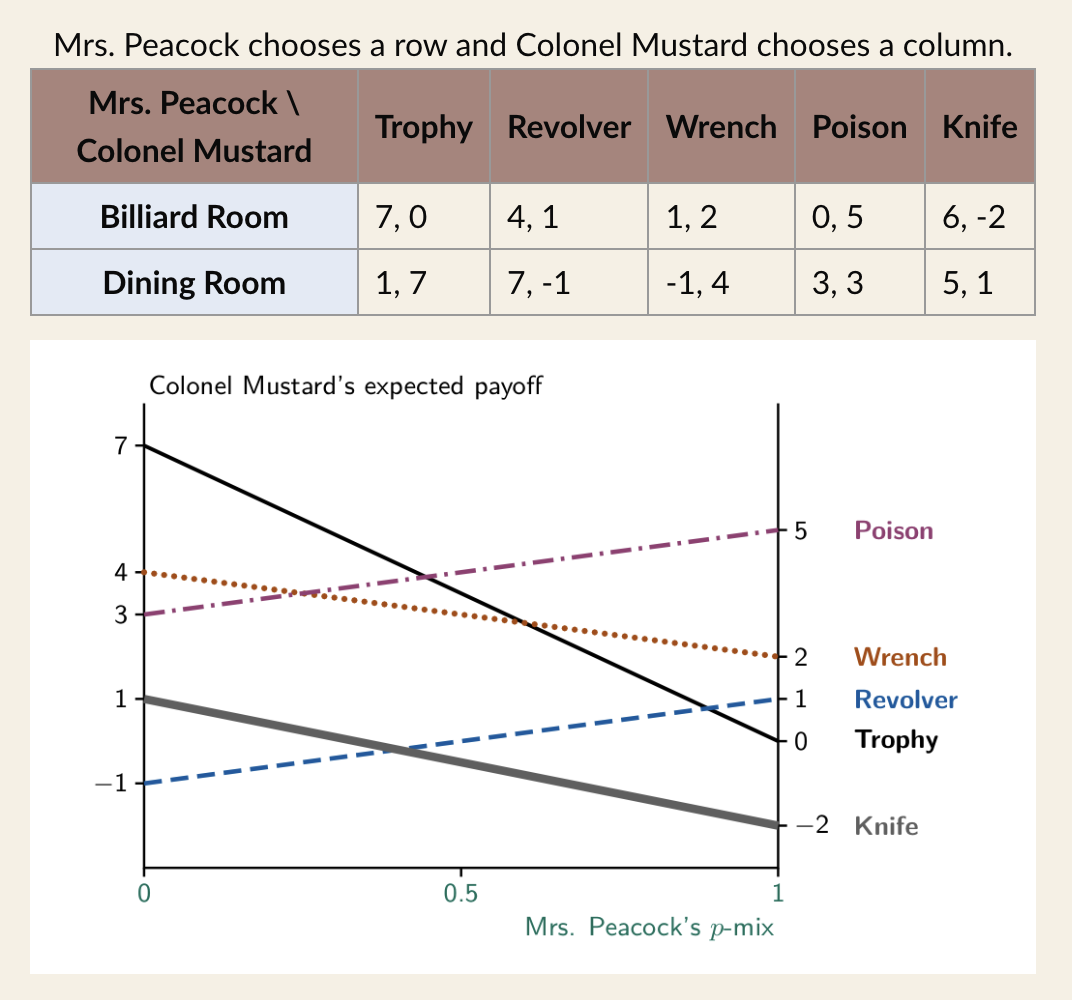
in equilibrium Colonel Mustard mixes
Trophy and Poison

The mixed-strategy Nash equilibrium is
(4/9[Billard Room] + 5/9[Dining Room] , 1/3[Trophy]+0[revolver] + 0[wrench] + 2/3[Poison] + 0[knife]

Poacher’s expected payoff from Ridge is
6q1 + 4q2 + 2(1-q1-q2)

Poacher’s expected payoff from River is
9q1 + 2q2 + 0(1-q1-q2)

Poacher’s expected payoff from Forest is
3q1 + 1q2 + 7(1-q1-q2)