Proteins pt 2 (ppt 2)
 Call Kai
 Learn
 Practice Test
 Spaced Repetition
 Match
 Flashcards
 Knowt Play
1/17

There's no tags or description
Looks like no tags are added yet.
18 Terms
primary
linear sequence of amino acids linked by peptide bonds
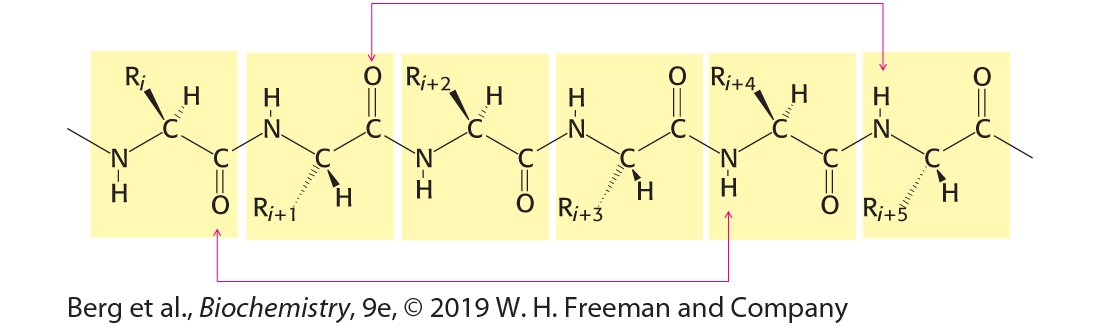
secondary
C=O is the acceptor
N-H is the donor
hydrogen bonds forming
no R groups involved here

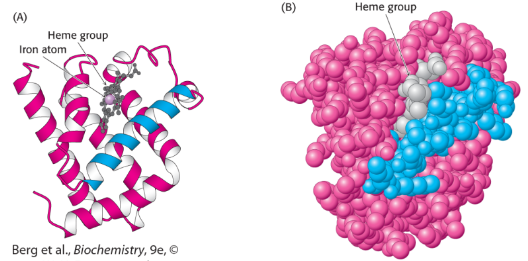
tertiary
R groups start to interact here
folds?
H bond, disulfide bridge, hydrophobic interactions, ionic bonds
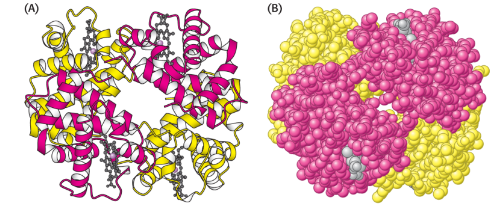
quaternary
composed of multiple polypeptide chains or subunits
not all proteins show this level of complexity
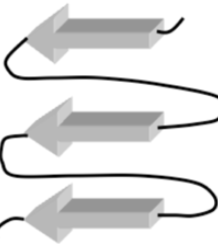
beta sheet parallel
angled bonds


beta sheet antiparallel
straight bonds

polypeptide turns and loops
can change directions with reverse turn (aka β turns or hairpin turns) or omega (Ω) loops

exact same sequence but one is alpha helix and the other is a beta sheet?
protein function will differ and might be suited better in one structure vs. the other

hydrogen bonding in alpha helix
whats the pattern? REWATCH VID

motif
combos of secondary structures
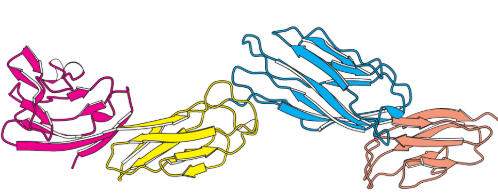
domain
Independent regions within a polypeptide, connected by a short link
can have motifs but not the inverse
intrinsically disordered proteins
protein that lacks stability and remains flexible: all organisms have it
can be the entire protein or a large portion
p53 →mutated cancer cell
globular protein
compact 3d shape and water soluable
fibrous protein
long fibers with structural roles
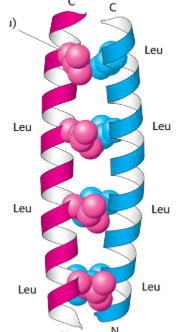
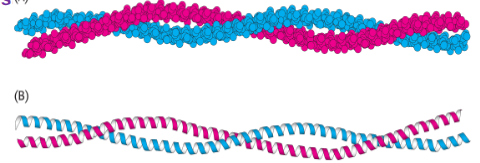
keratin
wool and hair
2 R handed alpha helices intertwined
stabilized?
→ Hydrophobic interactions + H bondsTRUE alpha helices
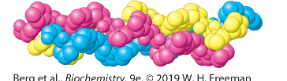
collagen
found in skin, bone, tendons, cartilage, teeth
Gly = tiny → fits in the center → every 3rd position
Triple coil, not true alpha helices
what interactions stabilize the triple coil structure?
H bonds between the chains

some amino acids disrupt alpha helix, why?
their unique side chains interfere with the rigid structure

thermodynamics of protein folding
top of the funnel is the max disorder LEAST STABLE
middle is where folds begin to form- Trial and error in folding
bottom is the established folded proteins MOST STABLE