AHS3263: Balanced Anesthesia & Multi-Modal Analgesia
 Call Kai
 Learn
 Practice Test
 Spaced Repetition
 Match
 Flashcards
 Knowt Play
1/25

There's no tags or description
Looks like no tags are added yet.
26 Terms
What is Pain?
Sensory
Emotional
Subjective
Do you need to be awake to feel pain? NO
Stimuli:
Mechanical (pressure, pinch)
Heat
Chemical
Analgesia:
Most general anesthetics ARE NOT analgesics
Must provide additional analgesic at ALL stages pre-, Intra, & postoperatively
General rule - ERR on the side of more analgesia
Analgesia - the relief or prevention of pain
Responses To Pain:
General Signs of Pain (In order of frequency):
Vocalization
↑ (high) HR
↑ (high) RR
Restlessness
↑ (high) BT
↑ (high) BP
Posturing
Unwillingness to move
Trembling
Depression
Insomnia - inability to fall asleep
Caution: dysphoria - (a state of mental unease, anxiety, & restlessness
Physiologic Effects of Pain:
Release of ACTH & cortisol, causes:
↑ (high) insulin
Delayed healing & immunosuppression
↑ (high) dyspnea
Coagulopathies - condition where the blood loses its normal to clot
DIC (disseminated intravascular coagulation) - blood disorder where the body simultaneously clots & bleeds abnormally
Long term recumbency
Pain Perception:
Nociception (“to injure) includes four distinct phases: transduction, transmision, modulation & perception
Transduction
PERIPHERAL NOCICEPTORS respond to mechanical, thermal or chemical stimuli & turn it into ELECTRICAL SIGNALS
Transmission
PERIPHERAL PAIN is conducted to the SPINAL CORD
Modulation
Pain is AMPLIFIED or SUPPRESSED in the SPINAL CORD
Perception
Pain is PROCESSED & recognized in the BRAIN

Untreated Pain:
If untreated may lead to:
Destructive behavioral
Autonomic
Neuroendocrine (cells or tissues that combine the nervous system & hormone-producing glands)
Immunological responses
STRESS
Self mutilation (self-inflicted injury)
Immune incompetence (immune system cannot properly defend the body against infections/viruses)
Spiral deterioration (health decline)
DEATH
Wind-Up:
Wind-up - When repeated pain signals make the nervous system more sensitive, causing pain to continue or feel stronger even after the original injury has healed
UNTRETED pain gets WORSE
Nerve fibers transmitting the painful impulses to the brain become "trained" to deliver pain signals better
Nerves become more effective at sending pain signals to the brain
The intensity of the signals increases over & above what is needed to get the affected person's attention
Preemptive Analgesia:
Treatment that is initiated BEFORE surgery in order to PREVENT the establishment of CENTRAL SENSITIZATION evoked by the incisional & inflammatory injuries occurring during surgery & in the early postoperative period
Preemptive analgesia can PREVENT the SENSITIZATION of pain pathways
Multimodal Analgesia:
A method of pain management which COMBINES various groups of medication for PAIN RELIEF
Example:
Opioids
Anti-inflammatory (NSAID)
Local anesthetic
What is Surgery:
Physical removal, repair or readjustment of organs & tissues
Involves cutting into the body
What is Anesthesia?
Can you do surgery without anesthesia? YES
Anesthesia - ABSENCE of sensation
Can affect the entire body (loss of consciousness) or a region of the body
What Kinds of Anesthesia Exists?
General
Unconscious & insensible to pain
Administered by inhalant or parenteral (IM, IV)
Local
Loss of sensation in a LOCALIZED body part of region


What does Parenteral Mean?
Parenteral - administration of substances OUTSIDE of the gastrointestinal tract (GI TRACT)
General Anesthesia:
Parenteral
IM - telazol, ketamine
IV - Continuous rate infusion (CRI)
Propofol
Fentanyl
Inhalant
Isoflurane
Sevoflurane
Inhalant Anesthetics:
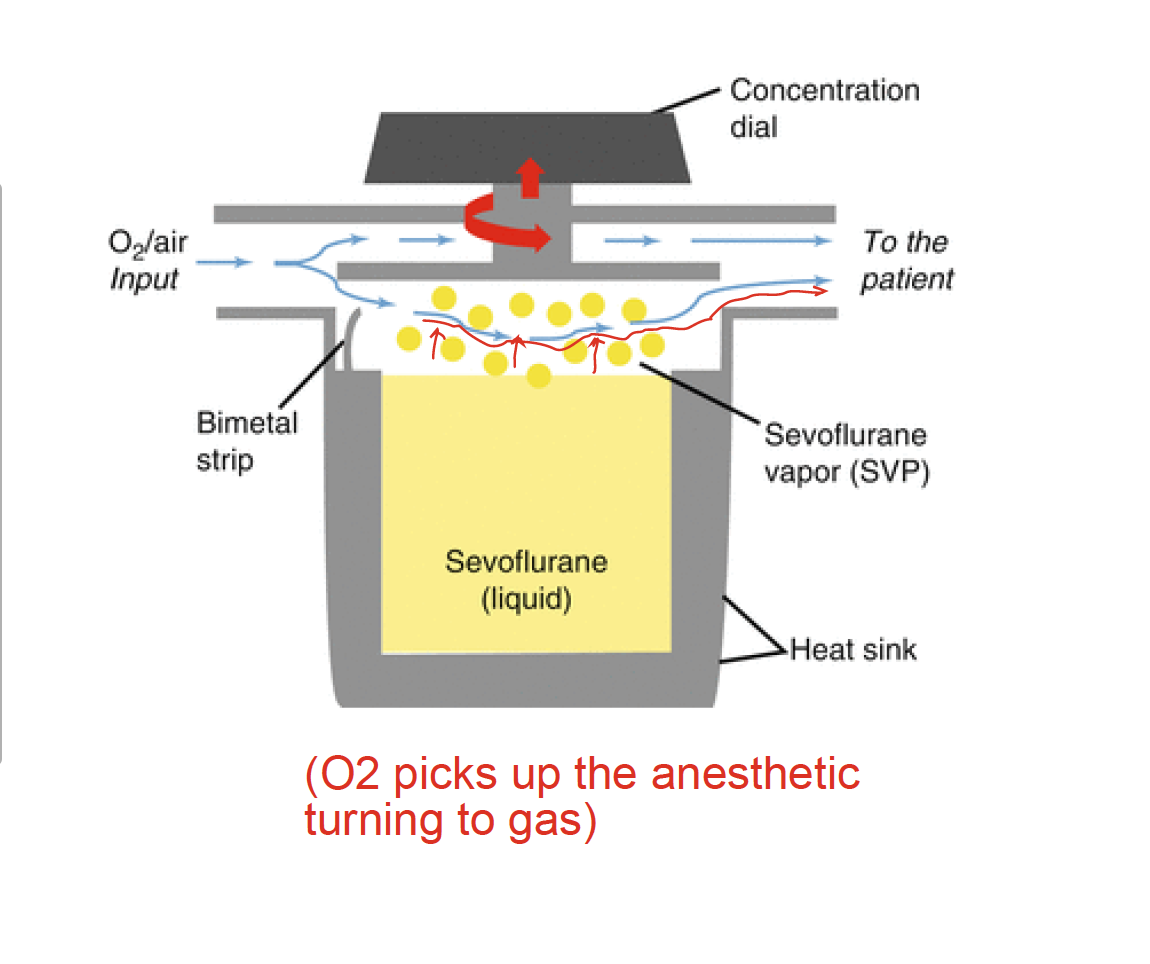
Liquid agents VAPORIZED in OXYGEN administered via breathing system
Anesthetic agents = Liquid at ROOM temperature
Inhalant anesthesia turns LIQUID to GAS
Ex:

Vaporizer - Vaporizes LIQUID into GAS
How Does An Anesthesia Machine Work?
Deliver OXYGEN
VAPORIZE anesthetic, mix with O2 (oxygen), deliver to patient
REMOVE exhaled gases from patient, dispose through scavenging equipment or recirculate (after removing CO2 - carbon dioxide ) to patient
Two Types of Circuits:
Rebreathing
Animal REBREATHES the OXYGEN/GAS
Non-rebreathing
Animal DOES NOT rebreathe the OXYGEN/GAS
Rebreathing Circuit:
Exhaled gases MINUS CARBON DIOXIDE are returned back to the patient
Cycle (steps):
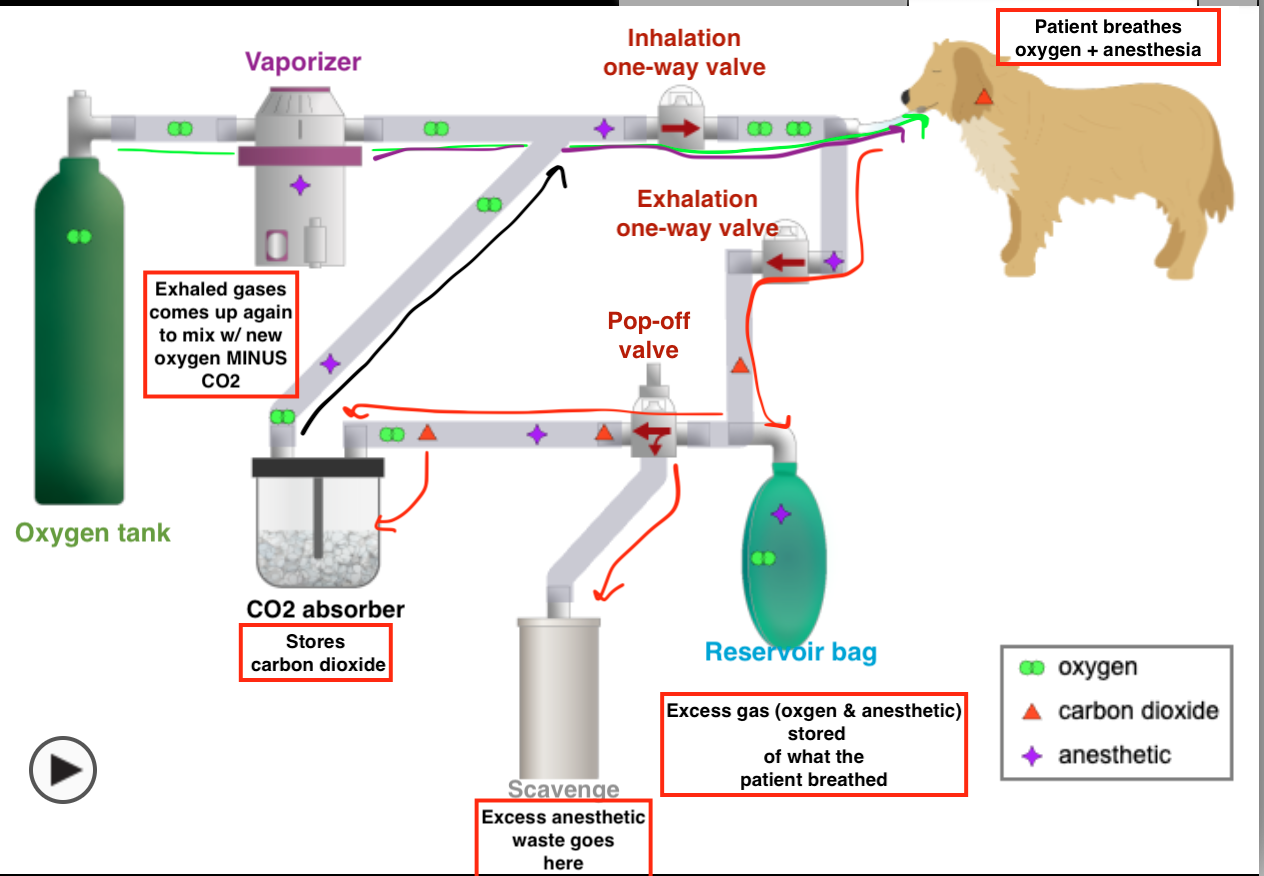
O2 (oxygen) —→ Flowmeter (controls the amount of O2 flowing through the anesthesia machine) —→ Vaporizer (adds the anesthetic to the O2) —→ Inspiratory one-way valve (allows gas to flow in one direction TOWARD the patient) —→ Patient inhales O2 + anesthetic —→ Patient exhales CO2 - containing gas —→ Expiratory one-way valve (allows exhaled gas to flow AWAY from the patient) —→ CO2 absorber (removes CO2 from the exhaled gas) —→ Reservoir bag (hold excess gas before it is breathed in again) —→ Back toward the inspiratory one-way valve —→ Patient
Inspiratory valve = comes BEFORE patient
Expiratory valve = comes AFTER patient
Pop off valve - releases excess gas & pressure (dangerous to close off b/c lungs explode - ALWAYS HAS TO BE OPEN)
Scavenge/scavenging system - removes excess waste anesthetic gas (where the anesthetic wast goes)
Pros
Low-flow system
Low waste gas produced
Good moisture & temperature conservation
Cons
Requires CO2 absorber canister
Animals > 7k
Which Animals to Give Rebreathing Circuit?
Over 7kg
Why?
Animal needs enough RESPIRATORY DRIVE (the automatic signal sent by the brain that tells an animal to breathe)
Multimodal Analgesia vs. Balanced anesthesia:
Multimodal analgesia
A method of pain management which COMBINES VARIOUS groups of medication for PAIN RELIEF
Balanced anesthesia
Combine several agents, in SMALLER DOSES, to MAXIMIZE POSITIVE effects (analgesia, muscle relaxant) while MINIMIZING NEGATIVE effects (cardiac/respiratory depression)
Learning Module - Anesthetic Rebreathing Circuit:
Inhalant anesthesia - involves taking a LIQUID COMPOUND (isoflurane, sevoflurane, etc) & transforming it ("vaporizing") it into a GAS that a patient can inhale
Rebreathing anesthetic circuit - allows an animal to REBREATHE its EXHALE GASES
Used for animals over 7kg b/c the animal should be able to exhale hard enough to overcome the resistance created by the components of the rebreathing system
Animals smaller than 7kg typically DO NOT have the respiratory drive for a rebreathing circuit & require a non-rebreathing system to receive anesthesia
Parts of the anesthesia machine:
Oxygen source - oxygen tank (common tanks - H tanks & E tanks)
Reservoir bag - STORAGE for GAS in the system
For excess gases that patients can use if necessary
Visual assessment of breathing
Can use for manual ventilation of a patient
Vaporizer - where liquid anesthetic agents are turned into GAS molecules
OXYGEN comes into the vaporizer, picks up the GAS ANESTHETIC AGENT at a certain concentration, & then delivers it to the patient
Anesthetic machines is measured in percentages % (if you have your setting on 2, you are giving 2% of the anesthetic gas)
Inhalation one-way valve - PREVENTS exhaled gases from the animal from going BACKWARD TOWARDS the fresh (oxygenated) gas source
Exhalation one-way valve - PREVENTS the exhaled gases, which now contain CARBON DIOXIDE, from being REBREATHED by the animal
Placed downstream from the patient
Pop-off valve - RELEASE the EXCESS GAS
Allows gas to leave the circuit if the pressure becomes too high
CLOSURE of this valve with an animal attached can lead to DEATH (NEEDS TO REMAIN OPEN)
Used b/c we deliver more oxygen than the patient needs, the system could result in the reservoir bag, or worse, the patient’s lungs bursting
Scavenge - STORES the EXCESS ANESTHETIC WASTE removed from the system
Attached to the pop-off valve
CO2 absorber - STORES carbon dioxide
Exhaled CARBON DIOXIDE must be REMOVED from the system via the CO2 absorber BEFORE gas is returned to the animal
The exhaled gases, MINUS the CARBON DIOXIDE, remixes with the incoming oxygen & GOES BACK to the animal (that is why is called rebreathing system)
Why should you be cautious with alcohol during surgical prep?
It can decrease body temperature
Most all anesthetics are also analgesics:
False
It is easy to determine if an animal is painful:
False
The following are example of parenteral medication expect:
Pills by mouth (oral administration)
Veterinarians are able to perform surgery without a gas anesthetic machine:
True