Accounting Formulas
 Call Kai
 Learn
Learn Practice Test
 Spaced Repetition
 Match
Match Flashcards
 Knowt Play
1/49

Earn XP
Description and Tags
Name | Mastery | Learn | Test | Matching | Spaced | Call with Kai | Chat |
|---|
No analytics yet
Send a link to your students to track their progress
50 Terms
What are the three functions of managerial accounting?
Planning, 2. Controlling, 3. Directing and Motivationg
What is Manufacturing Overhead?
Manufacturing costs that cannot be traced directly to units produced.
What is Prime cost?
Direct Materials + Direct Labour
What is Conversion cost?
Direct Labour + Manufacturing Overhead
What comes into Product (manufacturing) costs?
These are recognized as an asset until goods sold: raw materials inventory, work-in-progress inventory, and finished-goods inventory. They are recognized as an expense when goods are sold (COGS).
What about Period (non-manufacturing) costs?
These are assigned to the period of time in which incurred, profit is overstated if period costs are improperly recorded as product costs as the goods remain in inventory.
Income statement for a merchandising company:

Income statement for a manufacturing company:
*work backwards to COGM then available for sale

What is the format and process for Statement of Cost of Goods Manufactured?
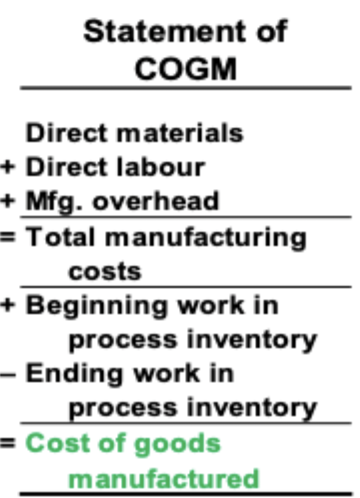
Practice the breakdown of the schedule of COGM, going from Bg RM Inv to total manufacturing costs, to COGM
format eg.

How does variable and fixed cost react in total to activity level changes.
Variable cost will change in total as the activity level changes while fixed cost remains the same.
How does variable and fixed cost react per unit to activity level changes.
Variable cost per unit remains the same over wide ranges of activity whereas average fixed cost per unit goes down as activity level goes up or vice versa.
What is true variable cost?
A variable cost whose total dollar amount varies in direct proportion to changes in the activity level.
What is marginal cost?
The additional cost caused by producing one more unit of output.
What is average cost?
Average cost is the average cost per unit of output.
What is the equation for mixed cost?
Y = a + bX
Y = the total cost
a = the total fixed cost (the vertical intercept of the line)
b = the variable cost per unit of activity (the slope of the line)
High-low method formula:
(Y high - Y low)/(X high - X low) this is to find b in the mixed cost equation
What does it mean for the T Statistic to be > 2.
The absolute value of T must be greater than 2 for the regression model to be appropriate.
Practice the structure of a Contribution Format Income Statement:
*example (the contribution margin format emphasizes cost behaviour, the CM covers fixed costs and provides for income.

Side-by-side comparison of the Contribution Income Statement and Traditional Income Statement: notice the differences

What is the Contribution Margin (CM) formula?
CM = Sales - variable costs
CM per unit formula
CM per unit = Sales per unit - variable costs per unit
CM Ratio Formula
CM Ratio = CM per unit/Selling Price per unit
Breakeven (BE) unit sales formula:
BE unit sales = Fixed Costs/CM per unit
Breakeven sales dollars formula:
BE sales dollars = Fixed costs/CM Ratio
What is Margin of Safety?
The amount by which budgeted or actual sales revenue exceeds breakeven sales revenue → this is the amount by which sales can drop before a loss is incurred.
Margin of Safety (MOS) in sales dollars formula:
MOS sales $ = total sales $ - breakeven sales $
MOS in units formula:
MOS in units = total unit sales - unit breakeven sales
MOS Ratio Formula:
MOS Ratio = MOS/Sales in $ or = MOS in units/sales in units
How to find the Target Operating Income (TOI)?
Operating Income = Target dollar amount:
CM must cover fixed costs + targeting operating income
Add the amount of target profit to the amount of fixed costs and use the same formula.
Unit sales for TOI formula:
unit sales = (fixed costs + TOI)/CM per unit
+at BE point, TOI = 0
Sales dollars for TOI formula:
sales dollars = (fixed costs + TOI)/CM ratio
Formula for Net Income
Net Income = NIBT*(1 - t)
*tax rate = t
Formula for NIBT
NIBT = Net Income/(1 - t)
*in the target profit formula use this amount of NIBT profit as the target operating profit
NIBT in sales $ formula:

NIBT in unit sales formula:

What is an advantage of a high fixed cost structure?
Income will be higher in good years compared to companies with a lower proportion of fixed costs.
What is a disadvantage of a high fixed cost structure?
Income will be lower in bad years compared to companies with a lower proportion of fixed costs.
What is operating leverage?
A measure, at a given level of sales, of how sensitive net operating income (pre-tax) is to a percentage change in sales.
*a mix of fixed and variable costs
Degree of Operating Leverage (DOL) formula:
DOL = CM in total/Operating Income
Percentage Change in Operating Income formula:
Percentage Change in Operating Income = DOL*% change in sales
What are the two types of Product Costing?
Process Costing: a company produces many units of a single product (eg. a potato chip manufacturer)
Job Order Costing: many different unique products are produced each period (eg. a golf course designer)
How are costs allocated for Job-Order Costing?
charge direct material and direct labour costs to each job as work is performed
manufacturing overhead (MOH), including indirect materials and indirect labour, are allocated to all jobs rather than directly traced to each job.
What is a predetermined overhead rate (POR)?
A POR is based on estimates of the amount of overhead and the level of the cost driver made at the beginning of the accounting period.
POR Forumla:
POR = Budgeted OH/Budgeted Cost Driver Amount
*make sure to either use budgeted or actual appropriately
What adjustments must be made to OH at the end of a period?
OH Variance = Actual OH - Applied OH
Adjusted COGS = Normal COGS - OH Variance
What does under-applied mean in terms of applying overhead?
Under-applied OH exists when the amount of OH from the POR is less than the total amount of OH actually incurred.
What does over-applied mean in terms of applying overhead?
Over-applied OH exists when the amount of OH from the POR is greater than the total amount of OH actually incurred.
What can you do with under/overapplied OH?
Close out to COGS
Allocate between WIP, FG, and COGS in proportion to the OH applied during the current period, in the ending balances of these accounts.
Carry the balance forward
*will only be tested on option 1 and 3
Summarize over-applied and under-applied MOH:
