W2: Anxiety and its Disorders
 Call Kai
 Learn
 Practice Test
 Spaced Repetition
 Match
 Flashcards
 Knowt Play
1/55

There's no tags or description
Looks like no tags are added yet.
56 Terms
What is the difference between anxiety, fear and a panic attack?
Anxiety: negative affect with somatic tension; future-oriented
Fear: negative affect with strong sympathetic arousal; present danger
Panic attack: fear occurring at an inappropriate time
How does the intensity vary for each?
Panic > fear > anxiety
What are the 4 components of anxiety response?
Emotional
Physiological: autonomic nervous system activation
Cognitive response: attentional reorienting & narrowing, worry, avoidance
Behavioural response: FOF, avoidance
What are the 4 factors that decides when anxiety is no longer adaptive?
Duration (prolonged)
Intensity (too overwhelming)
Appropriateness of response
Interference and distress
How common are anxiety disorders?
They are the most common mental disorders
What is the comorbidity of anxiety disorders?
High comorbidity: >20% diagnoses have 2-3 or more diagnoses
What are the 3 main features shared by anxiety disorders?
(Neuro)biological
Cognitive
Behavioural
Based on the neurobiology understanding (Calhoun & Tye), how do anxiety disorders arise?
Arise from disruptions in the interconnected circuit system in our brains, where neutral information is misinterpreted as threat, producing an inappropriate emotional and behavioural responses
What 2 processes does the network undergo?
Interpretation
Evaluation
What happens in ‘Interpretation’?
Assigning an emotional value to stimuli (harmless or dangerous?)
E.g. Is that person's expression friendly or hostile?
What happens in ‘Evaluation’?
Weighing threats against your other competing needs
E.g. "This meeting makes me nervous, but I need this job, so I'll go anyway."
What is the result of these 2 processes?
Produces appropriate responses: calm, alert, afraid etc
What are 2 main networks that triggers anxiety?
Affective salience network (the “alarm team”)
Cognitive control network (the “manager team”)
What changes are found in anxiety disorders?
Hypoconnectivity (weaker communication) between the affective salience network and the cognitive control network; inter-network connectivity
What are disease models?
A lab manipulation that creates disease processes or symptoms
What are 3 criteria that makes disease models useful?
Face validity (procedure, symptoms, response resemble the diesese)
Predictive validity (treatments should have the same effect on the disease as on the model)
Theoretical basis (the model’s rationale matches the cause of the disease)
What is a common disease model?
Animal model/Cross-species anxiety test

How are cross-species anxiety tests validated?
Predictive validity: do treatments that reduce anxiety in rodents also reduce it in humans. with similar physiological mechanisms?
Face validity: the human paradigm should be similar to the rodent paradigm
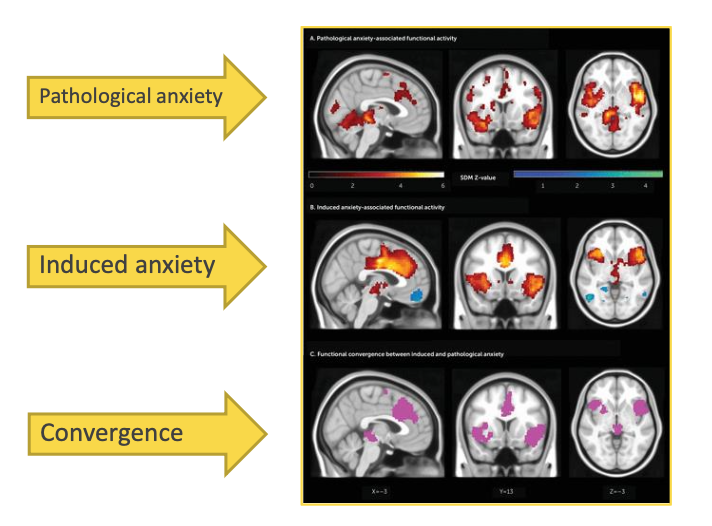
What does this study show us?
The brain regions active in an anxiety disorder are largely the same ones active when a healthy person feels normal & temporary anxiety; there’s high overlap/convergence
What is fear generalisation?
After classical conditioning, the fear spreads to other stimuli similar to the conditioned stimulus (e.g. from one dog to other dogs)
How is fear generalisation tendency different in people with anxiety disorders vs healthy people?
People with anxiety disorders tend to have higher fear generalisation
e.g. low FG: fear of small dogs only; high FG: fear of all dogs
What 2 information-processing biases are shared across anxiety disorders?
Attentional bias : noticing threats first (*reliability issues)
Interpretation bias - interpreting ambiguous information as threatening
What are the 4 disorders types within anxiety?
Specific phobia
Panic disorder
Social phobia/Social anxiety disorder
Generalised anxiety disorder
What is specific phobia?
A marked fear about a specific object or situation
How long must a fear last for it to be considered as a phobia?
Persistent for 6 months or more
What is the two-stage theory of phobias?
Acquired by classical conditioning
Maintained by operant conditioning
What is the main component of anxiety?
Appraisal
What 3 aspects does anxiety appraisal involve?
Danger and harm
Uncontrollability
Unpredictability
What are the 2 types of treatment of specific phobias?
Exposure therapy: graded/hierarchical exposure (in-vivo)
Cognitive therapy: challenging faulty appraisals
What is a panic attack?
An abrupt surge of intense fear/discomfort that peaks within minutes, with 4 or more of these symptoms

What extra criteria distinguish panic disorder and panic attacks?
For it to be considered panic disorder, there must be recurrent unexpected attacks, with at least one followed by 1+ month of:
1. persistent worry about more attacks or their consequences
a significant maladaptive change in behaviour
What is agoraphobia?
A marked fear of 2+ of the following:
Public transport
Open spaces
Enclosed spaces
In line or in a crowd
Being outside of home
(aka places/situations where escape is difficult, help might be unavailable)
What is the typical pattern of the development of panic disorder?
Panic symptoms → “i’m having a heart attack” → seeks medical advice → medical cause disconfirmed →”something is wrong with me", i’m going crazy” → fear of fear (afraid of having another panic attack)
What does Klein’s false suffocation alarm hypothesis suggest about how PAs occur?
Normal: automatic suffocation alarm that detects CO2/O2 imbalance
PD: the threshold for setting it off is pathologically lowered
What is a finding that goes against a pure biological (suffocation alarm) account of panic?
In a sodium lactate test, physiological responses was similar for everyone, but the panic disorder group reported feeling much more fear (interpretation)
What does Clark (1986) suggest about the cognitive model of panic?
It is a vicious cycle
A trigger (internal/external) → perceived threat → apprehension → bodily sensations → catastrophic interpretation of the sensations (“im having a heart attack'“) → more perceived threat → panic
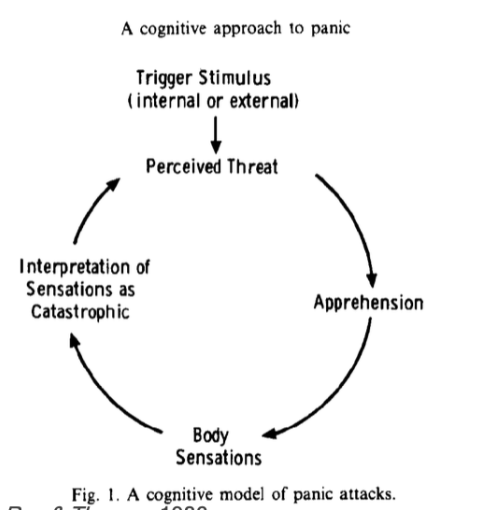
What is the behavioural (interoceptive conditioning) account of panic disorder?
After the first panic attack, fear depends on interoceptive conditioning (conditioned fear of internal bodily cues), so normal body sensations can become automatically linked with terror, hence even slight changes in the body can trigger panic (e.g. shortness of breath from running)
What does this explain?
Why attacks often feel unexpected
What are the 4 components of treatment for PD?
Education about anxiety
Challenge cognitions: correct misinterpretation of sensations
Exposure to internal feared cues: change conditioned reactions to cues (e.g. CBT)
Exposure to external feared cues: reduce avoidance
What is social phobia/social anxiety disorder?
A persistent fear of social or performance situations involving unfamiliar people or scrutiny
What do people with social phobia believe others perceive them as?
As inept, stupid, foolish (social deficits)
What are 3 common safety behaviours?
Avoiding eye contact
Talking to safe people
Covering face with hair/hands
What are the 4 ways social anxiety is maintained in the cognitive lens of social phobia?
Increased self-focused attention/self-monitoring (see self from a negative, feared observer perspective)
Use of misleading internal information (feeling anxious = looking anxious)
Safety behaviours
Pre- and post-event processing
What are the 2 causes of social phobia?
Genes and temperament (especially shyness and wariness of new situations)
Environmental factors: life experiences with parents, peers and culture, and the thinking patterns and safety behaviours these create
What are the 2 main treatment methods for social phobia?
In vivo exposure therapy
Group therapy

What do patients go through in vivo exposure therapy?
List of their worst fears from least to most feared, and work their way up overcoming them
What is key for successful in vivo exposure therapy?
Repetition & generalisability
What are 5 benefits of group therapy?
Vicarious learning
See others with same problem
Public commitment to change
Ability to role play
Multiple people to challenge thoughts
What is Generalised Anxiety Disorder (GAD)?
Excessive anxiety and worry about a number of events or activities (e.g. work or school performance)
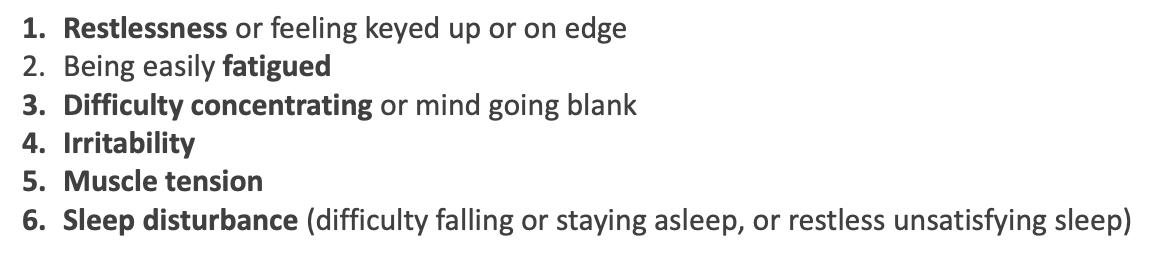
What is another disorder that is characterised by almost all of GAD symptoms?
Major depressive disorder (everything except muscle tension)
Based on this, what is a characteristic of GAD?
High comorbidity (most people with GAD also have other types of mood or anxiety disorder)
What are the 3 possible transdiagnostic risk factors?
Sexual and physical abuse, especially in childhood
Harsh parenting
Parental psychopathology (parent’s mental health conditions)
What are 4 examples of intrusive thoughts as a transdiagnostic mechanism/symptom?
OCD: obsessions, intrusive unwanted thoughts
PTSD: recurrent, involuntary intrusive memories
Eating disorder: intrusive eating-related thoughts and images
Depression: intrusive memories
What are 3 other transdiagnostic mechanisms?
Intrusive thoughts
Repetitive negative thinking
Emotion regulation difficulties
Executive control deficits
What are transdiagnostic treatments and how effective?
Treatments that identify and target common core maladaptive processes underlying many diagnoses
e.g. transdiagnostic CBT for depression and anxiety
Qn: Compare the cognitive models of panic disorder and social phobia: what is misinterpreted in each?
Panic disorder: bodily sensations
Social phobia: the self as seen by others