Physics 4B Lab Final
 Call Kai
 Learn
 Practice Test
 Spaced Repetition
 Match
 Flashcards
 Knowt Play
1/42

There's no tags or description
Looks like no tags are added yet.
43 Terms
The first step in charging by induction is to bring a charged rod near a conductor, (the object to be charged). This results in the conductor being __________.
polarized
In the second step in charging by induction, you keep the charged rod near the conductor. You touch the conductor with you finger. This is called __________.
grounding
In your last step, remove both the rod and the finger. If the rod had been negatively charged, now the conductor is __________.
positively charged
When you polarize an object by bringing a charged rod near it, is the object neutral or charged?
neutral
According to theory, when you charge a conical conductor, the greatest charge density occurs where you have the ________ radius. NOTE ON TERMINOLOGY. For example, the Earth has a larger radius and smaller radius of curvature than the Moon. Radius of curvature = 1/radius.
smaller
According to theory, the net charge on a hollow sphere conductor resides _______
on the outer surface
According to theory, when you bring an uncharged sphere near a charged sphere, the uncharged sphere will
Will remain neutral but polarized
When you transfer electrons from an object, that object _______
becomes positively charged.
When calculating the electric field at a point in space due to a continuous line charge, you need to use calculus to get the exact value.
true
In lab, when we approximated the electric field at a point in space due to a continuous line charge, we used the component method of adding vectors.
true
Which is true of electric fields when you draw them?
Draw them with direction from + charge to -
Which is true of equipotential energy lines?
They are always perpendicular to the electric field lines.
What is true of electric field lines?
They point from higher potential towards lower potential.
What is true of electric field lines?
They are always perpendicular to the surface of a charged conductor in electrostatic equilibrium (as drawn outside of the surface)
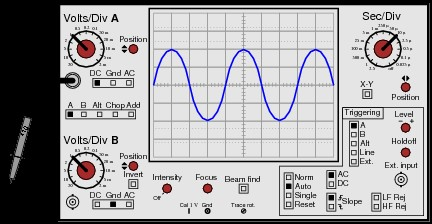
The volts/div for this oscilloscope are set to 2 V/div. The peak-to-peak voltage is _______ V.
8
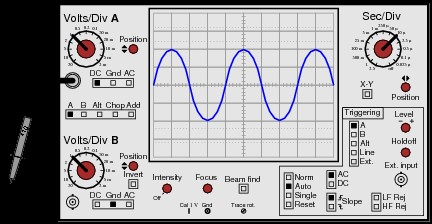
The sec/div is 5 microseconds/div. The period is ______ microseconds.
20
What happens to the capacitance of a capacitor when the distance between the plates is increased?
Capacitance decreases
What happens to the charge on a capacitor when the capacitance of a capacitor decreases and the battery remains connected?
Charge decreases
What happens to the capacitance of a capacitor when a dielectric is inserted between the plates of a capacitor (distance between the plates remains constant)?
Capacitance increases
What happens to the potential difference (delta V) across a capacitor when the capacitor is charged by a battery, the battery is then disconnected, and the capacitance is increased by inserting a dielectric?
The potential difference decreases.
According to Ohm's Law, I = (delta V) / R, if R = constant and the voltage is doubled, then the current _____.
doubles
According to Ohm's Law, I = (delta V) / R, if R is doubled and the voltage is doubled, then the current _____.
remains the same
According to Ohm's Law, I = (delta V) / R, if R = constant and the current is doubled, then the voltage is _____.
doubled
According to Ohm's Law, I = (delta V) / R, if R = constant and the voltage is decreased by a factor of two, then the current _____.
decreases by two
What is true of resistors wired in series:
The current through the resistors is the same.
What is true of resistors wired in parallel?
The voltage across the resistors is the same.
Ammeters are always wired in ___________.
series
Voltmeters are always wired in ____________.
parallel

For the following circuit, write two loop equations, one for loop marked S1, and one for loop marked S2.
EMF1 = 8V, EMF2 = 12 V, R1 = 8 ohms, R2 = 5 ohms, R3 = 16 ohms.
S1: (-8 ohms*I1)-5 ohms*I2+(8V)=0
S2: +5ohms*I2-16ohms*I3-12V-8V=0
The magnetic field direction at the center of a current-carrying loop is __________________.
perpendicular to the plane of the loop
μ 0 is called
the permeability constant
The magnetic field at the center of the loop is __________________.
directly proportional to the current in the loop
The magnetic field at the center of the loop is inversely proportional to the __________________.
diameter of the loop
Was an EMF induced in the secondary coil when the magnetic field was held constant?
No, There was no change in flux.
When the number of turns increase in a secondary coil that experiences a change in flux, which of the following is correct?
The emf across the secondary coil increases.
In part 5 of the lab, with the swinging pendulum with the coil, the emf induced in the swinging coil was proportional to which of the following?
The square root of the change in height of the pendulum
Why was the iron core used in last week's lab?
To increase the magnetic field inside the coil
In an RLC circuit, when the frequency is not at the resonant frequency of the circuit, then the current through the circuit and the total voltage across the circuit are not in phase. When the frequency is at the resonant frequency of the circuit, then the current through the circuit and the total voltage across the circuit are in phase.
true
The impedance of a circuit is the same as resistance of the circuit.
false
The magnetic field of a dipole moment at a distance x on the perpendicular axis can be written as a constant times which of the following?
1/ (distance x cubed)
What are the units of a dipole moment?
amps*m²
When a magnetic dipole is places in an external magnetic field, it lines up such that the dipole moment vector mu is _________.
parallel or antiparallel to the external magnetic field
Which of the following does not have a magnetic dipole moment?
a plastic bead