BIO201 Exam 1 - Cell Biology
 Call Kai
 Learn
 Practice Test
 Spaced Repetition
 Match
 Flashcards
 Knowt Play
1/64

There's no tags or description
Looks like no tags are added yet.
Name | Mastery | Learn | Test | Matching | Spaced | Call with Kai | Chat |
|---|
No analytics yet
Send a link to your students to track their progress
65 Terms
What is a cell and why is it important?
The fundamental unit of life; all organisms consist of cells from pre-existing cells.
Why are microscopes needed to see cells?
Most cells (1-100 µm) are too small for the naked eye to resolve.
What are the three major domains of life?
Bacteria, Archaea (both prokaryotic), and Eukarya (eukaryotic).
What are archaea and their extremophile adaptations?
Prokaryotes without nuclei; survive extreme environments using ether-linked membrane lipids and heat-stable proteins.
What four features are conserved in all cells?
Plasma membrane, ribosomes, DNA, and cytoskeleton (or cytoplasm).
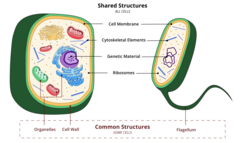
How do prokaryotic and eukaryotic cells differ?
Eukaryotes have a nucleus, membrane-bound organelles, linear chromosomes, and larger size.
What is the structure and function of the nucleus?
Stores DNA; enclosed by a double membrane with nuclear pores regulating molecular traffic.
What is the structure and function of a mitochondrion?
Generates ATP via cellular respiration; double-membraned with cristae, matrix, DNA, and ribosomes.
What is selective permeability in the plasma membrane?
The phospholipid bilayer regulates entry/exit, letting specific substances cross while blocking others.
What is the fluid mosaic model?
A dynamic phospholipid bilayer embedded with floating proteins, cholesterol, and carbohydrates.
How do fatty acids and cholesterol affect membrane fluidity?
Unsaturated fatty acids increase fluidity; cholesterol buffers fluidity against high and low temperatures.
What are peripheral, integral, and transmembrane proteins?
Peripheral attach to surfaces; integral embed in bilayer; transmembrane span across the entire membrane.
Where are glycoproteins and glycolipids located and what is their role?
On the outer membrane surface; function in cell recognition and molecular signaling.
How do size, charge, and polarity affect membrane permeability?
Small nonpolar molecules pass easily; large, polar, or charged substances require transport proteins.
What are typical sizes for cells, mitochondria, and ribosomes?
Prokaryotes ~1-10 µm, eukaryotes ~10-100 µm, mitochondria ~1-10 µm, ribosomes ~20-30 nm.
What is a plant cell vacuole and its function?
A large central membrane sac storing water, nutrients, and waste while supporting turgor pressure.
How is turgor pressure maintained in plant cells?
Water enters the vacuole, pushing against the rigid cell wall to keep plants firm.
What is a chloroplast and its structure?
Photosynthetic organelle in plants/algae; contains outer/inner membranes, stroma, and thylakoids in grana.
What is the difference between free and bound ribosomes?
Free ribosomes make cytosolic proteins; bound ribosomes on rough ER synthesize membrane/secretory proteins.
How do rough and smooth endoplasmic reticulum differ?
Rough ER has ribosomes and processes proteins; smooth ER lacks ribosomes and synthesizes lipids.
What is the main function of the Golgi apparatus?
Modifies, sorts, and packages ER-derived proteins and lipids into vesicles for transport.
What are the three components of the cytoskeleton? (Filiments)
Microtubules, microfilaments (actin), and intermediate filaments.
What subunits make up microtubules, microfilaments, and intermediate filaments?
Microtubules use tubulin, microfilaments use actin, and intermediate filaments use proteins like keratin.
What are the functions of actin microfilaments?
Maintain cell shape, support microvilli, drive cell crawling, muscle contraction, and cytokinesis.
What is the role of intermediate filaments?
Provide mechanical strength, resist cellular tension, and anchor organelles like the nucleus.
What path does a secreted protein take through the endomembrane system?
Nucleus (mRNA) → Rough ER → Transport vesicle → Golgi → Secretory vesicle → Plasma membrane.
How is a growing protein targeted to the ER membrane?
A signal sequence binds Signal Recognition Particle (SRP), directing the ribosome to ER receptors.
What is the role of ER membrane tubes?
Connect ER regions and link ER to Golgi, facilitating internal transport of biomolecules.
What modifications occur to proteins inside the Golgi?
Proteins are trimmed, glycosylated (adding sugar chains), sorted, and packaged into transport vesicles.
How are transport vesicles directed to correct cell destinations?
Motor proteins move them along cytoskeleton tracks; Vesicles are studded with proteins (Zip Codes), that line up at a specific receptors at the destination
What motor protein moves vesicles along microtubules toward the plus end?
Kinesin walks toward the plus end (periphery) using ATP energy.
How is insulin released from pancreatic cells?
Packaged at trans-Golgi into secretory vesicles, transported along microtubules, and released via exocytosis.
What is diffusion versus net diffusion?
Diffusion is random thermal movement; net diffusion is overall movement down a concentration gradient.
Why is net diffusion important in biological systems?
Moves essential gases (O₂/CO₂) and nutrients across membranes without spending cellular energy.
What is osmosis?
Net diffusion of water across a selectively permeable membrane toward higher solute concentration.
What three conditions are required for osmosis?
Concentration gradient, selectively permeable membrane, and solute that cannot cross the membrane.
How does a concentration gradient represent potential energy?
Molecules concentrated on one side store potential energy, released as kinetic energy during diffusion.
What is an ion channel and how does it function?
Transmembrane pore allowing specific ions to cross passively; can be gated by signals.
How does a membrane carrier protein work?
Binds specific solute, undergoes conformational change, and releases solute on the opposite side.
How do active and passive membrane transport differ?
Active transport requires energy (ATP) to move solutes against gradients; passive moves down gradients.
How does the Na+/K+ pump operate?
Uses ATP to pump 3 Na+ ions out and 2 K+ ions into the cell.
What are the three forms of cellular work?
Chemical work (building molecules), transport work (pumping solutes), and mechanical work (movement).
What are kinetic, potential, and thermal energy?
Kinetic is motion energy, potential is stored energy, and thermal is random heat energy.
How is potential energy stored in chemical bonds?
Stored in shared electron arrangements; nonpolar bonds (e.g., C-H) hold higher potential energy.
What is free energy (G) and its equation?
Energy available to do work; Free Energy = Thermal + Potential (predicts reaction spontaneity).
What characterizes a spontaneous chemical reaction?
Negative ΔG (releases free energy), decreased potential energy, and increased entropy.
How do cells drive non-spontaneous reactions?
By energy coupling: pairing non-spontaneous processes (ΔG > 0) with exergonic reactions like ATP hydrolysis.
Why does ATP store high potential energy?
Three negatively charged phosphate groups closely packed together create strong electrostatic repulsion.
What is phosphorylation and why is it important?
Transfer of a phosphate group from ATP to a molecule, increasing its free energy.
What are the stages of Cellular Respiration?
glycolysis, pyruvate processing, citric acid cycle, electron transport chin (ETC), oxidative phosphorylation
What is oxidation?
Loss of electrons
What is reduction?
Gain of electrons
What is the goal of cellular respiration?
To produce ATP

Reactants/products of Glycolysis?
Glucose (6C) into 2 pyruvate (3C) + 2 ATP.
Net 2 ATP and 2 NADH
Reactants/products of pyruvate processing?
Pyruvate (3C) into Acetyl (CoA) (2C) + Co2 + NADH
Reactants/products of the citric acid cycle
Acetyl (CoA) (2C) into Co2 + ATP + NADH + FADH2 + H ions (protons)
Reactants/products of oxidative phosphorlation
FADH2 + NADH into 28 ATP
Where is Glycolysis preformed?
In the cytoplasm
Where is pyruvate processing and citric acid cycle preformed?
In the matrix
Where is oxidative phosphorylation preformed?
In the inner mitochondrial membrane, matrix, and inter membrane space
What are the electron transporters?
NADH and FADH
How does ATP syntheses work?
It uses the proton gradient as a force to spin a turbine and generate the energy to preform ADP+P into ATP.
Why do we breath oxygen?
To empty out the protons in oxidative phosphorylation
Enzymes
Catalysts, made of proteins, decrease activation energy, variable effeciency (Tempiture, shape, pH), and they are reusable
Exergonic vs Endergonic reactions
Exergonic = Spontaneous, decrease/use free energy.
Endergonic = Non-spontaneous, increase free energy