Chemistry OCR - Module 5: Section 3 Transition Elements
 Call Kai
 Learn
 Practice Test
 Spaced Repetition
 Match
 Flashcards
 Knowt Play
1/29

There's no tags or description
Looks like no tags are added yet.
30 Terms
Where are the transition metals in the periodic table?
d-block
What are the electron configurations of the transition elements?
A d sub-shell can hold 10 electrons. So transition elements must form at least one ion that has between 1 and 9 electrons int he d sub-shell. All the period 4 d-block elements are transition elements apart from scandium and zinc. The diagram shows the 3d and 4s sub-shells of these elements.

When ions are formed, why do the s electrons get removed first?
when transition elements form positive ions, the s electrons are removed first, then the d electrons.
Iron can form Fe2+ ions and the Fe3+ ions.\
When it forms 2+ ions, it loses both its 4s electrons.
Fe = 1s22s22p63s23p64s2 → Fe2+ = 1s22s22p63s23p63d5
Only once the 4s electrons are removed can a 3d electron be removed.
e.g. Fe2+ = 1s22s22p63s23p63d6 → Fe3+ = 1s22s22p63s23p63d5
Why are Scandium and Zinc not transition elements?
Scandium and Zinc cannot form stable ions with incomplete d sub-shells. So neither of them fits the definition of a transition element.
Scandium only forms one ion, Sc3+, which has an empty d sub-shell. Scandium has the electron configuration 1s22s22p63s23p63d14s2. It loses three electrons to form Sc3+, which has the electron configuration 1s22s2sp63s23p6.
Zinc only forms one ion, Zn2+, which has a full d sub-shell. Zinc has the electron configuration 1s22s22p63s23p63d104s2. When it forms Zn2+ it loses 2 electrons, both from the 4s sub-shell, so it keeps its full 3 d sub-shell.
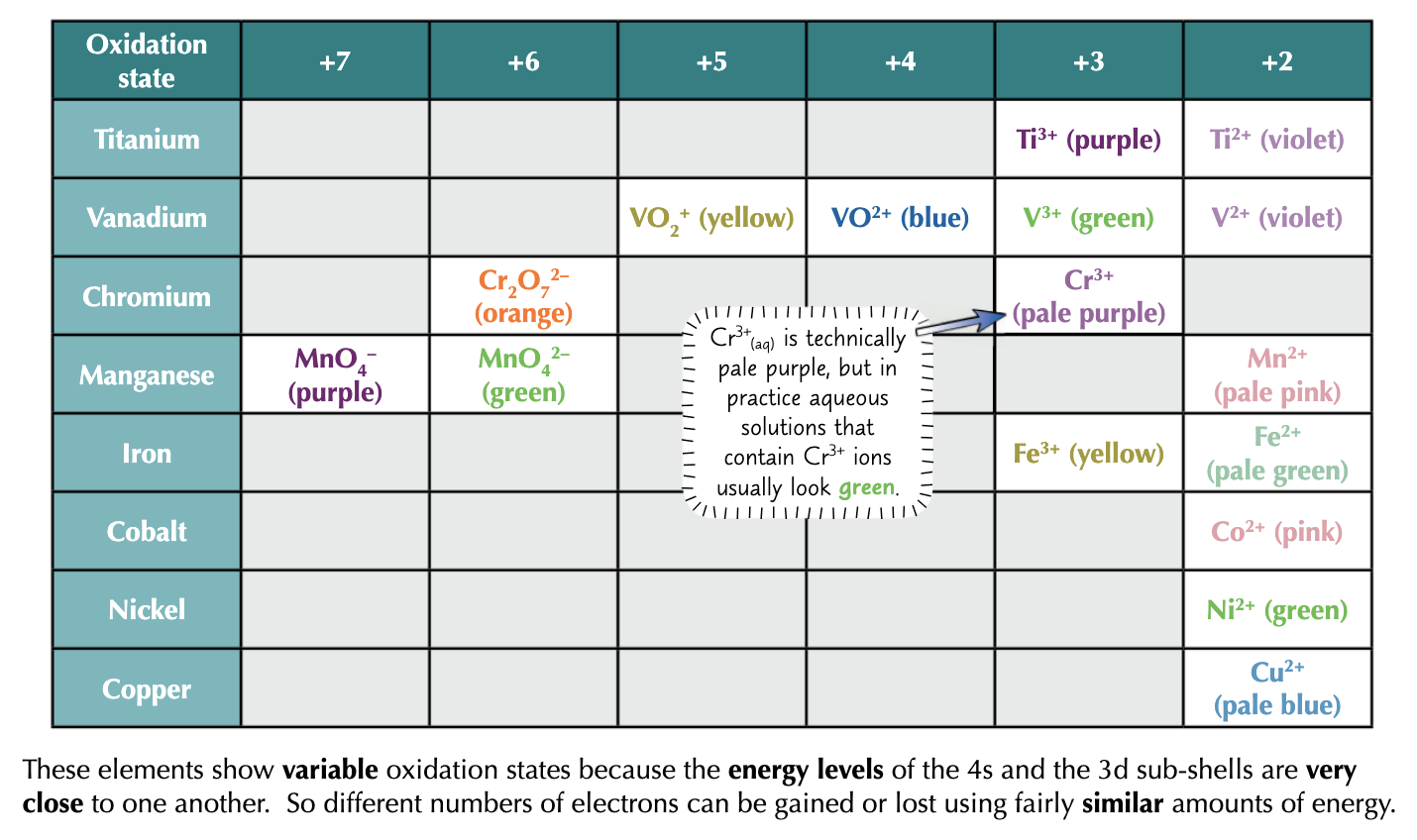
What are the common coloured ions and oxidation states.
Why do transition elements and their compounds make good catalysts?
Transition elements and their compounds make good catalysts because they can change oxidation states by gaining or losing electrons within their d orbitals. This means they can transfer electrons to speed up reactions.
Transition metals are also good at absorbing substances onto their surfaces to lower the activation energy of reactions.
Catalysts are good for industry and for the environment as they allow reactions to happen faster and at lower temperature and pressures, reducing energy usage.
Using transition element catalysts can pose health risks as many of the metals and their compounds are toxic. For example, long terms exposure to copper can damage the liver and kidneys, and exposure to manganese can cause psychiatric problems.
What are the brightly coloured precipitates of transition element hydroxides?
When you mix an aqueous solution of transition element ions with aqueous sodium hydroxide (NaOH) or aqueous ammonia (NH3) you get a coloured hydroxide precipitate.
In aqueous solutions, transition elements take the form [M(H2O)6]n+. They can also be written as Mn+(aq), as long as the metal ion is only bonded to water. If it is bonded to anything else you need to write out the whole formula.

What is a complex ion?
A complex ion is a metal ion surrounded by coordinately bonded ligands
What is a coordinate bond?
A coordinate bond (or a dative covalent bond) is a covalent bond in which both electrons in the shared pair come from the same atom.
What is a ligand?
A ligand is an atom, ion or molecule that donates a pair of electrons to a central metal atom or ion.
What is the coordination number?
The coordination number is the number of coordinate bonds that are formed with the central metal atom/ion.
In most of the complex ions that will be studied, the coordination number will be 4 or 6. If the ligands are small, like H2O, CN- or NH3, 6 can fit around the central metal atom/ion. But if the ligands are larger, like Cl-, only 4 can fit around the central metal atom/ion.
What shape is the complex ion if the coordination number is 6? Give examples of complex ions with a coordination number of 6.
An octahedral shape.
[Cu(H2O)6]2+(aq)
[Co(NH3)6]2+(aq)
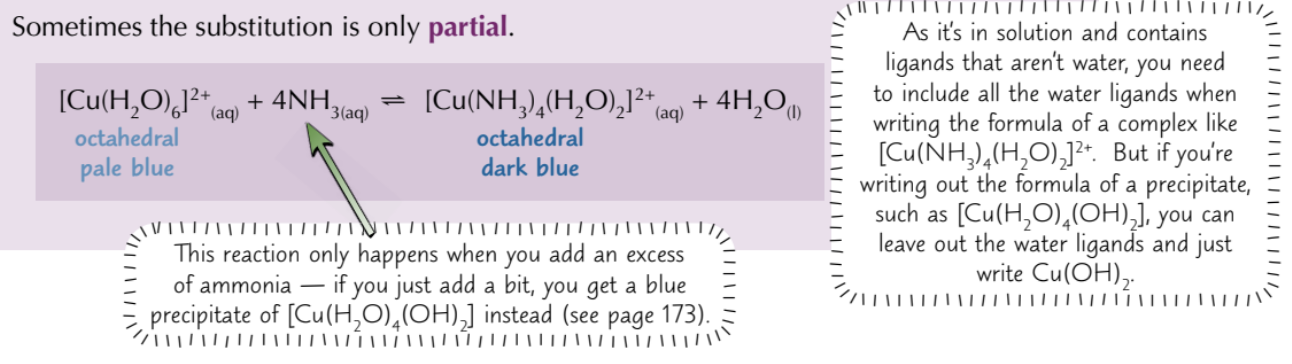
[Cu(NH3)4(H2O)2]2+(aq)

What shape does a complex ion with 4 coordinate bonds make? Give examples of complex ions with a coordination number of 4.
Tetrahedral shape e.g. [CoCl4]2-, which is blue, and [CuCl4]2-, which is yellow.
but not always. In a few complexes, 4 coordinate bonds form a square planar shape. e.g. [NiCl2(NH3)2]

Why must a ligand have at least one lone pair of electrons?
A ligand must have at least one lone pair of electrons, or it will not have anything to form a coordinate bond with.
What are the ligands with a different number of lone pairs called?
Ligands that have one lone pair available for bonding are called monodentate
Ligands with two lone pairs are called bidentate. Bidentate ligands can each from two coordinate bonds with a metal ion.
Ligands that form two or more coordinate bonds are called multidentate.
How can complex ions show optical isomerism?
Optical isomerism is a type of stereoisomerism. With complex ions, it happens when an ion can exist in two non-superimposable mirror images. This happens in octahedral complexes when three bidentate ligands, are attached to the central ion. E.g. [Ni(NH2CH2CH2NH2)3]2+

How can complex ions show cis/trans isomerism?
Cis/trans isomerism is a special case of E/Z isomerism. When there are only two different groups involved you can use the cis/trans naming system. Square planar and octahedral complex ions that have at least two pairs of ligands show cis/trans isomerism. Cis isomers have the same groups on the same side, trans have the same groups opposite each other.

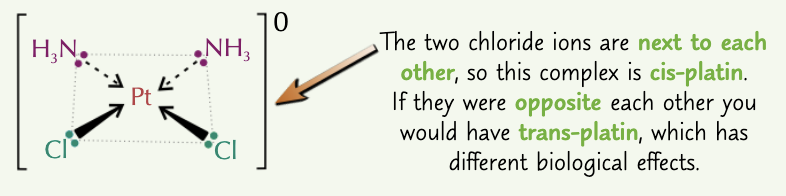
What is cis-platin?
Cis-platin is a complex of platinum(II) with two chloride ions and two ammonia molecules in a square planar shape. It is used as an anti-cancer drug.
How does cis-platin bind to DNA in cancer cells?
The two chloride ligands are very easy to displace. So the cis-platin loses them, and bonds to two nitrogen atoms on the DNA molecules inside the cancerous cell instead.
This block on its DNA prevents the cancerous cell from reproducing by division. The cell will die, since it is unable to repair the damage.
The downside is that cis-platin also prevents normal cells from reproducing, including blood, which can suppress the immune system and increase the resit of infection. Cis-platin may also cause damage to the kidneys.
How can ligands exchange places with one another?
One ligand can be swapped for another ligand, this is ligand substitution. It usually causes a colour change.
If the ligands are of similar size, e.g. H2O, NH3 or CN-, then the coordination number of the complex ion does not change, and neither does the shape.
How can ligands of similar size exchange places with one another?
If the ligands are of similar size, e.g. H2O, NH3 or CN-, then the coordination number of the complex ion does not change, and neither does the shape.

How can ligands of different sizes exchange places with one another?
If the ligands are different sizes, e.g. H2O and Cl-, there is a change of coordination number and a change of shape.

How can partial ligand substitution occur?
How does Fe2+ in Haemoglobin allow oxygen to be carried in the blood?
Haemoglobin contains Fe2+ ions. The Fe2+ ions form 6 coordinate bonds. Four of the lone pairs come from nitrogen atoms within a circular part of the molecule called ‘haem’ which is a multidentate ligand. A fifth lone pair comes from a nitrogen atom on a protein (globin). The last position has a water ligand attached to the iron.
In the lungs the oxygen concentration is high, so the water ligand is substituted for an oxygen molecule (O2), forming oxyhaemoglobin. This is carried around the body and when it gets to a place where oxygen is needed, the oxygen molecule is exchanged for a water molecules again.
If carbon monoxide (CO) is inhaled, the haemoglobin swaps its water ligand for a carbon monoxide ligand, forming carboxyhaemoglobin. This is bad because carbon monoxide is a strong ligand and does not readily exchange with oxygen or water ligands, meaning the haemoglobin cannot transport oxygen any more.

How can transition elements take part in redox reactions?
Transition elements can exist in many different oxidation states.
They can change oxidation state by gaining or losing electrons in redox reactions.
For complex ions in solution, a change in oxidation state is often accompanied by a colour change.
Give the interconversion between Fe2+ and Fe3+.

Give the interconversion between Cr3+ and Cr2O72-.

Give the reduction of Cu2+ and disproportionation of Cu+.

How can transition element ions be identified using sodium hydroxide?
Many transition element ions form coloured precipitates when aqueous sodium hydroxide is added.
This is a good way to identify which transition element ions might be in a mixture.
Add NaOH(aq) solution, dropwise from a pipette, to a test tube containing the unknown solution and record the colour of any precipitate formed.
The table shows some of the ions that can be identified using this method.

How can some ligands be identified using simple tests? Give the test and observation for CO32-, Cl-, Br-, I-, SO42-, NH4+.
