test 3 environmental
 Call Kai
 Learn
 Practice Test
 Spaced Repetition
 Match
 Flashcards
 Knowt Play
1/33

There's no tags or description
Looks like no tags are added yet.
34 Terms
some groups have more species than others
species are not evenly distributed among taxonomic groups. insects are the most abundant organism species
edward o. wilson
developed theory of island biography
first to use “biodiversity” in a scientific paper
champion of conservation
entomologist specialized in ants
theory of island biography
big islands close to mainland: high pops., lower rate of extinction
small island close to mainland: lower immigration rate, high extinction rate
big islands far from mainland: high pop., higher extinction rate, low immigration rates
small islands far from mainland: smaller pop., high extinction rate, low immigration rates

biodiversity is unevenly distributed
abundance increases towards the poles
species richness increases towards the poles
natural selection
variation: genetic mutations arise in populations of species
adaptation: some individuals’ mutations mean they are better suited to their environment than others. this leads to differential reproductive success
how do new species evolve?
speciation: one species splits into two or more species
geographic isolation: happens first, physical isolation of a species for a long period
reproductive isolation: mutations and natural selection in geographically isolated populations lead to inability to produce viable offspring when members when members of two difference populations meet
extinction
extirpation: local extinction (other populations of said species exist elsewhere)
mass extinction: 5 over 500 million years; earth has had 5 major extinctions in the past 440 mill years (humans causing 6th)
bg extinction: typically low
today’s extinction rate is 100-1000 times higher than bg rate and its rising
vulnerable species to extinction
vulnerable: endemic species, large species, specialists, apex predators, large range required, small/isolated populations
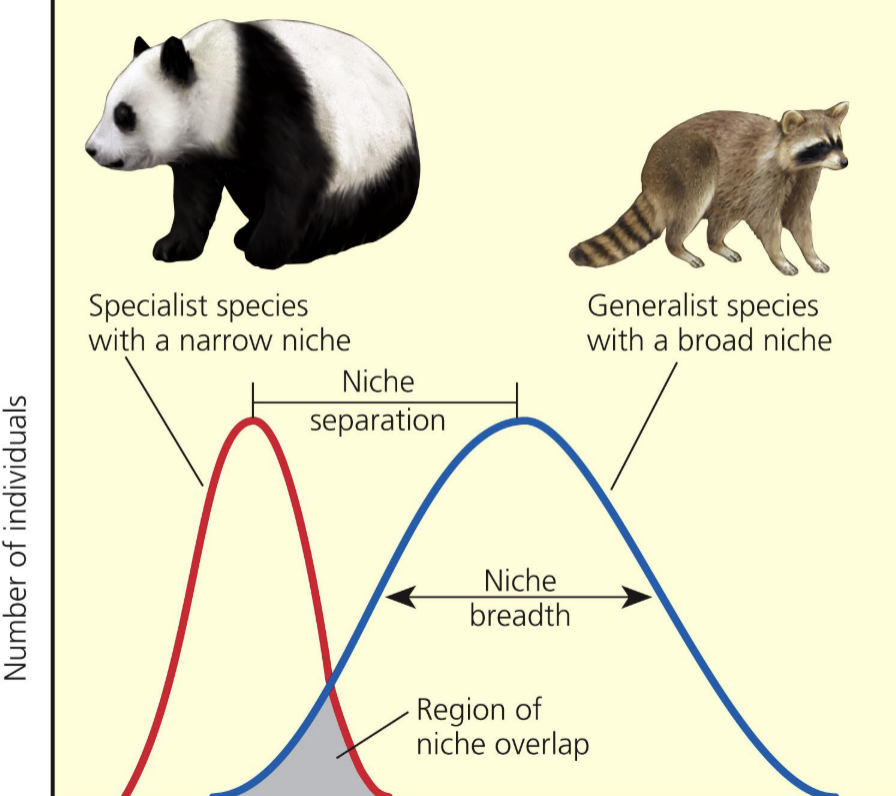
niche
the summary of everything an organism does
use of resources, functional role in a community
specialists vs. generalists
s: specific habitat, range, food
g: edge species, omnivorous, don’t need specific food/habitats
population density
the number of individuals in a population per unit area
high density advantages: easier to find mate (add more)
high density disadvantages: increased competition and vulnerability to predation, increased transmission of disease, sometimes organisms leave bc its too dense
population distribution
spacial arrangement of organisms

limiting factors
physical, chemical, and biological attributes of the environment that restrain population growth
carrying capacity
the maximum population size of a species that its environment can sustain
s shapes logistics curve
density dependent factors
limiting factors whose influence is affected by population density
risk of predation, disease, and competition
density-independant factors
limiting factors whose influence is not affected by population density
events such as landslides, fires, and floods
biotic potential (an organisms capacity to produce offspring)
k - selected species
species with long gestation periods, few offspring, and strong parental care, low biotic potential, stabilize at or near carrying capacity (good competitors)
r - selected species
species that reproduce quickly and offer little or no care for offspring, have high biotic potential, populations fluctuate greatly
species interact in 5 key ways
predation:
parasitism:
mutualism: black rhinos and ox-peckers
commensalism: one organism benefits off another without harming it, bromeliads in a tree
competition:
resource partitioning
process by which species use different resources or shared resources in different ways
ex) birds all eat insects, but they all catch them on different parts of the tree
primary succession
no soil in a terrestrial system, no bottom sediment in an aquatic system, takes hundreds to thousands of years, need to build up soils/sediments to provide necessary nutrients
secondary succession
some soil remains in a terrestrial system, some bottom sediments remain in an aquatic system, ecosystems have been disturbed, removed, destroyed
how do fragmented forests effect ecosystems?
edge species prevail (white tail dear, crows, opossums, raccoons), and forest interior species suffer (oven birds)
metapopulations
a network of separated subpopulations, each occupying a patch of a mosaic (fragmented complex ecosystem)
how can we join subpopulations?
habitat corridors (link “patches” together)
how does energy (sun) interact with ecosystems?

order energy is converted to biomass
primary production: conversion of solar energy to chemical energy in glucose by autotrophs
secondary production: biomass generated by heterotrophs from consuming autotrophs
gross primary production: total amount of energy captured by autotrophs
net primary production: energy remaining after respiration—used to generate biomass
high net primary productivity
ecosystems whose plants rapidly convert solar energy to biomass
ex) rainforests, corral reefs
macronutrients and nutrients
macronutrients: nutrients required in larger amounts (phosphorous, nitrogen, carbon)
nutrients: elements & compounds required for survival that are consumed by organisms
how do nutrients circulate through ecosystems?
sink: a pool that mostly accepts nutrients
source: a pool that mostly releases nutrients
how does the water cycle affect all other cycles?
it is essential for biochemical reactions, involved in nearly every environment system
hydrologic cycle: summarizes how liquids, gasses, and solid water flow through the environment (oceans are the main resirvoir)
evaporation: process by which water moves from aquatic and land systems into the atmosphere
transpiration: release of water vapor by plants
precipitation: run-off and surface water where water returns to the earth as rain, snow, and flows into oceans/lakes etc.
ground water & aquifers
ground water: water found underground beneath layers of soil
aquifers: underground reservoir of ground water found in sponge like regions of rock and soil (refills from water seeping through rock). this water may be ancient and can take years to refill
water table
the upper limit of ground water in aquifers; ground water becomes exposed to air where the water table reaches the surface (exposed water runs off to the ocean or evaporates)
human impacts on the water cycle
removing forests/vegetation increases erosion, decreases transpiration, and decreases filtration of water
daming rivers slows water movement to the sea & increases evaporation
irrigating crop fields depletes rivers and lakes, & lowers water table