17th Nov_Lecture 20
 Call Kai
 Learn
 Practice Test
 Spaced Repetition
 Match
 Flashcards
 Knowt Play
1/28

There's no tags or description
Looks like no tags are added yet.
29 Terms
what are the 3 diff types of cytoskeleton?
- microtuble
- actin filaments
- intermediate filaments
microtubles subunit
alpha and beta
alpha and beta - which of these content GTP and TAG ?
the beta subunit has GTP
microtubule dimers non-covalent bonds lead to formation of
13 of proto filaments forms microtubes
2 ends of mictrotubles
alpha beta, plus and minus
chracteristic of minus
not really growing, depolymerization happens more, shortening more
plus end
polymerization, growth end
lot of concentration minus in test tube, what happens?
dimers added to plus end
minus end and plus end, GTP hydrolyses and addition of dimers ?
+ = addition of dimers more than the GTP -hydrolyses-getting added
(formation of GTP cap)
- = rate of GTP hydrolyses is more than the addition of dimers
minus end
(already added GTP, changes the conformation and falls)
which end beta?
+ (b+)
looking at lumen of microtubules (13) postive end and negative end?
+ = beta
- = alpha
unique property?
dynamic instability
centrosome
centromer come out from? seating
gamma nucleating sites
drugs affecting the polymerization and depolymerization?
know this
monomer ?
ATP - actin
+ and - and abundant of actine presnet?
add on both
microtubule = plus?
-
polymerization and ATP
depolyrmerization = ADP - end

EcoRI fragments generally ligate more efficiently because complementary overhangs can re-anneal.
A researcher wants a plasmid to produce a gene product in host cells while allowing cells carrying the plasmid to be identified. Which combination of elements best supports these goals?
A promoter, gene insert, antibiotic resistance gene, and origin of replication
A researcher cuts a plasmid and a gene fragment with the same restriction enzymes before introducing them into bacteria. Why is this strategy effective?
The compatible sticky ends allow DNA ligase to join the insert and plasmid into a recombinant plasmid.

~490bp
~1000bp
~2000bp
5. ~750 bp????
A DNA gel shows a bright band that has migrated farther than the bands in a control lane. Which interpretation is best supported by the electrophoresis principles provided?
The sample contains a larger amount of smaller DNA fragment.
Is it possible that the bacteria grown on the plate post TRANSFORMATION has the plasmid but NOT THE GENE OF INTEREST?
plasmid can religate itself
A researcher must verify not only that an insert is present, but also its size and whether its nucleotide sequence is correct. Which method provides the most complete confirmation?
Sequencing with vector-specific or insert-specific primers
What happens to the mutated restriction site? Will that be cut?
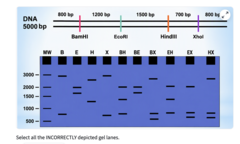
B
E
H
X

Hind III (H): 3500, 1500