History 10 Test 1 Terms
 Call Kai
 Learn
 Practice Test
 Spaced Repetition
 Match
 Flashcards
 Knowt Play
1/59

There's no tags or description
Looks like no tags are added yet.
Name | Mastery | Learn | Test | Matching | Spaced | Call with Kai | Chat |
|---|
No analytics yet
Send a link to your students to track their progress
60 Terms
Mesopotamia
A region between the Tigris and Euphrates rivers that developed the first urban societies. In the Bronze Age this area included Sumer and the Akkadian, Babylonian and Assyrian empires, In the Iron Age, it was ruled by the Neo-Assyrian and Neo-Babylonian empires.
Sumerians
The people who dominated southern Mesopotamia through the end of the third millennium B.C.E. They were responsible for the creation of many fundamental elements of Mesopotamian culture-such as irrigation technology, cuneiform, and religious conceptions.
Sargon
2340 B.C. leader of the Akkadians who overran the Sumerian city-state and set up the first empire
Hammurabi
Amorite ruler of Babylon (r. 1792-1750 B.C.E.). He conquered many city-states in southern and northern Mesopotamia and is best known for a code of laws, inscribed on a black stone pillar, illustrating the principles to be used in legal cases.
Nile River
The river in which early kingdoms in Egypt were centered around.
Menes
King who united upper and lower Egypt
Khufu
Khufu, Greek Cheops, (flourished 25th century BCE), the second king of the 4th dynasty (c. 2575-c. 2465 BCE) of Egypt and builder of the Great Pyramid at Giza., the largest single building of that time.
Nubia/Kush
below Egypt; used Nile; used iron
Hyksos
a group of nomadic invaders from southwest Asia who ruled Egypt from 1640 to 1570 B.C.E
Ahmose
New Kingdom pharaoh who drove the Hyksos out of the Nile Delta and reunited Egypt.

Hatshepsut
Queen of Egypt (1473-1458 B.C.E.). Dispatched a naval expedition down the Red Sea to Punt (possibly Somalia), the faraway source of myrrh. There is evidence of opposition to a woman as ruler, and after her death her name was frequently expunged.

Thuthmosis III
6th Pharaoh of Egypt
Took the throne after he came of age and Hatshepsut ruled in his stead.
He led 17 successful military campaigns and had plenty victories
He led the Battle of Megiddo
Megiddo
Location of a battle (1457 B.C.E.) between the Egyptians and the Hittites. So many battles were fought over the centuries in this location that it became immortalized in the Christian Bible as the apocalyptic battlefield of "Armageddon".

Amenhotep IV
He later changed his name to Akhenaton, abandoned the old system of worship and begin worshiping only one god, Aton.

Indo-Europeans
In about the 1500s BCE, these people were migrating tribes from present-day southeast Russia. Some traveled to Europe, some to Persia, and some to India. Thus, today many people in Europe, Persia, and India share some linguistic, cultural, and biological roots.

Aryans
nomads from Europe and Asia who migrated to India and finally settled; Vedas from this time suggest the beginning of a caste system
Hittites
The group of people who toppled the Babylonian empire and were responsible for two technological innovations--the war chariots and the refinement of iron metallurgy. The also even seemed to be a threat to the Egyptians.
Rameses II
king of Egypt between 1304 and 1237 BC who built many monuments. Also known as Rameses the Great and
Qadesh
-second known battle
-Egyptians vs. the Hittites (Egyptians led by Rameses II and Hittites led by Muwatallis
-biggest battle known, more chariots in history of the world ever
-more men fought, 50,000 men combined
Phoenicians
located on the eastern Mediterranean coast; invented the alphabet which used sounds rather than symbols like cuneiform.They spoke a Semitic language and the greeks later adopted their alphabet.
Minoans
The Mediterranean society formed on the island of Crete and was a big maritime society. Their name comes from King Minos, a legendary King of Crete. They were NOT Greek but they did influence Greek culture on the mainland.
Myceneans
People from the Greek mainland who conquered central Crete; warring people who grouped themselves into clans and tribes. They were the last phase of the Bronze Age in Greece and the book mentions that the cause of the Collapse of Mycenaean Civilization could've been caused by earthquakes, greek speaking invaders from the north, etc. The Bronze Age is followed by the Dark Ages of Greece and then the archaic era in Greece.
Sea Peoples
Unknown group of strong warriors who crushed the Hittites and destroyed cities in southwest Asia, who fought the Egyptians for 50 years.
Dark Age of Greece
period of Greek history where not much information was recorded - population declined - food shortages - increase in the use of weapons - adopted Phoenician alphabet.
Homer's work (poetry) emerged at the end of this period.
Assyrian Empire
The empire of Assyria ruled over the middle east and Asia from 900 to 600 BCE, including Persia until the subjects of the Assyrian empire rose up in destroyed the capital in 612 BCE. By 605 the empire was completely destroyed, however, the fall didn't mean freedom for the Persians but now they were ruled by the media( the neighbors of Persia). After the fall of Assyria, the new great powers were Media, Egypt, Babylonia, and Lydia.
Archaic Age of Greece
Greek time period immediately following the Dark Ages. It was characterized by the rise of the polis. It was a time of great change. The population and number of cities increased dramatically and had colonies in Asia Minor, southern Italy, Corsica, Sicily, and parts of North Africa.
Hoplite
A citizen-soldier of the Ancient Greek City-states (polis). They were primarily armed as spear-men. They had to provide for their own armor, and weapons and initially were a small class until when the Greeks started using Iron, it became more affordable to serve in the military and this directly led to the Polis. They were the only ones with political power

polis
A city-state in ancient Greece.

Sparta
Greek city-state that was ruled by an oligarchy, focused on military, used slaves for agriculture, discouraged the arts. One of the most famous oligarchies amongst the Polis.
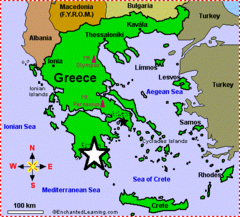
helots
enslaved people in ancient Sparta
oligarchy
It means rule of the few. A government ruled by a few powerful people, Sparta was the most notable Polis that had this form of government.
Athens
A democratic Greek polis that accomplished many cultural achievements, and who were constantly at war with Sparta.

democracy
It means Rule of the many. Athens was the most famous of these. In Athens, all male citizens regardless of wealth were able to participate in politics. If you couldn't afford weapons then you served in the military in other ways (riding boats in the navy) only 25% of the population had political power.
Persian Empire
Greatest empire in the world up to 500 BCE. Spoke an Indo-European language. A multi-ethnic and multi-religious empire. Fell to Alexander the Great.
Cyrus II
he is also known as Cyrus The Great he was also known as the man who established the Persian Empire.
Most of what we know today about Persia is through the Greeks (they are VERY biased).
In 550 CE Cyrus was able to free Persia from Median rule and he conquered Media in 546, they conquered Lydia, and in 539, they conquered Babylonia. Almost overnight, in 539, Persia became an empire. Most empires are generally conquered in a short period of time.

Cambyses II (530-522 BC)
Cyrus dies in 530 BCE and was succeeded by his Cambysses from 530-522 BCE during his reign, Persia conquered Egypt and this marked the end of an independent Egypt throughout history. Cambyses dies in 522 in mysterious circumstances and his cousin(Darius) takes the throne.
Darius I
Third ruler of the Persian Empire (r. 521-486 B.C.E.). He crushed the widespread initial resistance to his rule and gave all major government posts to Persians rather than to Medes.
During his reign, he was able to conquer parts of India and some parts of Europe near the Danube River near Macedonia.
satrapies/satraps
Administrative and tax districts; Mostly Persians; Each had a contingent of the military; Watched by imperial spies
Zoroastrianism
Religion was founded in Persia, and they believed in 2 gods Ahura Mazda, and Angra Madra. They believed in the duality of good and evil and that we as humans had free will to choose to be good or evil, and ultimately they believed that good would triumph.

Persian War
5th century B.C.E wars between the Persian empire and Greek city-states; Greek victories allowed Greek civilization to define identity.
Battle of Marathon
(490 B.C.E.) Battle where the Persians who invaded Greece were defeated on the Plain of Marathon by an Athenian army.
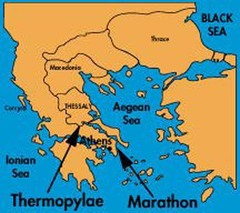
Xerxes
son of Darius; became Persian king. He vowed revenge on the Athenians. He invaded Greece with 180,000 troops in 480 B.C.. He is not as good as his father, in terms of military leadership and he makes mistakes that allows the Greeks to win the Persian War.
Battle of Salamis
One of Xerxes' greatest mistakes since the battle was fought in a narrow channel and put the Persians at a disadvantage, he placed most of the Persian fleet there. 480 B.C.E. The battle that effectively ended the Persian war. The Greek fleet, although vastly outnumbered, defeated the Persian fleet. This helped end the Persian war, freeing Greece.

Battle of Platea
Battle where Sparta and Athens combined to defeat the Persians and end the Persian Wars

Delian League/Athenian Empire
(478 BC) an association of about 150 Greek Polis (city-states), under the leadership of Athens, their purpose was to continue fighting in the Persian War after the Battle of Plataea. Athenians took over the leadership of the Greek world by forming a defensive alliance against the Persians called the Delian League. Under the leadership of the Athenians, the Delian League pursued the attack against the Persian Empire. By controlling the Delian League, Athens had created an empire.
Pericles
Athenian leader noted for advancing democracy in Athens and for ordering the construction of the Parthenon. Later dies from the Plague of Athens.

Peloponnesian War (431-404 BCE)
27 YR war between Athenians and the Peloponnesian League which was led by the Spartans. Athens's strategy of defense; however, by the 2nd yr of war, a plague killed 1/3 of the pop. Pericles died the following yr.
Political outcome: Athens was reduced to a weak city-state while Sparta became the leading power. This led to next 10 yrs of petty wars; destroyed cooperation
Macedonia
An ancient kingdom north of Greece, whose ruler Philip II conquered Greece in 338 B.C.
Philip II
Remains on the throne for 23 years which is the longest in a while for a Macedonian King. He transforms Macedonia into the greatest power in Greece and he ends up uniting Greece(Polis fall) and demands the other city-states to contribute to his army. He ends up getting assassinated at his daughter's wedding and is succeeded by his son, Alexander.
Alexander III (the Great)
Macedonian king, son of Philip II, who established an empire stretching from Greece to Egypt to the Indus River east of Persia; brought Greek influence to empire. Wanted a unified empire/ closer bond. Tolerant to the people he conquered., -son of Philip 11 and pupil of Aristotle
-during the Persian Wars against Greece, Alexander invaded and destroyed the Persian Empire with 40,000 Greek soldiers
-his kingdom extended from Greece to India
-was responsible for the spread of the Greek language and customs throughout the then-known world (Austin no. 2 = Plut. Alex. 10.6-11, Diod. 17.14), (356-323BC)
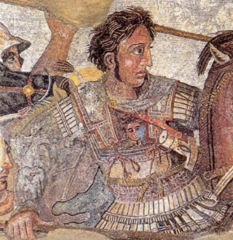
Darius III
Persian king who lost his empire to Alexander the Great.
Issus
This major defeat of Darius by Alexander the great sealed the fate of the Persian empire; however, Darius escaped by Chariot. [333BC]
Gaugamela
The site of a battle in 331 BC between Alexander the Great and Darius III. Alexander emerged victorious. The defeat began the elimination of the Persian Empire. Darius gets assassinated by his own men because they were convinced that they couldn't win the War.
Hydaspes River (Battle)
- 326 BC took place in India
- Alexander wins and wants to keep conquering more land but his generals make him turn back (had to fight elephants)
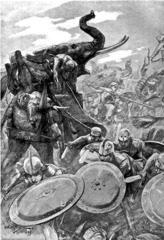
Porus
- Ruler of northwestern India during the battle against Alexander III at Hydaspes River. Has a large fleet of battle elephants. Still remains king after getting defeated by Alexander.
Epigoni Wars
(323-276 BC)
Wars between generals after Alexander's death → led to Hellenistic Kingdoms
creates 3 Hellenistic empires
Hellenistic Age
Historians' term for the era, usually dated 323-30 B.C.E., in which Greek culture spread across western Asia and northeastern Africa after the conquests of Alexander the Great. The period ended with the fall of the last major Hellenistic kingdom to Rome, but Greek cultural influence persisted until the spread of Islam in the seventh century C.E.

Alexandria
City on the Mediterranean coast of Egypt founded by Alexander. It became the capital of the Hellenistic kingdom of Ptolemy. It contained the famous Library and the Museum and was a center for leading scientific and literary figures in the classical and postclassical eras.

Aristarchus
(310?-250? BCE) Greek scientist who first stated that the Earth revolved around the Sun, and rotated on its axis.

Eratosthenes
Greek mathematician and astronomer who estimated the circumference of the earth and the distances to the moon and sun (276-194 BC)
