WEEK 5: Transfers & Guarding
 Call Kai
 Learn
 Practice Test
 Spaced Repetition
 Match
 Flashcards
 Knowt Play
1/55

There's no tags or description
Looks like no tags are added yet.
56 Terms
What are the 11 common medical diagnoses in physical therapy that frequently require transfer training?
Cerebrovascular Accident (CVA / Stroke)
Traumatic Brain Injury (TBI)
Spinal Cord Injury (SCI)
Multiple Sclerosis (MS)
Lower extremity (LE) fractures with weight-bearing restrictions
Total Hip Replacement (THR)
Total Knee Arthroplasty (TKA)
Lumbar spinal fusions
Amputations
Open heart surgery / Cardiac surgery
General muscle deconditioning and weakness

What is a gait belt, and what is its primary clinical purpose?
A sturdy strap worn around a patient's waist; serves as a safety device used by PTAs to help:
control physical movement
maintain balance
to prevent falls
Used during transfer and walking (gait) training.
Why is a loose gait belt considered a serious safety liability during patient transfers?
If a patient starts to lose balance, the belt will slide up their torso until it catches under their armpits → fails to stop the initial fall, making recovery much harder and risking injury
What are the general guidelines for deciding when to use a gait belt?
For geriatric pts, neurological pts, and athletic populations?
Golden Rule = When in doubt, always put one on
Geriatric patients = probably
Neurological patients = depends
Athletic population = usually not
Is a gait belt ever intended to be used to manually lift a patient?
No
How do you properly don and secure a gait belt on a patient?
Ensure the patient is safely seated (w/c or EOB)
Ask about medical lines, tubes, or recent abdominal surgeries to adjust placement
Wrap snugly around the waistline, keeping hand placement respectful
Thread the strap through the serrated teeth side of the buckle first, pull snug, then feed through the outer smooth loop/D-ring
Confirm fit = Only a slight up/down snug movement should be possible

In physical therapy documentation, what does an 'Independent' (Ind) level of transfer mean?
Pt can consistently perform skills safely w/ no one present
What is the difference between Supervision (S) and Close Supervision (CS) transfer levels?
Supervision (S) = Pt requires someone within arm’s reach as a precaution; low probability of pt having a problem requiring assistance
Close Supervision (CS) = person assisting is positioned as if to assist (hands raised but not touching pt); full attention on pt; fair probability of pt requiring assistance

What defines Contact Guard Assistance (CGA) during a transfer?
PT/PTA positioned as w/ CS, but hands are on pt, but not giving any assistance; high probability of pt requiring assistance
How are Minimal, Moderate, and Maximum Assistance defined by patient effort percentages?
Minimum Assistance (Min A) = Pt performs 75% or more of the effort; therapist provides up to 25% help
Moderate Assistance (Mod A) = Pt performs 50% of the effort; therapist provides 50% help
Maximum Assistance (Max A) = Pt performs 25% or less of the effort; therapist provides ~75% help
What defines a 'Dependent' transfer?
Transfers where pt is fully dependent on others
What are the 4 fundamental rules of safety and comfort during patient treatment?
Pt safety
Pt comfort
Therapist safety
Therapist comfort

Why is bending at the waist with straight legs mechanically dangerous when lifting a patient?
Bending at the waist moves the axis of rotation far away from the body's load
Gravity pulls down on the Head, Arms, and Trunk (HAT), creating a long resistance arm that forces the erector spinae muscles to generate massive, dangerous contraction forces to hold the posture

How does bending the knees and staying close to the patient improve biomechanics during a transfer?
Squatting lowers the center of mass (CoM) & brings the patient's load directly over the therapist's base of support
This shortens the lever arm, reducing back strain and sharing the lifting work across the gluteal, quadriceps, and erector spinae muscles
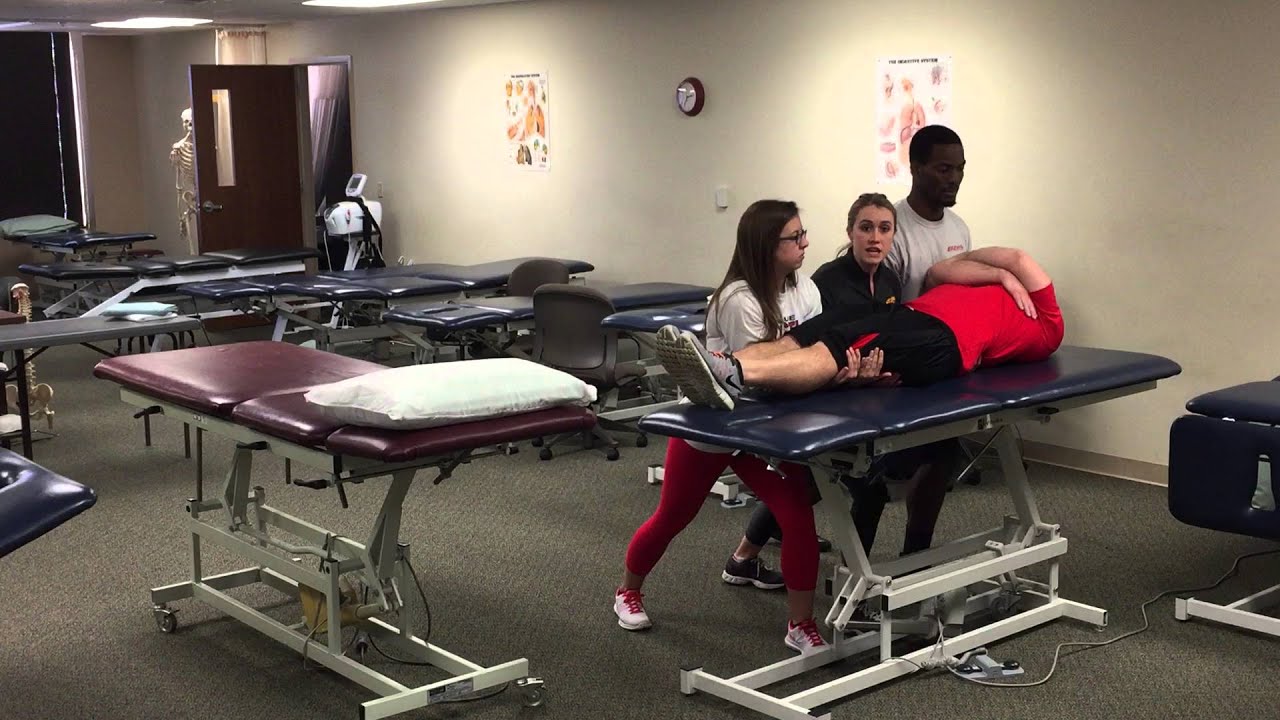
What is a 3-person dependent transfer, and when is it typically utilized? What role does each clinician play?
A dependent lift used to move a completely horizontal, immobile patient between surfaces of equal height (such as a stretcher to a bed)
One clinician supports the head and upper torso
Second supports the lower trunk/pelvis,
Third supports the LEs


When is a 2-person dependent transfer done?
Used when a patient cannot weight-bear or safely assist, especially when transferring between surfaces of unequal heights (ex. wheelchair to bed) or during floor-to-chair recovery lifts

What is a lateral transfer, and where does its primary movement take place?
Moves a pt sideways between adjacent seating surfaces (e.g., bed to wheelchair) without placing weight through the LE; primary movement occurs as a side-to-side shift at the hips
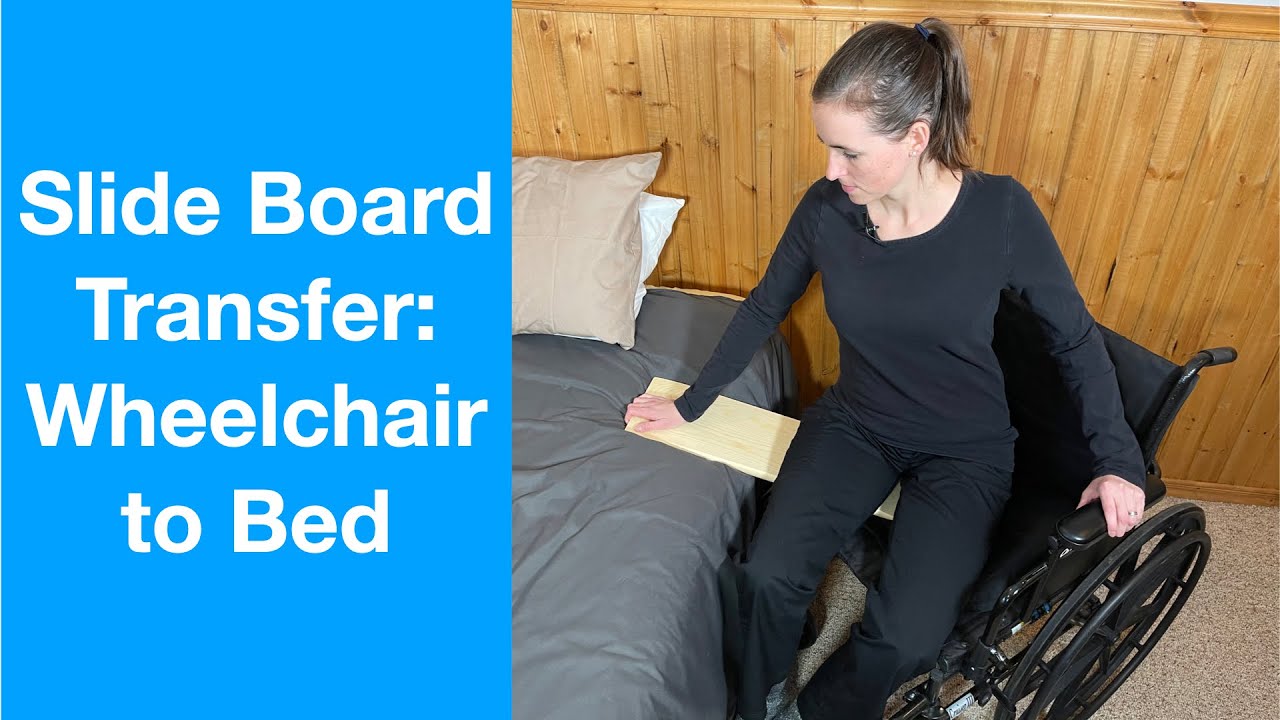
What physical capabilities must a patient possess to perform an independent sliding board transfer?
high levels of UE (arm/shoulder) strength
strong trunk/core strength
ability to follow instructions to lift their weight slightly and slide across the board safely

What safety warning must be given to patients regarding the cutout handle slots on a transfer sliding board?
NEVER to place their fingers inside or underneath the board's handle slots during the transfer
slots are strictly for positioning the board
gripping inside them can result in severely pinched or crushed fingers under body weight
What is the key functional distinction between a Squat Pivot transfer and a Stand Pivot transfer?
Squat Pivot Transfer = Pt rises into a partial squat (hips clear the seat) before pivoting on their feet and sitting down
Stand Pivot Transfer = Pt comes into a fully upright standing position, stabilizes, and takes small pivoting steps before sitting
What environmental adjustments must be made for a squat pivot transfer?
remove obstacles (w/c leg rests & possibly, arm rests)
attempt to equalize surface heights
secure both surfaces (make sure w/c is locked)
ensure pt has shoes or grip socks on
use a gait belt for dependent transfers
What are the two techniques patients use to scoot forward to the front edge of a seat before standing?
Lateral Weight-Shifting = Shifting weight onto one hip while moving the opposite hip forward, alternating side to side (boot scoot)
Forward Hip Slide = Leaning the upper trunk back against the w/c backrest while sliding both hips forward

How should front caster wheels on a wheelchair be positioned prior to a transfer?
Facing backwards to prevent tripping
For an independent squat pivot transfer, how should a patient's feet be positioned prior to initiating a squat pivot transfer?
Feet should be slightly staggered
The foot furthest from the target surface is tucked back under the knees to push upward
The foot closest to the target surface is positioned slightly forward to lead the pivot direction
What is the 'Head/Hip Whip' rule during squat pivot transfers?
Pt’s head and trunk lean away from the movement direction so the hips swing toward the target surface (Head moves opposite to the hips)
Describe the correct physical stance for a clinician providing an assisted squat pivot transfer.
Positioned directly in front of the patient
Hips and knees flexed with a WBOS
Staggered feet mimicking the patient's feet (inner foot slightly posterior)
Holding the gait belt with an underhand grip on both sides of the lumbar spine
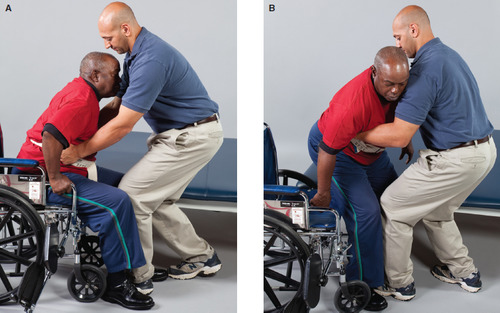
When is using rhythmic rocking momentum appropriate before initiating a transfer?
Rocking forward and backward on a count of 'three' helps generate forward momentum to assist weak patients rising into standing
STRICTLY PROHIBITED if the patient has surgical movement precautions
How does a clinician use their own weight to assist a patient rising during a squat pivot transfer?
The clinician’s weight shifts posteriorly (leans back onto their rear foot) while lifting through the gait belt
Leverages the clinician's body weight as a counterbalance to assist raising the patient's mass
What is 'Knee Blocking' in transfer training, and what is its primary clinical purpose?
Physical stabilization technique where the therapist places their knee/shin directly against the anterior aspect of a patient's knee/tibia
prevents weak or paretic knees from buckling forward during weight-bearing

According to the Knee Blocking Decision Tree, when is NO knee blocking required?
When BOTH lower extremities are reliably strong enough to support the patient's weight; therapist provides close guarding without physical knee contact
When should a clinician perform 1-on-1 knee blocking during a transfer?
1-on-1 knee blocking (one therapist knee against one patient knee) is indicated when AT LEAST ONE lower extremity is reliably strong, while the other leg is weak or unstable; clinician blocks the single weak leg
When are 2-on-1 or 2-on-2 knee blocks indicated?
2-on-1 Knee Block = Used when one leg is only partially reliable and needs extra support from both therapist knees
2-on-2 Knee Block = Recommended when NEITHER leg is reliable (e.g., paraplegia, severe bilateral weakness, or Max A transfers)
Describe the 3 steps for executing a 2-on-2 knee block
Patient's feet are close together
Therapist places their knees firmly around the outer/front (anterolateral) sides of both patient’s knees
Therapist's rear foot is positioned back to block patient feet from pivoting out of alignment
What is the strict rule regarding patient arm placement around a therapist during transfers?
Patients MUST NEVER wrap their arms around the therapist's neck
Doing so can cause neck injury risk to the clinician if the patient slips or falls
Where should a patient place their hands during a transfer if they cannot push from the seat?
Patient should place their hands on the therapist's shoulders, upper arms, or waist
Must be re-instructed immediately if they reach for the therapist's neck
What safety questions and checks must occur right before lowering a patient onto a new seating surface?
Ask the patient if they feel the seating surface touching the back of their legs/knees
Instruct the patient to reach back with one or both hands to feel the armrests or bed
Cue trunk forward flexion ('nose over toes') to control descent slow and smooth; never let the patient 'flop'
What 3 surgical precautions apply to a Total Hip Replacement (THR) posterolateral approach?
No hip flexion beyond 90°
No hip internal rotation (IR)
No hip adduction (crossing leg past body midline)
How must a THR posterior approach patient scoot forward in a chair without breaking precautions?
lean back against the w/c backrest or bed & sliding their pelvis forward
must NOT bend their upper body forward, as that would flex the hip past 90°
How should a THR posteriolateral approach patient position their legs when standing up?
Extend the involved (surgical) leg out in front before standing
Pushing up mainly through the non-surgical leg keeps the operated hip extended and safe from flexion above 90°
How do you prevent internal hip rotation during a pivot transfer on a posterolateral THR patient?
Cue the patient to externally rotate (point toes outward) on the surgical leg during the pivot, taking small steps
Never allow the feet to remain planted while turning the torso
Why is turning the torso with planted feet hazardous for a posterior THR patient?
If feet stay planted on the floor while the upper body turns toward the non-surgical side, the pelvis shifts over the operated hip, causing sudden internal rotation
What are 3 standard Sternal Precautions following open heart surgery?
No lifting, carrying, pushing, or pulling more than 5-10 lbs
No pushing off armrests using arms during transfers ('hug a pillow' instead)
No reaching arms behind the back or reaching overhead
Typically mandated for 4 to 12 weeks post-surgery
How do sternal precautions alter standard sit-to-stand transfer mechanics?
Patients cannot push through their upper extremities (arms)
They cross their arms across their chest (often holding a pillow) and rely entirely on leg momentum and trunk lean to stand up
What safety precautions apply to the involved (weak/paralyzed) arm during stroke (CVA) or TBI transfers?
NEVER pull or yank on a patient's hemiplegic arm to assist a transfer or catch balance, as this can cause subluxation or rotator cuff tearing
Momentarily tuck the weak hand into the gait belt (strap only, away from buckle) to protect it
How do CVA impairments like aphasia or visual spatial neglect impact transfer training?
Receptive Aphasia = pt struggles to understand spoken commands; use short, direct visual demonstrations
Visual Neglect = pt ignores space on their weak side; therapist must approach from and draw awareness to the neglected side
What are the 7 brief, general steps for a safe lateral transfer?
Gather supplies and check footwear
Organize lines/tubes
Position and secure both surfaces close together
Apply gait belt
Communicate clear plan with patient
Maintain core stability/body mechanics
Position patient safely with call bell and personal items in reach

What is a pivot disk, and what safety precaution must be taken when using one?
A rotating floor platform placed under a patient's feet to allow easy 360° turning without stepping.
CAUTION: They spin very fast and can slide out on smooth tile or thick carpet if not properly controlled

What is a pivot pole assistive device?
A floor-to-ceiling vertical tension pole placed between seating surfaces
provides a sturdy handhold for patients with good upper body strength to pull themselves standing and guide pivot transfers
What are the step-by-step procedures for transferring a patient from a wheelchair to a high treatment plinth table using a step stool?
Position wheelchair parallel/angled to locked plinth table; lock brakes
Patient stands up with clinician guarding hip and shoulder
Patient steps up onto the step stool using their STRONGER lower extremity first
Patient places hand on plinth for balance, turns, and sits on table edge
Clinician MUST guard on the patient's WEAK side throughout
Which leg steps up first onto a step stool during a w/c-to-plinth transfer?
The patient must step up with their STRONGER (uninvolved) lower extremity first ('up with the good')
Which side of the patient must the therapist guard during a transfer from a w/c to a high plinth table?
The therapist MUST guard on the patient's WEAK (involved) side to immediately stabilize them if the affected leg buckles or gives way
What are the 9 steps for a w/c to car transfer?
Slide the seat back & recline backrest
Remove armrest & leg rests of w/c on car side
Position wheelchair in the door opening, & apply locks
Scoot to the front edge of the chair, & position feet like you would for a pivot transfer
Grasp secure item in car (ex. backrest)
Flex neck & upper trunk to clear doorframe
Pull on secure item & pivot hips onto car seat
Bring LEs into car
Adjust position as needed
Why should wheelchair armrests be strategically managed during transfer training?
Removing the armrest on the transfer side eliminates physical barriers so hips can slide freely across surfaces
Leaving the opposite (contralateral) armrest in place gives the patient a solid surface to push off from
How does Contact Guard Assistance (CGA) differ from Close Supervision (CS)?
Contact Guard (CGA) = Hands are physically touching the patient/gait belt at all times (0% lifting assistance)
Close Supervision (CS) = Hands are hovering near the patient without touching.
What are 4 reasons why proper communication essential throughout every stage of a patient transfer?
reduces patient anxiety
prevents sudden unpredictable movements
ensures shared timing (e.g., counting '1, 2, 3')
fosters patient cooperation and safety
What is the primary action site during a sit pivot / squat pivot transfer?
The primary pivot action occurs through the FEET as they bear weight and swivel, while the hips move through an arc toward the target surface